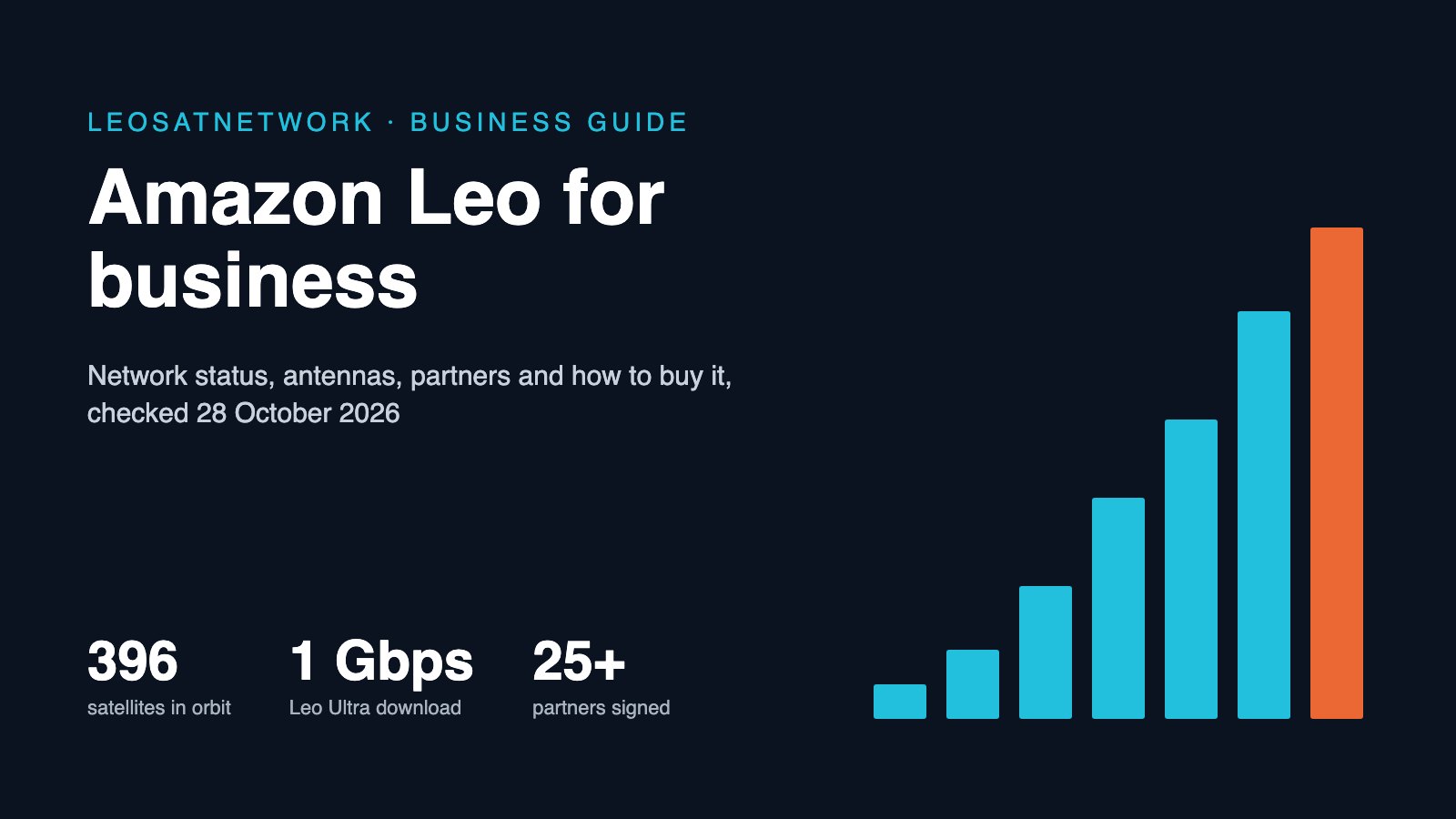
Amazon Leo is Amazon's low Earth orbit satellite broadband network, the project formerly called Kuiper. On 28 October 2026 it had 396 satellites in orbit after 14 launches, enough for Amazon to plan initial service "across certain latitudes" before the end of 2026. It is not on general sale yet: Amazon has run a private enterprise preview since November 2025, its antennas were still awaiting FCC authorization, and no price has been published. The commercial model is already clear, though. Amazon will sell mainly to businesses, governments, airlines and telecom operators, and mostly through partners: AT&T, NTT, Vodafone, DIRECTV and SKY Brasil, Far EasTone and more than a dozen authorized resellers had signed by October 2026. This guide sets out where the network stands, what it will offer a business, who will sell it in each market, how it compares with Starlink and Eutelsat OneWeb, and what to do while you wait. Every fact is dated and sourced; we update the page as the rollout moves.
Amazon Leo at a glance
| Item | Status on 28 October 2026 |
|---|---|
| Satellites in orbit | 396 launched in 14 missions (April 2025 to July 2026); more than 1,000 built |
| Planned constellation | More than 3,000 satellites in the first generation (3,236 authorized by the FCC), at 590 to 630 km |
| Next launches | 40 satellites on ULA Vulcan (13 November 2026), 36 on Ariane 64 (from 23 November 2026) |
| Service | Private preview with Amazon employees and selected enterprises; initial service planned in 2026 in certain latitudes |
| Antennas | Leo Nano (100 Mbps), Leo Pro (400 Mbps), Leo Ultra (1 Gbps down / 400 Mbps up), Aviation Antenna |
| Prices | Not published |
| Sales model | Partners first: telecom operators, authorized resellers, airlines, plus direct enterprise and government sales |
| Enterprise extras | Direct to AWS, Private Network Interconnect, web console and APIs |
| Phones | Direct-to-device system of up to 5,105 satellites from 2028, after the Globalstar acquisition (FCC-approved 27 October 2026) |
Where the network stands
Amazon started full-scale deployment in April 2025 and had launched 396 satellites by July 2026: 224 on eight Atlas V flights, 72 on three Falcon 9 flights and 100 on three Ariane 64 flights. The pace picked up in 2026 as heavier rockets arrived; the June Ariane 64 mission carried 36 satellites, which Amazon calls the heaviest commercial payload ever launched. With the Atlas V fleet exhausted, the next missions move to ULA's Vulcan (40 satellites per flight, the first of 38 contracted) and Ariane 64, with Blue Origin's New Glenn (48 satellites per flight, 24 firm launches) to follow. That last part slipped: on 28 May 2026 a New Glenn booster that was to carry the first 48 Leo satellites exploded during a static-fire test at Cape Canaveral and damaged Blue Origin's only launch pad (the satellites were not on board); Blue Origin aims to fly again before the end of 2026. Amazon says its manifest now exceeds 100 launches.
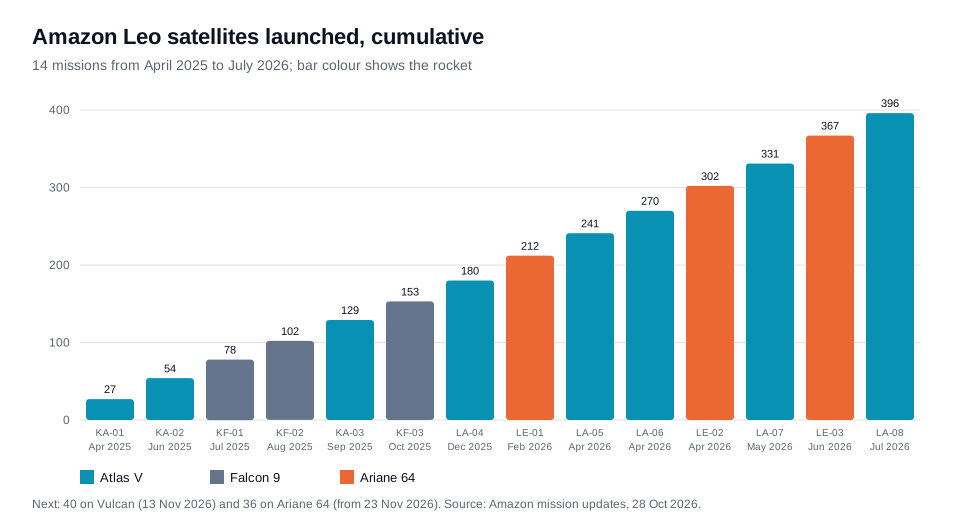
Production is no longer the bottleneck. Amazon says it has built more than 1,000 satellites in its Kirkland, Washington factory, more than a third of the first-generation constellation, and now builds at least three or four a day. Launch capacity is the constraint: Amazon asked the FCC in January 2026 for more time, citing a "near-term shortage of available rockets".
The FCC deadline
Amazon's FCC licence required half of the constellation, about 1,618 satellites, in orbit by 30 July 2026. On 5 June 2026 the FCC granted a limited waiver instead. The final deadline for the full constellation stays at 30 July 2029, but satellites launched after 30 July 2026 temporarily lose their priority status for spectrum: until 30 March 2028 or until Amazon reaches the half-way mark, or from 30 October 2027 if Amazon shows that half the constellation is built with launches secured. In practice this matters to spectrum coordination with other operators, not to customers.
How it works
Each Leo satellite carries phased-array antennas for customers, parabolic antennas for the ground stations, and optical inter-satellite links, the laser connections that let traffic cross the constellation without a ground station in view. Amazon says it is building more than 300 ground gateways; each one uses Amazon's fibre network to reach the nearest AWS edge location, then the internet, the customer's AWS resources or a private network. That AWS backbone is the main technical difference with other networks for a business buyer.
When can a business buy Amazon Leo?
Not yet, except as a preview participant. Amazon opened an enterprise preview in November 2025 with production hardware, and named JetBlue, Vanu, Hunt Energy Network, Connected Farms and Crane Worldwide Logistics among the first customers. In July and September 2026 it said it had enough satellites to start "providing initial service this year across certain latitudes" and would extend coverage as more satellites launch. On 28 October 2026 its website still said the antennas "have not been authorized as required by the rules of the Federal Communications Commission" and could not be sold until they are.
Coverage will grow by latitude rather than by country: LEO networks first serve the latitudes where their orbital shells give continuous coverage, then move toward the equator as satellites are added. SKY Brasil has said its service will start in the south of the continent and move north toward the equator. The dates partners have announced give a realistic timeline:
| Market | Partner | Announced start |
|---|---|---|
| United States (enterprise) | AT&T Business | Phased deployment; pricing and availability "in the coming months" (September 2026) |
| Australia (homes) | NBN Co via retailers such as SkyMesh | Amazon targeted mid-2026; SkyMesh now says 2027 |
| South Africa (homes, small businesses) | Herotel, brand evry | Commercial launch expected in 2027 |
| Taiwan | Far EasTone | 2027 at the earliest, after six regulatory steps (four completed by September 2026) |
| Japan (enterprise, public sector) | NTT Docomo Business, SKY Perfect JSAT | Technical verification under way (June 2026) |
| South America (homes and businesses) | DIRECTV Latin America, SKY Brasil | Gradual, from the south of the continent |
| Aviation | JetBlue; Delta | JetBlue from 2027; Delta on 500 aircraft from 2028 |
Licensing also shapes the order. Amazon holds UK earth-station licences from Ofcom, received 10-year frequency rights from France's Arcep in July 2025 (a decision challenged by a French union before the Conseil d'État), and has been granted spectrum permits in Spain. In South Africa it sells wholesale capacity to Herotel, which holds the local licence; in Taiwan, Far EasTone's own 28 GHz spectrum is part of the deal.
The antennas
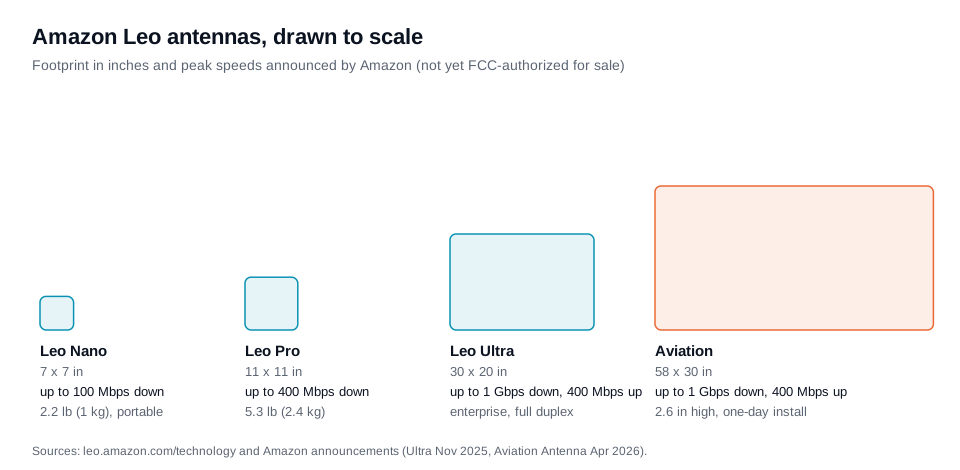
Amazon has announced four terminals, all flat electronically steered phased arrays with no moving parts, designed in-house:
| Antenna | Size and weight | Peak speed | Built for |
|---|---|---|---|
| Leo Nano | 7 x 7 in, 2.2 lb (1 kg) | 100 Mbps down | Portable use, small sites, field teams |
| Leo Pro | 11 x 11 in, 5.3 lb (2.4 kg) | 400 Mbps down | Homes, small businesses, vessels |
| Leo Ultra | about 20 x 30 in | 1 Gbps down, 400 Mbps up, full duplex | Enterprise sites, cell backhaul, ships, government |
| Aviation Antenna | 58 x 30 x 2.6 in, integrated modem | 1 Gbps down, 400 Mbps up | Commercial aircraft, installed in one day |
Two numbers stand out for business use. Leo Ultra's 400 Mbps upload is several times what consumer satellite terminals deliver, which matters for video surveillance, cloud backups and cell backhaul; Amazon says it can carry thousands of IoT sensors and hundreds of HD cameras on one site. And all speeds are "based on limited preliminary testing", in Amazon's words: real performance will depend on how many satellites are overhead in each region and how many customers share them.
On price, Amazon has said nothing official. Andy Jassy has suggested Leo would come at a lower cost than alternatives, and in 2023 Amazon said the Leo Pro would cost less than 400 dollars to produce, but neither is a retail price. Expect business pricing through partners, quoted per site and often bundled with the partner's own network.
What Amazon Leo adds for enterprises
Amazon pitches Leo for Business on its AWS backbone rather than on raw speed:
- Direct to AWS (D2A): traffic from a Leo antenna reaches an AWS Virtual Private Cloud through AWS Direct Connect or Transit Gateway without touching the public internet; Amazon says a connection can be configured in under five minutes, with existing AWS APIs, SDKs and CloudFormation.
- Private Network Interconnect (PNI): remote sites connect straight to a company's data centre or network core at major colocation facilities, set up in days rather than weeks.
- One console and APIs to provision antennas and connections, with unified billing and support from a single global provider and proactive monitoring.
- Encryption across the network and, for public bodies, a separate Leo for Government organisation.
Amazon's business pages list the target industries: agriculture, aviation, construction, energy, maritime, media, mining, retail, telecom and transportation. For telecom operators the use case is cell-site backhaul: connecting 4G and 5G masts in remote areas without fibre or microwave, plus portable backhaul for cells on wheels and backup links when fibre is cut. Vodafone signed for exactly that in March 2026, starting in Germany and other European countries and, through Vodacom, in Africa; Verizon has worked with Amazon on rural backhaul since 2021, and Vanu uses Leo to place rural cell towers in southern Africa.
Who sells Amazon Leo
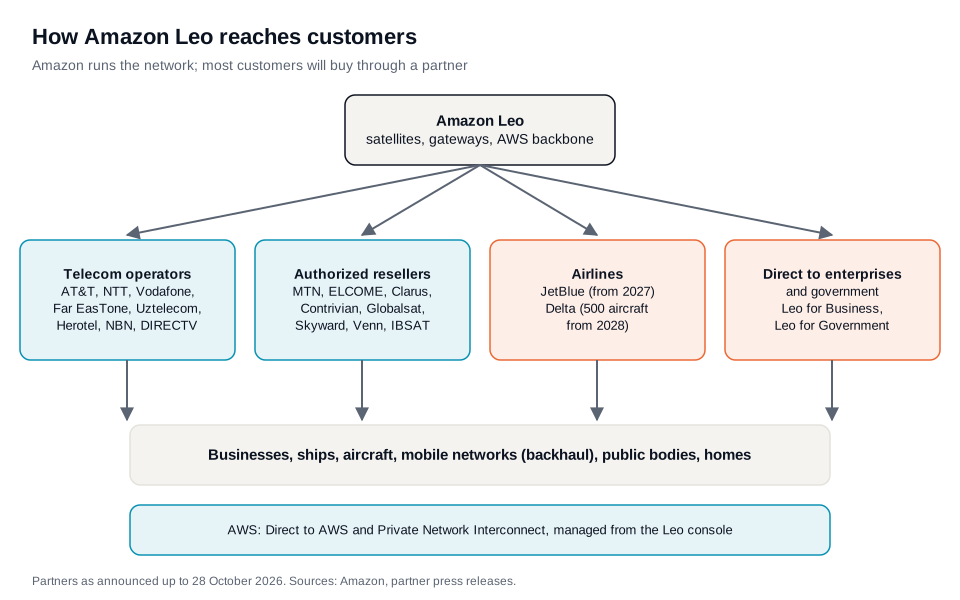
Most business customers will buy Amazon Leo from a partner, not from Amazon. By the end of October 2026 four kinds of partner had signed:
Telecom operators
| Operator | Market | Role | Announced |
|---|---|---|---|
| AT&T Business | United States | Leo bundled with AT&T fibre and 5G as one managed service for enterprise and public sector | February 2026, expanded 8 September 2026 |
| NTT Docomo Business | Japan | Authorized reseller for companies and public bodies; backhaul for Docomo base stations | 9 June 2026 (partnership since 2023) |
| SKY Perfect JSAT | Japan | Authorized reseller for enterprise and public sector | 12 June 2026 |
| Far EasTone | Taiwan | Authorized distributor; maritime, agriculture, mining | 19 May 2026 |
| UZ-SAT (Uztelecom) | Uzbekistan | Authorized distributor for logistics, mining and public sites | 22 September 2026 |
| Herotel | South Africa | Retail service evry for homes and small businesses | 15 July 2026 |
| DIRECTV Latin America and SKY Brasil | Nine South American countries | Homes (since the 2024 agreement) and businesses | 24 February 2026 (business) |
| NBN Co | Australia | Wholesale service for more than 300,000 premises, sold by retailers such as SkyMesh | 5 August 2025 |
| Vodafone and Vodacom | Europe, Africa | Backhaul for 4G and 5G sites | 2 March 2026 |
Authorized resellers and integrators
| Company | Focus | Region | Announced |
|---|---|---|---|
| ELCOME | Merchant shipping, offshore, fishing, yachting, government | Middle East, Asia, Europe, Africa, North America | 10 February 2026 |
| MTN | Shipping, yachting, offshore, cruise, ferries | Global | 10 February 2026 |
| Contrivian | State and local government | United States | 11 March 2026 |
| Globalsat Group | Enterprise: mining, offshore oil and gas, agriculture | North, Central and South America | 18 March 2026 |
| Skyward | Enterprise and energy; early access programme | United States | 23 March 2026 |
| Venn Telecom | Managed connectivity, mining and energy | Europe (France, Benelux, Germany) | 13 April 2026 |
| Clarus Networks | Vessels and offshore platforms | United Kingdom, global | 17 June 2026 |
| Pulsar International | Commercial maritime | Global, Asia-Pacific office in Hong Kong | June 2026 |
| IBSAT | Distributor to companies and 80 regional ISPs | Spain and Portugal | 4 August 2026 |
| PEAKE | Public safety and government kits | United States | 2026 |
Two patterns are worth noting. Amazon has signed maritime specialists first, because ships sail where coverage is easiest to deliver early and because those integrators already run several networks side by side. And many of these resellers also sell Starlink or Eutelsat OneWeb: Amazon is entering an existing channel rather than building a new one, which is good news for buyers who want two networks from one supplier. Our Amazon Leo providers directory lists them with contact details.
Airlines and government
JetBlue was the first airline to sign, in September 2025, with service on selected aircraft from 2027. Delta followed on 31 March 2026 with a multi-year deal starting with 500 aircraft in 2028, free for SkyMiles members, using one Aviation Antenna per aircraft. Airbus has agreed to make Leo available in its aircraft catalogue. On the government side, Amazon runs Leo for Government for US and allied agencies; resellers such as Contrivian and PEAKE target state, local and public-safety users.
Phones and IoT: the Globalstar deal
On 14 April 2026 Amazon agreed to buy Globalstar, the mobile satellite operator behind Apple's Emergency SOS and Find My via satellite, for about 11.5 billion dollars. The FCC approved the transfer of Globalstar's licences on 27 October 2026; closing is expected in 2027. Amazon also signed with Apple to keep powering satellite features on iPhone and Apple Watch. On 27 July 2026 it filed with the FCC for a separate direct-to-device system of up to 5,105 satellites in five orbital shells, using L-band and S-band spectrum, with deployment from 2028. For businesses this means Amazon Leo will eventually cover both fixed broadband sites and phones or IoT devices in the field, sold largely through mobile operators.
Amazon Leo vs Starlink vs Eutelsat OneWeb
| Amazon Leo | Starlink | Eutelsat OneWeb | |
|---|---|---|---|
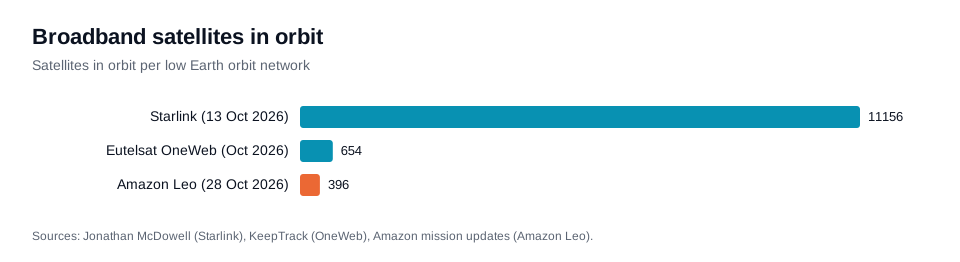
| Satellites in orbit | 396 (28 Oct 2026) | 11,156 (13 Oct 2026) | About 654 (Oct 2026) |
| Commercial status | Preview; initial service from late 2026 | Sold in about 167 markets, 12.0 million subscribers (30 June 2026) | Commercial since 2023, business and government only |
| Top antenna speed | 1 Gbps down / 400 Mbps up (Ultra) | 400+ Mbps (Performance kit) | Up to 195 Mbps down / 32 Mbps up (Hughes, Kymeta terminals) |
| Sales model | Partners and direct enterprise | Direct, retailers and 227 authorized resellers | Distribution partners only |
| Business extras | Direct to AWS, private interconnect | Priority plans, public IP, SLA | Partner-managed, sovereign European operator |
| Next step | Vulcan and New Glenn launches, FCC device approval | V3 satellites on Starship | Next-generation satellites from Airbus, launches from late 2026 |
The comparison is uneven today: Starlink has twenty-eight times more satellites in orbit and a working service in most of the world. Amazon's advantages are elsewhere. Its antennas promise more upload capacity, its AWS integration removes VPNs and public internet hops for cloud workloads, and its partner model fits enterprises and operators that already buy through carriers. For buyers who want two independent LEO networks, Amazon Leo and OneWeb are the alternatives to pair with Starlink; our satellite options guide compares all orbits.
Amazon Leo by industry
Maritime
Ships were Amazon's first reseller market. ELCOME, which serves a fleet connectivity footprint of more than 5,000 vessels, and MTN signed on 10 February 2026, followed by Clarus Networks and Pulsar International in June. Vessels will use Leo Pro or Leo Ultra, both designed for maritime conditions, and Amazon's optical inter-satellite links are meant to keep coverage in mid-ocean far from gateways. Expect Leo to arrive on ships as a second LEO path next to Starlink or OneWeb, managed by the same integrator; our maritime connectivity guide explains how fleets combine networks today.
Energy, mining and remote industry
Hunt Energy Network was one of the first preview customers and created Skyward to resell the service. Globalsat Group targets Andean mines, offshore oil and gas in the Gulf of Mexico and agricultural monitoring in the Amazon basin; IBSAT lists agriculture, maritime transport, energy, remote construction, healthcare and industrial IoT in Spain and Portugal. These sites need upload capacity for cameras and telemetry, where Leo Ultra's 400 Mbps upload is the main argument.
Telecom backhaul
Mobile operators are using Leo to connect masts that fibre does not reach: Vodafone in Europe and, through Vodacom, in Africa; NTT Docomo in Japan for disaster recovery; Verizon in the United States; Vanu for new rural towers in southern Africa. Amazon also markets portable backhaul for cells on wheels at events and emergencies.
Retail, construction and branch networks
Amazon's business pages position Leo as a primary or backup line for points of sale and branch offices, and for construction sites that need connectivity before fibre arrives. In the United States AT&T Business bundles it with fibre and 5G as one managed service, which is how most multi-site companies are likely to buy it.
Aviation
The Aviation Antenna, announced on 13 April 2026, is built for wide-body and regional jets: one antenna per aircraft, 1 Gbps down and 400 Mbps up, installed in a day. JetBlue (from 2027) and Delta (500 aircraft from 2028) are the launch airlines; both keep Wi-Fi free for passengers.
Government and public safety
Leo for Government serves US and allied agencies, and resellers Contrivian (state and local government) and PEAKE (public safety kits) sell to the SLED market. Amazon emphasises encryption, private interconnection that bypasses the public internet, and its status as a non-SpaceX option for agencies that want two suppliers.
Amazon Leo by region
- North America: AT&T Business for enterprise and public sector; resellers Skyward, Contrivian, Globalsat, PEAKE, MTN; Verizon for backhaul. The United States is where the FCC licence and the first service sit.
- Europe: Vodafone for backhaul starting in Germany; resellers Venn Telecom (France, Benelux, Germany), IBSAT (Spain and Portugal) and Clarus Networks (United Kingdom, maritime); spectrum rights in the UK, France and Spain. Amazon's six additional Ariane 6 launches, ordered in September 2026, also anchor it in European industry.
- Latin America: DIRECTV Latin America and SKY Brasil in Argentina, Bolivia, Brazil, Chile, Colombia, Ecuador, Paraguay, Peru and Uruguay, for homes and businesses; Globalsat across the Americas.
- Africa: Herotel (evry) in South Africa, Vodacom for backhaul, Vanu for rural cell sites. Starlink had not applied for a South African licence by June 2026, so Amazon may reach that market first.
- Asia-Pacific: NTT Docomo Business and SKY Perfect JSAT in Japan, Far EasTone in Taiwan, NBN Co in Australia, Pulsar International from Hong Kong for shipping.
- Central Asia: UZ-SAT, part of Uztelecom, in Uzbekistan.
From Project Kuiper to Amazon Leo
Amazon announced Project Kuiper in 2019 and received FCC authorization for 3,236 satellites in July 2020. In April 2022 it signed what it called the largest commercial launch procurement in history, with Arianespace, Blue Origin and ULA, later adding SpaceX. Two prototype satellites flew in October 2023, full-scale deployment began on 28 April 2025 with an Atlas V, and on 13 November 2025 the programme took the name Amazon Leo. Amazon says it has committed more than 10 billion dollars to the network, and the Globalstar purchase adds about 11.5 billion.
Should you wait for Amazon Leo?
For most businesses with a need today, no. Amazon Leo will not be generally available in most markets before 2027, coverage will grow region by region, and prices are unknown. What we recommend:
- If you need connectivity now, deploy what is available (Starlink, OneWeb or VSAT, depending on the site) on contracts you can exit within 12 months, so you can switch or add Leo when it reaches your area. Our guide on choosing a business installer covers the questions to ask.
- If your workloads run on AWS, ask an Amazon Leo reseller about a pilot: Direct to AWS is a concrete advantage for remote sites that only talk to the cloud.
- If you run many sites or vessels, plan for two LEO networks. The integrators that sign with Amazon usually sell Starlink or OneWeb too, and can run both behind one SD-WAN.
- If you are a telecom operator or ISP, Amazon is signing backhaul and wholesale deals market by market; early partners get territory and pricing before the network is saturated.
- Put the questions in writing: which antenna, which latitudes are served from day one, whether the partner holds the local licence, the minimum term, and what happens if service starts later than planned.
What to watch next
- 13 November 2026: first Leo mission on ULA Vulcan (40 satellites); from 23 November: Ariane 64 with 36.
- End of 2026: initial service in the first latitude bands, and FCC authorization of the antennas.
- End of 2026 to 2027: New Glenn's return to flight after the May 2026 explosion, then its first Leo missions with 48 satellites each.
- 2027: commercial launches announced by Herotel (South Africa), Far EasTone (Taiwan), JetBlue and NBN retailers; Globalstar acquisition expected to close.
- 30 October 2027 / 30 March 2028: dates at which full spectrum priority can return under the FCC waiver.
- 2028: direct-to-device satellites start launching; Delta begins its 500-aircraft rollout.
- 30 July 2029: FCC deadline for the full first-generation constellation.
Find Amazon Leo providers
We list the resellers, operators and integrators that have announced Amazon Leo in our Amazon Leo providers directory, alongside OneWeb providers, Starlink resellers and enterprise satellite integrators. To compare offers for a project, describe it once and we send it to up to five companies that serve your area. If your company sells Amazon Leo and is not listed, add it here. For the earlier history of the AT&T deal, see Amazon Leo with AT&T vs Starlink Business, and for the state of the reseller market, our satellite installer market report.
Sources
- Amazon Leo mission updates, Amazon, updated 28 October 2026.
- Everything you need to know about Amazon Leo, Amazon (orbits, terminals, preview since November 2025).
- Amazon Leo technology, Leo for Business, Private Networking and Telecommunications, leo.amazon.com, read 28 October 2026.
- Amazon Leo introduces Ultra antenna, begins enterprise preview, Amazon, November 2025.
- From zero to 1,000, Amazon, 8 October 2026.
- Amazon Leo set to accelerate satellite production and launch cadence, Amazon, 23 March 2026.
- Amazon Leo adds 6 new Arianespace launches, Amazon, 10 September 2026.
- Amazon Leo Aviation Antenna, Amazon, 13 April 2026; Delta agreement, 31 March 2026.
- Amazon to acquire Globalstar, Amazon, April 2026; How Amazon Leo plans to connect mobile devices, 27 July 2026; FCC approval, DCD, October 2026.
- FCC gives Amazon Leo more time to launch, Payload, 9 June 2026; Light Reading.
- First maritime reseller agreements (ELCOME, MTN), Amazon, 10 February 2026.
- AT&T Business expands work with Amazon Leo, Via Satellite, 8 September 2026; first agreement, Light Reading, 5 February 2026.
- NTT Docomo Business reseller agreement, 11 June 2026; SKY Perfect JSAT, 12 June 2026.
- Far EasTone, Taipei Times, 21 May 2026; Uzbekistan (UZ-SAT), Amazon, 22 September 2026; Herotel, Amazon, 15 July 2026.
- DIRECTV and SKY Brasil business agreement, 24 February 2026; NBN Co selects Amazon, 5 August 2025; SkyMesh.
- Vodafone to use Amazon Leo for backhaul, The Register, 3 March 2026; Vanu, Amazon.
- New Glenn explosion: The Next Web, May 2026; Motley Fool, 14 July 2026.
- Resellers: Contrivian, Globalsat, Skyward, Venn Telecom, Clarus Networks, Pulsar, IBSAT, PEAKE.
- Comparison: Starlink statistics (Jonathan McDowell, 13 October 2026); OneWeb satellites in orbit (KeepTrack); Hughes OneWeb terminal; our Starlink in numbers (SpaceX SEC filings).