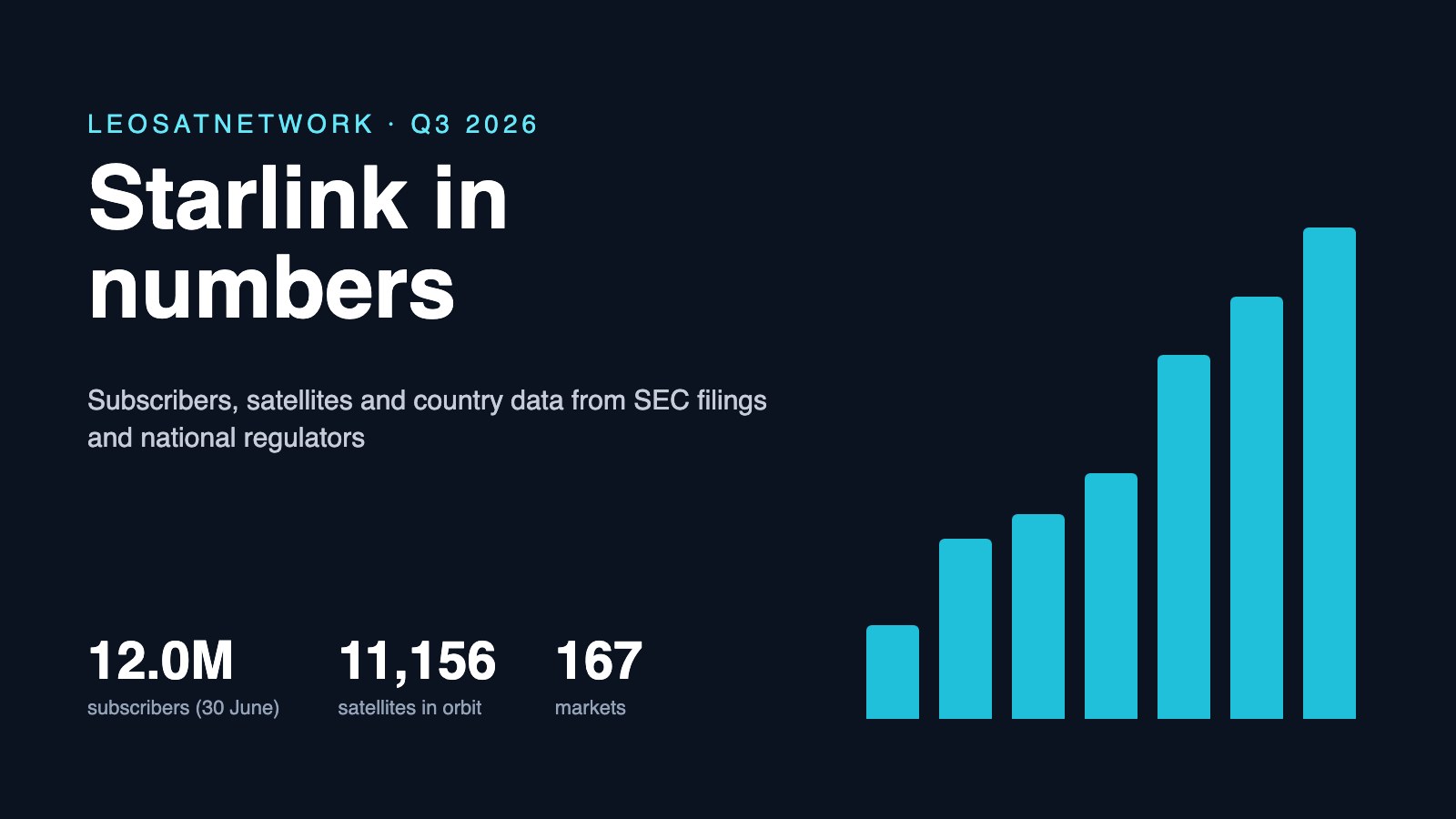
On 30 June 2026 Starlink had 12.0 million subscribers, twice as many as a year earlier, according to the quarterly report SpaceX filed with the US Securities and Exchange Commission after its June listing. On 13 October the constellation counted 11,156 satellites in orbit, and the service is sold in 167 countries, territories and markets. SpaceX publishes its third-quarter results in early November; until then, this page gathers the latest official figures: the company's SEC filings for the global numbers, an independent satellite count, and national regulators for the country data. Every figure below carries its date and source, and where a number covers all satellite operators rather than Starlink alone, we say so.
The headline numbers
| Indicator | Value | As of | Source |
|---|---|---|---|
| Starlink subscribers | 12.0 million (+100% year on year, +1.7 million in the quarter) | 30 June 2026 | SpaceX Q2 2026 results |
| Average revenue per subscriber (ARPU) | $66 a month (down from $85 a year earlier) | Q2 2026 | SpaceX Q2 2026 results |
| Connectivity revenue | $4.29 billion in the quarter (+66%) | Q2 2026 | SpaceX Q2 2026 results |
| Connectivity operating income | $1.66 billion (+79%) | Q2 2026 | SpaceX Q2 2026 results |
| Satellites in orbit / working | 11,156 / 11,142 (13,015 launched since 2019) | 13 October 2026 | Jonathan McDowell |
| Countries, territories and markets | 167 (164 on 31 March) | 10-Q, August 2026 | SpaceX 10-Q |
| Direct-to-cell (Starlink Mobile) | About 7.4 million monthly unique devices in about 30 countries | 31 March 2026 | SpaceX S-1 |
| Median latency / peak-hour download (residential) | About 25 ms / 225 Mbps | 31 March 2026 | SpaceX S-1 |
Subscribers: doubling every year
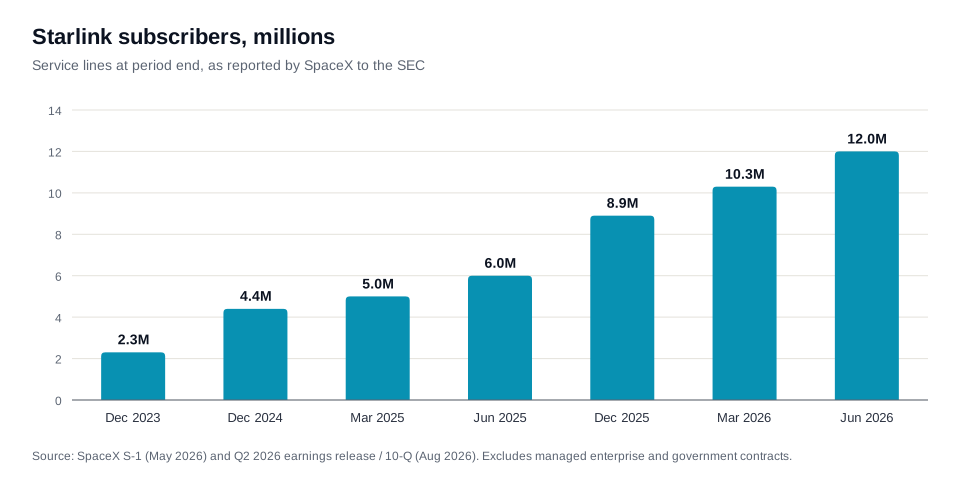
Starlink went from 2.3 million subscribers at the end of 2023 to 4.4 million at the end of 2024, 8.9 million at the end of 2025 and 12.0 million on 30 June 2026. Growth has not slowed with scale: the base grew 105% year on year in the first quarter of 2026 and about 100% in the second, adding 1.7 million lines between April and June, or roughly 570,000 a month.
What SpaceX counts as a subscriber. A subscriber is a service line on a starlink.com account: Residential and Roam plans, and the Local and Global Priority business plans. One household can hold two lines (a home plan and a Roam plan), and one line can serve many users. The count excludes customers with a negotiated contract, which is how most airlines, shipping companies, enterprise fleets and governments buy Starlink. The 12.0 million figure is therefore a floor for the number of connected sites, not a count of people.
Revenue per subscriber is falling, on purpose
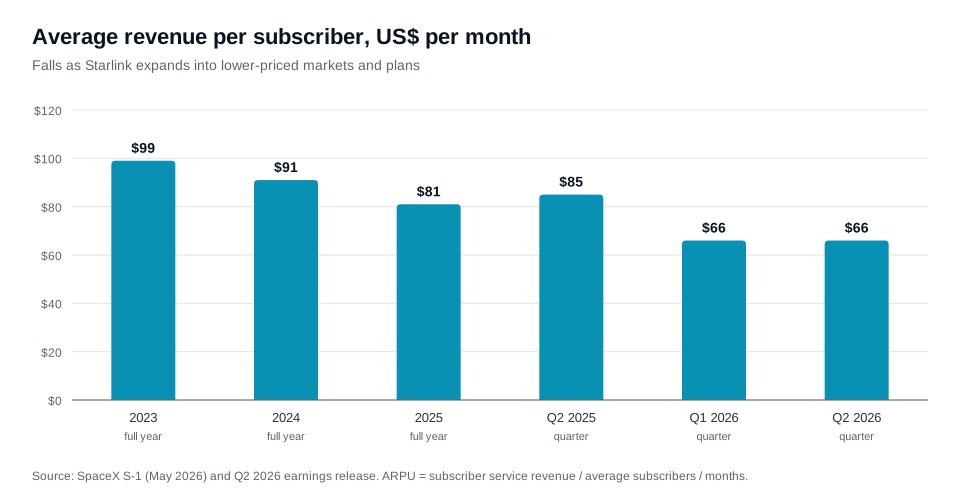
The average subscriber paid $99 a month in 2023 and $66 in the second quarter of 2026, a fall of a third. SpaceX attributes the 22% year-on-year decline to international expansion and the addition of lower-priced plans: growth now comes from markets such as Brazil, Nigeria, Kenya or the Philippines, where prices are set far below US levels, and from capped Residential Lite and 100 Mbps tiers in Europe and elsewhere. ARPU then held at $66 between the first and second quarters of 2026.
Where the money comes from
| Connectivity segment, US$ million | Q2 2025 | Q1 2026 | Q2 2026 |
|---|---|---|---|
| Consumer revenue | 1,721 | 2,148 | 2,485 |
| Enterprise & government revenue (incl. Starlink Mobile) | 867 | 1,109 | 1,806 |
| Total Connectivity revenue | 2,588 | 3,257 | 4,291 |
| Income from operations | 923 | 1,188 | 1,656 |
| Segment adjusted EBITDA | 1,583 | 2,087 | 2,597 |
| Capital expenditure | 1,130 | 1,332 | 1,367 |
Consumer subscriptions still bring in most of the revenue, but the fastest-growing line is enterprise and government: up 108% year on year to $1.8 billion in the second quarter, driven by aviation (a major agreement with American Airlines and new airlines including Southwest, Virgin Atlantic, Iberia and Aer Lingus), maritime, Starlink Mobile partnerships with SoftBank, NTT Docomo and Spark NZ, and government work. Connectivity is SpaceX's profitable segment: $4.4 billion of operating income in 2025, against $2.0 billion in 2024 and $0.5 billion in 2023. Readers buying for a company will find the resellers that handle these contracts in our Starlink resellers and enterprise satellite solutions directories.
The constellation
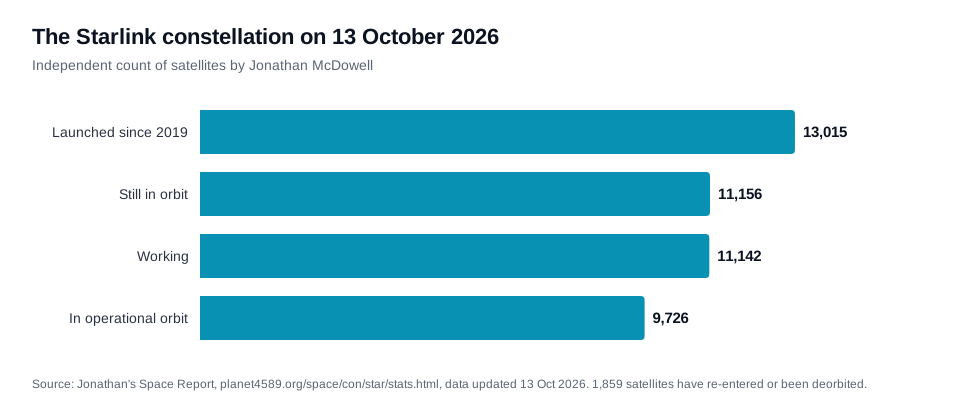
Jonathan McDowell, the astrophysicist who tracks every Starlink satellite, counted 13,015 launched since 2019 on 13 October 2026. Of those, 1,859 have re-entered, been deorbited or failed to reach orbit, 11,156 are in orbit, 11,142 are working and 9,726 have reached their operational orbit; the rest are raising their orbit or are being moved out of the constellation. About 3,140 of the satellites in orbit are first-generation; the rest are second-generation, including 674 direct-to-cell satellites launched in two shells, which carry the Starlink Mobile service sold through operators such as T-Mobile, Rogers, Entel or One NZ.
SpaceX's own figure was "over 10,200 Starlink broadband and mobile satellites" in its August 10-Q, and it said Starlink accounted for about 75% of all active manoeuvrable satellites in orbit at the end of March. Launch cadence explains the scale: SpaceX flew 78 rockets in the first half of 2026, 61 of them for its own payloads, mostly Starlink. The next step is the larger V3 satellite, designed for one terabit per second of downlink and launched by Starship: the July 2026 Starship flight deployed 20 production V3 satellites, and McDowell's count lists 46 third-generation satellites launched so far.
Country by country
SpaceX does not publish subscribers by country. National regulators do, for some markets, and Starlink itself announces milestones. The chart below brings together the latest figure we could verify for each country. Read it with two cautions: the reference dates differ, and in five countries the regulator only publishes all satellite lines, of which Starlink is the large majority but not the whole.
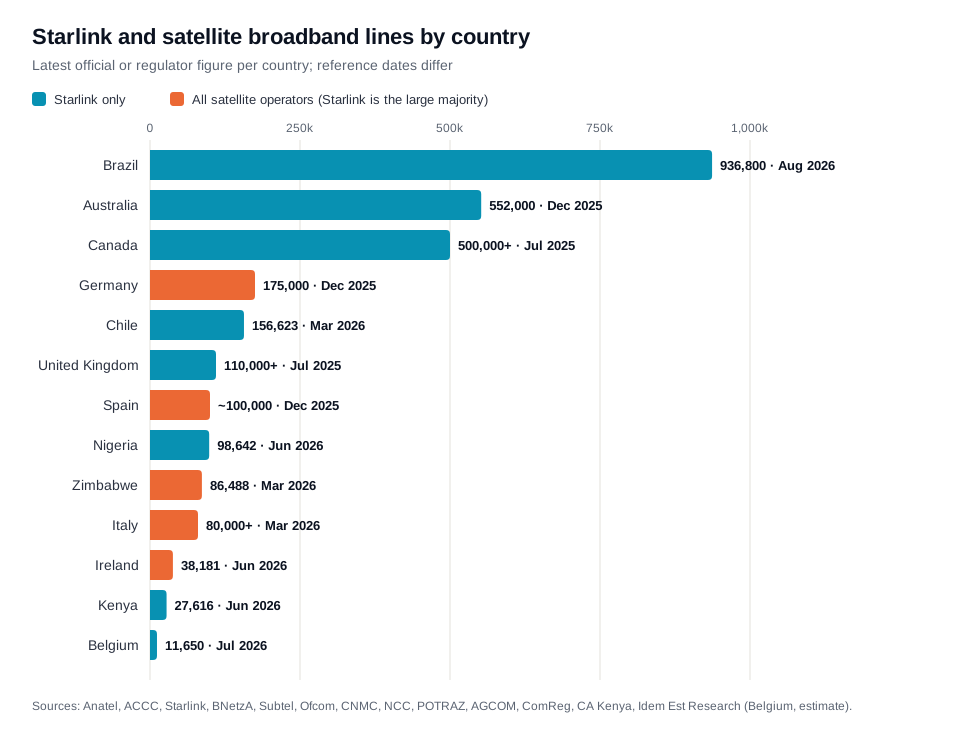
| Country | Lines | As of | What is counted | Source |
|---|---|---|---|---|
| Brazil | 936,800 | Aug 2026 | Starlink fixed broadband accesses | Anatel |
| Australia | 552,000 | Dec 2025 | Starlink subscriptions | ACCC |
| Canada | 500,000+ | Jul 2025 | Starlink customers | Starlink |
| Germany | ~175,000 | Dec 2025 | All satellite broadband customers | Bundesnetzagentur |
| Chile | 156,623 | Mar 2026 | Starlink fixed subscribers | Subtel |
| United Kingdom | 110,000+ | Jul 2025 | Starlink connections | Ofcom |
| Spain | ~100,000 | Dec 2025 | All satellite internet lines | CNMC |
| Nigeria | 98,642 | Jun 2026 | Starlink active subscribers | NCC |
| Zimbabwe | 86,488 | Mar 2026 | All VSAT subscriptions, mostly Starlink | POTRAZ |
| Italy | 80,000+ | Mar 2026 | All satellite lines (estimate) | AGCOM |
| Ireland | 38,181 | Jun 2026 | All satellite broadband lines | ComReg |
| Kenya | 27,616 | Jun 2026 | Starlink fixed subscriptions | Communications Authority |
| Belgium | 11,650 | Jul 2026 | Starlink subscribers (private estimate) | Idem Est Research |
The Americas
Brazil is the largest market with an official count. Anatel's data for August 2026 show 936,800 Starlink fixed broadband accesses, up about 42.7% since January, enough to overtake TIM and become the ninth-largest fixed broadband provider in the country; Starlink added 65,765 lines that month, more than Vivo (64,281), Claro (34,344) or TIM (11,335). Starlink itself announced 1 million customers in Brazil in January 2026; the gap with Anatel comes from the regulator's reporting lag and from what each counts. In Chile, Subtel counted 156,623 Starlink subscribers at the end of March 2026, up 81% in a year: 3.2% of all fixed internet connections. Canada passed 500,000 customers in July 2025 according to Starlink, about 8% of its base at the time. Our regional pages list the installers and resellers in Latin America, Mexico and Canada.
The United States remains the largest market, but there is no reliable current figure. SpaceX told the FCC in September 2025 that it served "more than 2 million subscribers in the United States alone". In August 2026 the FCC's own broadband (Section 706) report mentioned "over 7 million American subscribers", a figure analysts have questioned because it is hard to reconcile with SpaceX's 12 million worldwide. We use neither in the chart. See the Starlink in the United States guide for prices and installers.
Europe
European regulators rarely isolate Starlink, but their satellite totals tell the same story. In Germany, the Bundesnetzagentur counted about 175,000 satellite broadband customers at the end of 2025, against 83,000 a year earlier and 30,000 at the end of 2023. In the United Kingdom, Ofcom reported more than 110,000 Starlink connections (up from about 87,000), over 12,600 of them at addresses with no decent fixed or fixed-wireless broadband. In Spain, the CNMC counted close to 100,000 satellite internet lines at the end of 2025, ten times more than at the end of 2022, still about 0.5% of fixed broadband. In Italy, AGCOM estimates just over 80,000 satellite lines in March 2026, up from 67,000 in June 2025. Ireland had 38,181 satellite broadband lines in the second quarter of 2026, up 92% in a year, with Starlink holding 2.1% of all retail fixed broadband lines. In Belgium, the only figure is a private estimate of 11,650 subscribers at the end of July 2026, about twice the level of a year earlier. Country pages: Germany, United Kingdom, Spain, Belgium, and the European directory.
Africa
In Nigeria, the NCC counted 98,642 active Starlink subscribers at the end of June 2026, making it the second-largest internet service provider in the country, 12,742 subscribers behind Spectranet, with about 23% of the 420,989 ISP subscriptions. In Kenya, the Communications Authority counted 27,616 Starlink subscriptions on 30 June 2026, up 58% in a year and 99.7% of all satellite internet in the country. In Zimbabwe, POTRAZ reports VSAT subscriptions, which are now mostly Starlink: 86,488 in the first quarter of 2026, 17 short of the country's fibre connections. See our Starlink Africa and DR Congo pages.
Where no figure exists
France, Mexico, Japan, the Philippines, Indonesia, Poland and Portugal publish no current Starlink or satellite subscriber count that we could verify (Mexico's last public figure dates from 2023). The thirteen countries in the chart add up to roughly 2.9 million lines, a quarter of the global base; the United States and the markets without data make up the rest.
What to watch in the third-quarter results
- Subscriber additions: the pace was 1.7 million in the second quarter. In October 2026 new residential customers in eight Kenyan counties, including Nairobi and Mombasa, were on a waiting list because of network capacity: the third quarter will show whether growth holds as cells fill up.
- ARPU: whether it stays at $66 after two flat quarters, or resumes its fall as cheaper plans spread.
- V3 deployment: how many V3 satellites Starship carries after the July flight, which drives capacity in congested cells.
- Starlink Mobile: SpaceX received FCC approval of the EchoStar spectrum transfer (65 MHz in the US) in the second quarter; the next filings should show how direct-to-cell revenue grows within enterprise and government.
Method
Global figures come from SpaceX's filings with the US Securities and Exchange Commission (the S-1 prospectus of May 2026 and the 10-Q and earnings release for the quarter ended 30 June 2026). The satellite count comes from Jonathan McDowell's public catalogue, updated on 13 October 2026. Country figures come from national regulators where they publish them, read in their reports or, when the report itself was not accessible, through press articles quoting it; Canada's figure is Starlink's own announcement and Belgium's is a private estimate, both labelled as such. Figures that cover all satellite operators are shown in a different colour. We did not extrapolate or estimate any figure. Data checked on 15 October 2026.
Sources
- SpaceX reports second quarter 2026 results, earnings release filed with the SEC, 4 August 2026; Form 10-Q for the quarter ended 30 June 2026; Form S-1 registration statement, May 2026.
- Starlink statistics, Jonathan's Space Report (Jonathan McDowell), data updated 13 October 2026.
- Brazil: Starlink já é maior que TIM no Brasil, Canaltech, 7 October 2026 (Anatel data for August 2026); Starlink anuncia marca de 1 milhão de assinantes no Brasil, Teletime, 29 January 2026.
- Australia: Starlink on the Up Down Under, TeleGeography, 8 June 2026 (ACCC internet activity data to 31 December 2025).
- Canada: Starlink subscriber count in Canada tops 500,000, Drive Tesla Canada, July 2025 (Starlink announcement of 14 July 2025).
- Germany: Jahresbericht Telekommunikation 2025, Bundesnetzagentur, June 2026.
- Chile: El internet satelital de Elon Musk ya supera los 150 mil clientes en Chile, La Tercera, 22 May 2026 (Subtel data).
- United Kingdom: Ofcom, Connected Nations 2025, 19 November 2025; CSI Magazine summary.
- Spain: CNMC, informe sobre la conectividad por satélite, 30 September 2026.
- Nigeria: Starlink narrows the gap to under 13,000, Space in Africa, 26 August 2026 (NCC ISP data).
- Zimbabwe: Zimbabwe's VSAT subscriptions hit record 86,488, Space in Africa, 31 August 2026 (POTRAZ Q1 2026 report).
- Italy: AGCOM, Osservatorio sulle comunicazioni n. 2/2026.
- Ireland: ComReg, Quarterly Key Data Report Q2 2026.
- Kenya: Starlink passes 27,000 subscribers in Kenya, tech-ish, 25 September 2026 (Communications Authority report for April to June 2026).; Starlink Kenya capacity limits growth, TechTrendsKE, 6 October 2026.
- Belgium: Idem Est Research estimate reported by La Libre and La DH on 19 August 2026, via Selectra.
- United States: FCC says Starlink has over 7 million US subscribers. Wait, what?, Benton Institute, 16 August 2026 (SpaceX FCC filing of September 2025 and FCC Section 706 report).