On 8 September 2026 AT&T Business became the first major US carrier to sell Amazon Leo, Amazon's low-Earth-orbit broadband, as part of a single managed service next to its fibre and 5G networks: one contract, one bill, one support desk across the three access types. It is the first time a second LEO constellation is being sold to businesses at scale by a tier-one carrier. It is also an offer without a price, without a date and, for now, without commercial capacity behind it. This article sorts what is real from what is announced, puts Amazon Leo side by side with Starlink Business as it is sold today, and says what a buyer or a reseller should do with the news.
What AT&T actually announced
The 8 September announcement covers AT&T's roughly 2.5 million business and public-sector accounts. Amazon Leo is positioned as a third network layer rather than a standalone product: a site keeps its fibre or 5G link and adds satellite where the terrestrial options stop or where a second, physically independent path is required. The use cases AT&T lists are the classic ones for enterprise satellite: remote sites in oil and gas, mining and agriculture, temporary connectivity for events and construction, fleet assets, and backhaul for FirstNet public-safety deployments.
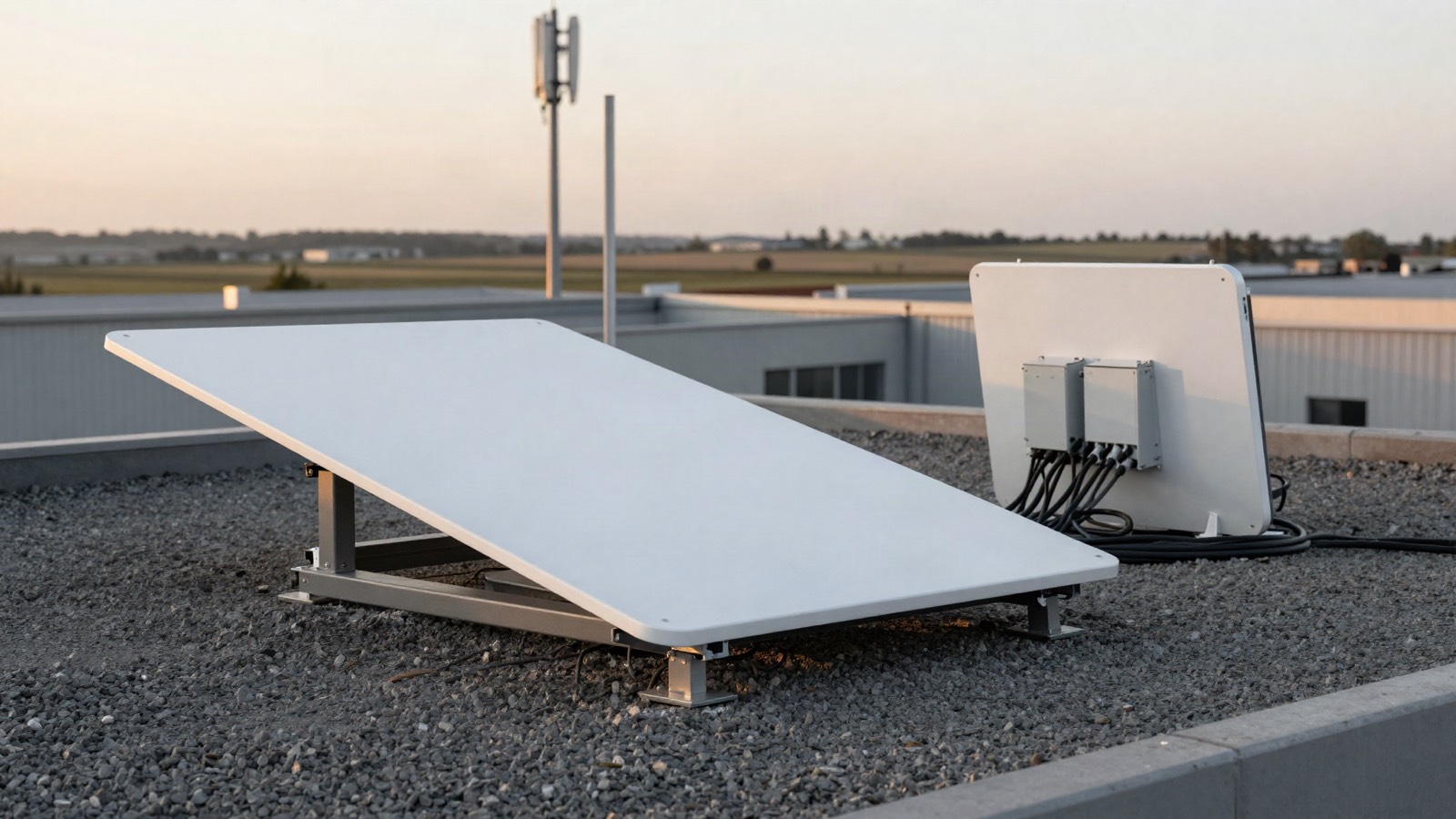
The terminal is the Leo Ultra, Amazon's enterprise antenna: a full-duplex phased array rated for up to 1 Gbps down and 400 Mbps up, mounted on a building or set on the ground. AT&T disclosed neither pricing nor a launch date; details are promised "in the coming months" and the rollout is described as "a structured, phased deployment designed to ensure business-grade reliability before broad availability". AT&T separately reaffirmed its investment in AST SpaceMobile for direct-to-smartphone service, which is a different product from a terminal-based enterprise link.
Where Amazon Leo stands in September 2026
- Satellites: 398 launched (396 production satellites and 2 prototypes) after the 2 July 2026 Atlas V flight, the last of nine Atlas V missions. The first-generation constellation is planned at 3,236 satellites. In June 2026 the FCC waived the licence milestone that required 1,618 satellites in orbit by 30 July 2026.
- Launch cadence: seven launches in 2026 so far, 216 satellites, on Ariane 6 and Atlas V. Vulcan Centaur has been paused since a solid-rocket-booster anomaly in February, and New Glenn lost its only launch pad in a static-fire explosion on 28 May; Blue Origin says it intends to fly again by the end of the year. On 9 September, at the International Space Summit in Paris, Amazon ordered six more Ariane 64 launches, taking its Arianespace order from 18 to 24 missions. The next flights on the manifest are an Ariane 64 with 36 satellites on 7 October and, if ULA returns to flight, a first Vulcan with 40 satellites in October.
- Service: an enterprise beta opened on 8 April 2026 with Verizon, AT&T, Vodafone, Vodacom, JetBlue, NBN Co, Vrio, NASA, Hunt Energy and Crane Worldwide Logistics. Amazon had pointed to mid-2026 for commercial availability; as of 21 September no commercial launch date has been announced, and no monthly price has been published anywhere.
- Terminals: Leo Nano (18 cm square, 1 kg, up to 100 Mbps), Leo Pro (28 cm square, 2.4 kg, up to 400 Mbps, announced at "under $400") and Leo Ultra (51 × 76 cm, 19.5 kg, up to 1 Gbps down / 400 Mbps up). Amazon quotes round-trip latency of about 50 ms and claims six to eight times the uplink throughput of existing satellite services.
The strategic choice is the opposite of Starlink's. SpaceX sold to consumers first and built its business, maritime and aviation tiers on top of a consumer-scale network. Amazon is selling through carriers and enterprises first (AT&T and Verizon in the United States, Vodafone and Vodacom in Europe and Africa, NBN Co in Australia) and will reach consumers later, starting with the northern US states where its coverage is densest.
Starlink Business today: the benchmark Amazon has to beat
Starlink Business is not a roadmap. It is a price list you can order from this afternoon, with hardware that ships in days and a reseller and installer channel in most countries. The numbers below were read on starlink.com on 21 September 2026 unless stated otherwise.
| Starlink Business (21 Sept 2026) | Amazon Leo (21 Sept 2026) | |
|---|---|---|
| Can you order it? | Yes, online or through an authorised reseller | No: enterprise beta only, no commercial date |
| Entry price | Local Priority from $55 a month, Standard kit $349 | Not published; Leo Pro terminal announced at under $400 |
| Fixed-site plans (US) | Local Priority 50 GB $55, 500 GB $155, 1 TB $280, 2 TB $530; add-on blocks of 50 GB ($25) or 500 GB ($125) (Business.org, June 2026) | Not published |
| Global / mobile plans | Global Priority 50 GB $250, 500 GB $650, 1 TB $1,150, 2 TB $2,150 a month per terminal (checked 18 Sept 2026) | Not published |
| Enterprise terminal | Starlink Performance kit, $1,999, 400+ Mbps today, gigabit via a 2026 plan upgrade with no hardware change | Leo Ultra, up to 1 Gbps / 400 Mbps, price not published |
| Contract | Monthly, 30-day refund, no early-termination fee | Not published |
| Extras on business plans | Network precedence, public IPv4, SLA, 24/7 prioritised support | Through the carrier (AT&T: one bill, 24/7 support across fibre, 5G and satellite) |
| Aviation | Regional 25 GB $4,000, Regional Unlimited $12,500, Global Unlimited $20,000 a month (prices doubled in 2026 from $2,000 and $10,000) | JetBlue in beta, no product |
Two things in that table matter more than the rest. First, Starlink's business pricing is not static: the entry Local Priority plan sits at $55 a month while aviation plans doubled this year and the enterprise antenna was repositioned around gigabit service. A buyer comparing offers in 2027 will not be comparing against today's Starlink price list. Second, the only Amazon Leo figure that exists is a terminal price, and terminal price is the smallest part of a three-year total cost of ownership.
What it changes for a buyer
A US site already on AT&T
Ask your account team for the Leo bundle terms when they exist, and do not wait for them to solve a need you have today. There is no price, no SLA text and no delivery date; a Starlink Performance kit on a Local Priority plan costs $1,999 plus $155 to $530 a month, ships this week and can be cancelled monthly when the AT&T offer becomes concrete. The US Starlink guide lists the installers and resellers who handle business sites.
Multi-country estates
Amazon Leo outside the United States is a beta run by Vodafone, Vodacom and NBN Co. Starlink remains the only LEO service with a published business plan you can deploy in dozens of countries under one account, and OneWeb remains the alternative for enterprise and government contracts that need a non-US operator. See our LEO providers and enterprise satellite solutions directories for the integrators who operate across borders.
Ships and aircraft
The Leo Ultra is designed with maritime and aviation in mind and JetBlue is a beta partner, but there is no maritime or aviation product to buy. Fleet decisions in 2026 are still Starlink Global Priority against VSAT, and our maritime comparison has the per-vessel numbers.
Resilience and dual-vendor requirements
This is where the announcement counts. Procurement rules that require two independent providers for a critical link, common in utilities, public safety and finance, could not be met with two LEO operators in the same market until now. From 2027, Amazon Leo through AT&T or Verizon becomes a credible second LEO path next to Starlink in the United States, and OneWeb fills that role today for customers who cannot wait.
What it changes for resellers and installers
Amazon is not opening a Starlink-style authorised reseller programme. It sells through carriers and large partners, which means the Leo Ultra will reach most sites through AT&T, Verizon or Vodafone field teams and their subcontractors rather than through independent resellers. For installers the practical consequence is a second enterprise antenna to learn: at 19.5 kg the Leo Ultra sits in the same mounting and power class as the Starlink Performance kit, with the same roof, mast and cabling questions. The sensible moves for a regional installer are to get onto the subcontractor lists of the carriers' integrators now, and to keep the Starlink authorised-reseller or installer status that brings in business today. Our US satellite providers page lists 59 companies that already do this work.
What to watch next
- The 7 October Ariane 64 flight and ULA's Vulcan return to flight: without Vulcan, Amazon's 2026 deployment depends on Ariane 6 alone.
- AT&T's price sheet and SLA language, promised within months.
- Amazon's first published monthly price, which will tell whether Leo competes on cost or on the carrier bundle.
- Starlink's gigabit plan upgrade for the Performance kit, announced for 2026 and not yet live.
Sources
- AT&T Business expands connectivity architecture with Amazon Leo satellite, AT&T newsroom, 8 September 2026; coverage by Wireless Estimator.
- Amazon Leo orders 6 more Ariane 64 launches from Arianespace, Via Satellite, 9 September 2026.
- List of Amazon Leo launches, satellite count and manifest, read 21 September 2026.
- Amazon Leo targets mid-2026 commercial launch as enterprise beta goes live, TNW, April 2026.
- Blue Origin identifies engine issue behind New Glenn explosion, Spaceflight Now, 6 August 2026.
- Starlink Business and Starlink Aviation, prices read on 21 September 2026; Local Priority tiers from Business.org, updated 24 June 2026; Performance kit price from Mobile Internet Resource Center.
- Starlink's Business Aviation prices doubled, GlobalAir, 2026.