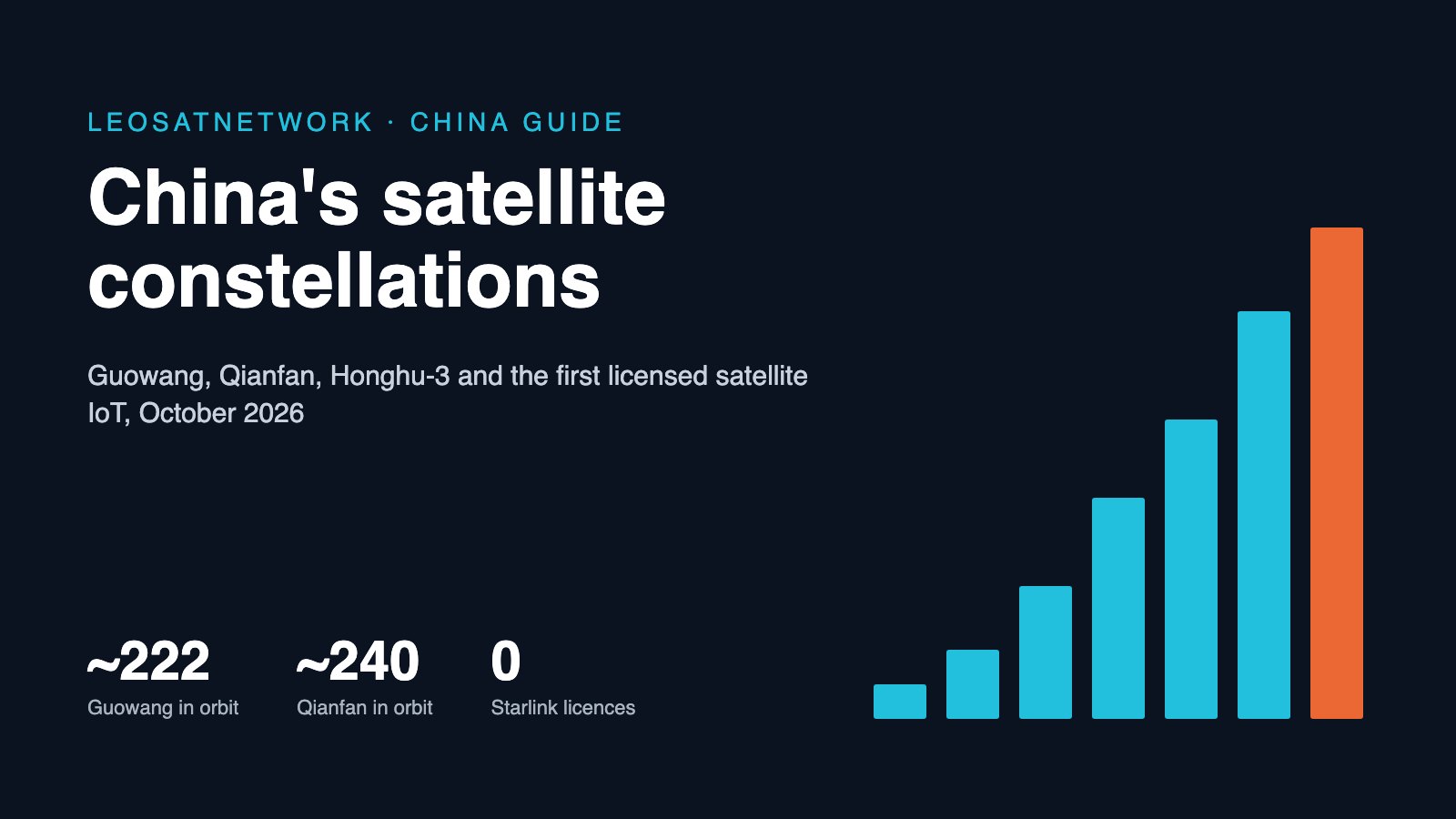
China is building two national low Earth orbit broadband constellations to rival Starlink, Guowang and Qianfan, plus a third private one, Honghu-3, and two satellite IoT networks that received the country's first commercial licences in 2026. In October 2026 Guowang had about 222 satellites in orbit and Qianfan about 240, against more than 11,000 for Starlink; neither sold a commercial broadband service yet. Inside China, satellite connectivity is still carried by licensed state operators on geostationary satellites (China Satcom, China Telecom Satellite and the transport ministry's CTTIC), because Starlink is not licensed in the country. Abroad, Qianfan is the first Chinese LEO network to be authorized in another market, Brazil. This guide explains who is building what, how far each network has got, what a business can buy in China today, and how Chinese constellations compare with Starlink, Amazon Leo and Eutelsat OneWeb. Facts are dated and sourced; trackers disagree on exact counts, so we give ranges where they do.
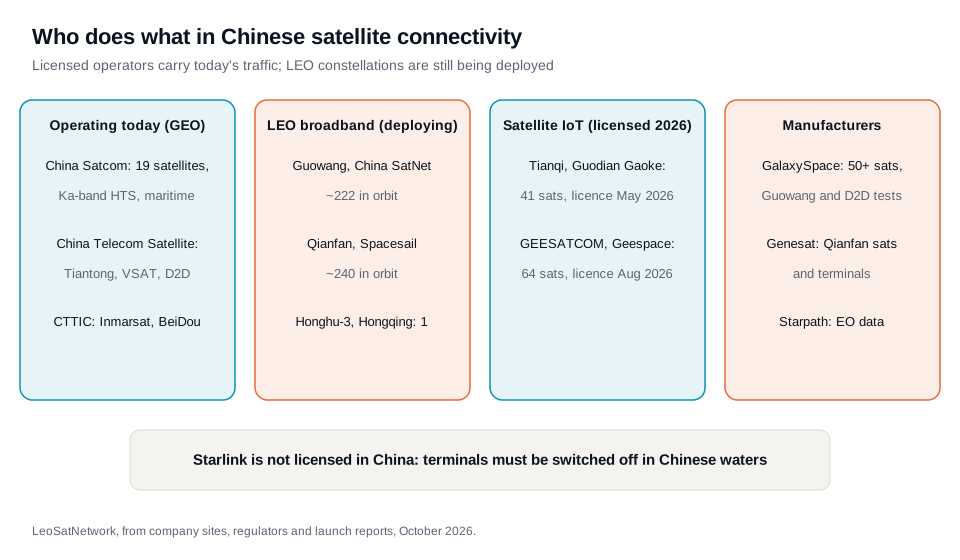
China's constellations at a glance
| Network | Company | Type | Planned | In orbit (Oct 2026) | Status |
|---|---|---|---|---|---|
| Guowang | China SatNet (state-owned) | Broadband | 12,992 (ITU filing) | About 222 | Deploying; no commercial offer announced |
| Qianfan (Thousand Sails, G60) | Spacesail (Shanghai, state-backed) | Broadband, direct-to-cell tests | About 15,000 | About 240 (about 22 reported failed) | Authorized in Brazil; commercial start targeted late 2026 |
| Honghu-3 | Hongqing Technology (48% Landspace) | Broadband | 10,000 | 1 demonstrator | First satellite launched 18 August 2026 |
| Tianqi | Guodian Gaoke | IoT | Second phase by 2028 | 41 | First commercial IoT trial licence (May 2026) |
| GEESATCOM | Geespace (Geely) | IoT, later phone and broadband | 5,676 in phase 3 | 64 | Commercial IoT trial licence (August 2026) |
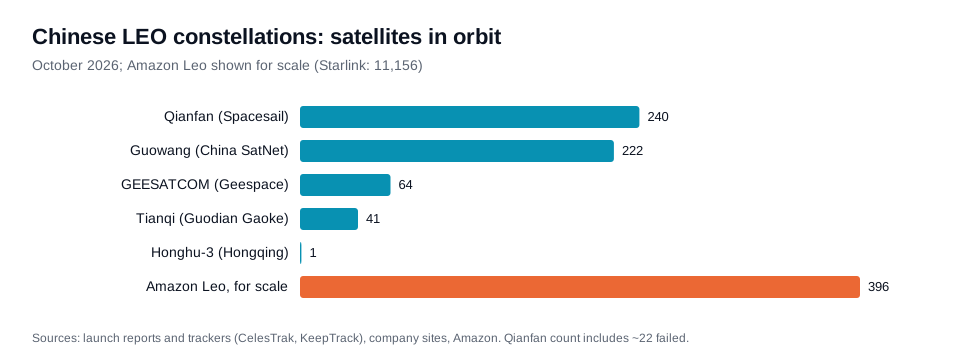
Why China builds its own networks
Three reasons drive the programme. The first is control: satellite connectivity in China is a basic telecom service reserved to licensed, mostly state-owned operators, and foreign networks are not licensed to serve the country. Starlink is not available in China, and ships must switch their Starlink terminals off in Chinese waters; the Ningbo Maritime Safety Administration fined a foreign vessel for using one on 22 December 2025. The second is spectrum and orbit: the ITU allocates frequencies and orbital positions largely to whoever files and deploys first, and Chinese operators filed plans adding up to almost 200,000 satellites in early 2026. The third is industrial: the constellations feed a domestic chain of satellite factories, rockets and terminals, from GalaxySpace in Beijing to Genesat's satellite plants in Shanghai.
Guowang: the national constellation
Guowang (国网, "national network") is run by China Satellite Network Group (China SatNet), a state-owned company created in April 2021 to build China's satellite internet. Its ITU filings cover 12,992 satellites in several shells at different altitudes. Production launches began at the end of 2024 and accelerated through 2025 and 2026 on Long March rockets; the 27th batch, launched from Wenchang on 9 October 2026, brought the total to about 222 satellites in orbit. Reports put the 2026 plan far higher than what was achieved, so the pace remains the main uncertainty.
China SatNet buys satellites from state manufacturers and from commercial ones: GalaxySpace's first satellites for Guowang flew in August 2025, with a second batch in January 2026. As a state network, Guowang is expected to serve government, defence, telecom operators and large enterprises first; no retail or business offer had been announced by October 2026.
Qianfan: the commercial challenger
Spacesail (Shanghai Spacesail Technologies, 上海垣信卫星), backed by the Shanghai government and based in Songjiang, is building Qianfan, also called Thousand Sails or G60. It launched its first satellites in August 2024 and had about 238 satellites up after 14 launches by July 2026, with trackers counting about 240 to 257 objects in October; independent tracker Jonathan McDowell counted 22 of them as failed in September 2026. The target is 324 satellites for initial service, about 15,000 in the long run.
Qianfan is the most internationally active Chinese network. Brazil's regulator Anatel authorized it on 12 February 2026 for up to 324 satellites until July 2031, after a 2024 memorandum with state operator Telebras; Spacesail plans at least six gateways in Brazil and targets commercial service in the fourth quarter of 2026. It has also signed with MEASAT in Malaysia (February 2025) and set up activities in Kazakhstan. In June 2026 it completed China's first direct-to-cell voice calls with unmodified smartphones, using a test satellite launched on 9 June, and its satellite maker Genesat showed Qianfan user terminals at MWC Shanghai on 26 June. In August 2026 Spacesail raised about one billion dollars in a round closed to foreign investors. No commercial service had been reported by September 2026.
Honghu-3 and the next wave
Honghu-3 is a 10,000-satellite plan filed with the ITU by Shanghai Lanjian Hongqing Technology, in which rocket maker Landspace holds 48%. Its first satellite, a demonstrator testing a deployable radiator, electric propulsion and a 100 Gbps laser link, flew on Landspace's reusable Zhuque-3 on 18 August 2026, a flight that also achieved China's first land recovery of an orbital booster. Geespace plans 264 satellites for direct-to-phone links in its second phase and 5,676 for broadband in a third. These plans matter less for what they will deliver soon than for the spectrum they reserve.
Satellite IoT: the first licensed services
The first Chinese LEO services open to businesses are not broadband but IoT. On 6 May 2026 the Ministry of Industry and Information Technology granted Guodian Gaoke the country's first two-year commercial trial licence for satellite IoT, for its Tianqi constellation of 41 satellites; it targets water resources, marine fisheries, energy, transport and logistics with modules and terminals. In August 2026 Geespace, the satellite arm of carmaker Geely, received the second licence for GEESATCOM, 64 satellites covering the globe except the poles, already used in production Zeekr cars, construction machinery and fishing fleets. Both are low-power, low-data networks for sensors and trackers, comparable to Iridium or Globalstar IoT rather than to Starlink.
Phones from space
China Telecom has sold direct-to-phone satellite service since 2023 on Tiantong, a geostationary system: messaging and calls on supported Huawei, Honor and Xiaomi models, without a new SIM. China Telecom Satellite launched it abroad first in Hong Kong, then in Laos, and has signed a memorandum in Cambodia. LEO direct-to-cell is at test stage: Spacesail's June 2026 calls, and a China Mobile test satellite built by GalaxySpace and launched the same day. ABI Research expects commercial LEO direct-to-cell services in China within about 18 months.
What a business can buy in China today
For companies operating in China, satellite connectivity today means licensed operators on geostationary satellites:
- China Satcom, the CASC operating company listed in Shanghai, runs 19 communications and broadcast satellites, including Ka-band high-throughput satellites, a carrier-grade broadband platform, an airborne connectivity platform and Haixingtong, its maritime service for crew internet, ship-shore data, video and vessel tracking.
- China Telecom Satellite sells Tiantong satellite phones and direct-to-phone service, VSAT, satellite broadband, international satellite links and airborne connectivity, with installation and maintenance.
- CTTIC, the transport ministry's telecom centre, runs maritime satellite (Inmarsat), search-and-rescue, transport emergency broadband and BeiDou services for shipping and transport.
- For sensors and trackers, Guodian Gaoke and Geespace sell licensed satellite IoT.
Foreign companies with sites or ships in China should plan on these operators, or on maritime satellite services such as Inmarsat, operated in China through CTTIC, and keep any Starlink terminal switched off within 12 nautical miles of the coast. Our maritime connectivity guide covers the port-arrival procedure.
Who may sell satellite services in China
Satellite communications are a basic telecom service in China, licensed by the Ministry of Industry and Information Technology (MIIT). Until 2026 these licences were held almost entirely by state-owned groups: China Satcom (CASC), China Telecom, China Unicom (which obtained a satellite mobile licence) and the operators of the national constellations. Value-added services, integration and terminals are more open, which is why private companies such as GalaxySpace or Geespace started as manufacturers and system suppliers.
The 2026 IoT licences mark a first opening. Guodian Gaoke's approval in May was described in Chinese media as the first time a private company was allowed to run a commercial satellite communications service, followed by Geespace in August. Both are two-year commercial trials. Broadband over Guowang and Qianfan is expected to follow the same route, with licences granted to the constellation operators and to the large carriers that resell them. For a foreign company, the practical consequence is simple: buy from a licensed Chinese operator, or through an international operator's licensed local partner, as with Inmarsat through CTTIC.
The industrial chain behind the constellations
China has built a satellite manufacturing base in five years. GalaxySpace in Beijing has launched more than 50 satellites of its own design, mass-produces phased-array antennas and other payloads, built China's first LEO broadband test constellation (Little Spider Web, eight satellites), supplies satellites to Guowang, and in 2026 launched a China Mobile direct-to-phone test satellite, SAR formations and a satellite for Thailand. Genesat (Gesi Aerospace), Qianfan's prime contractor, runs satellite factories in Shanghai's Songjiang district sized for about 150 large and 300 smaller satellites a year, and makes Qianfan user terminals. Geespace builds its satellites in its own "super factory" in Taizhou, Zhejiang, which produced the satellites for its six launches from 2022 to 2025.
Launch is the constraint. Most Chinese constellation satellites fly on Long March rockets from Wenchang, Taiyuan and Jiuquan, in batches of nine to eighteen. Commercial reusable rockets are arriving: Landspace's Zhuque-3 recovered its first stage on land in August 2026, on the flight that carried the first Honghu-3 satellite. How quickly reusable launchers reach a regular cadence will decide whether Guowang and Qianfan approach their targets this decade.
Chinese satellite connectivity abroad
Chinese operators are exporting along three routes. Qianfan offers LEO broadband to governments and operators, starting with Brazil, where Anatel's authorization requires Spacesail to show operations with at least 10% of the 324 authorized satellites within two years of its April 2026 publication; agreements with Malaysia's MEASAT and activities in Kazakhstan follow the same pattern. China Telecom exports Tiantong direct-to-phone service through local carriers, first in Hong Kong and Laos, with a memorandum in Cambodia. And China Satcom's geostationary fleet already covers South-East and South Asia, the Middle East, Africa, Europe and the Pacific for broadcasting and enterprise links.
For satellite providers outside China, this matters in two ways. In markets that sign with Chinese operators, Qianfan may become a lower-cost competitor to Starlink, Amazon Leo and OneWeb for government and carrier contracts. And spectrum coordination with Chinese filings will weigh on every other constellation's plans, since the ITU process rewards early filing and deployment.
For ship operators calling at Chinese ports
Ships are where foreign companies meet Chinese satellite rules most often. Starlink must be switched off in Chinese territorial waters, and enforcement is real since the December 2025 Ningbo penalty. Fleets keep a second link that is legal in China: an Inmarsat or VSAT service, or a Chinese maritime platform such as China Satcom's Haixingtong, which offers crew internet, ship-shore data and video backhaul, vessel tracking and video surveillance. Add the Starlink deactivation step to the port-arrival checklist and make sure the backup carries operational traffic during the call. Our maritime satellite providers directory lists integrators that manage both.
Planned vs launched
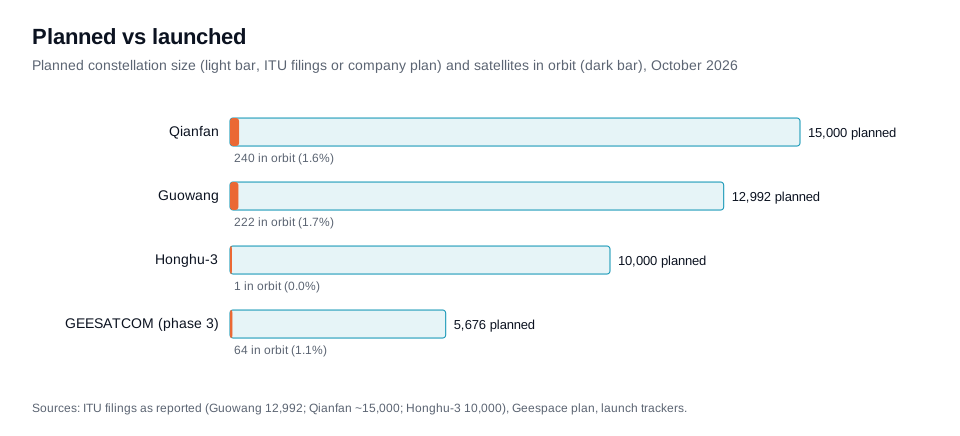
The gap between plans and launches is the defining fact of Chinese LEO in 2026. Each broadband constellation has less than 2% of its filed size in orbit. Launch capacity is the bottleneck, as it is for Amazon Leo: China's reusable rockets, such as Landspace's Zhuque-3, were only starting to fly in 2026. Until hundreds more satellites are up, coverage is intermittent and services remain trials.
How they compare with Starlink, Amazon Leo and OneWeb
| Guowang | Qianfan | Starlink | Amazon Leo | Eutelsat OneWeb | |
|---|---|---|---|---|---|
| Satellites in orbit (Oct 2026) | About 222 | About 240 | 11,156 | 396 | About 654 |
| Commercial broadband service | Not yet | Targeted late 2026 (Brazil, China) | About 167 markets | From late 2026 | Since 2023, business only |
| Sold in China | Expected | Expected | No (not licensed) | No | No |
| Abroad | Not announced | Brazil authorized; Malaysia, Kazakhstan agreements | Global | Partners on five continents | Global, via partners |
| Direct-to-phone | Not announced | LEO test calls (June 2026) | Starlink Mobile | From 2028 | No |
For a business outside China, Chinese LEO networks are not yet an option, with two possible exceptions in 2027: Qianfan in Brazil, and in countries that sign with Spacesail. For companies inside China, they will become the LEO option once licensed, since foreign networks are not. Our Amazon Leo guide and satellite options guide cover the alternatives elsewhere.
What to watch next
- End of 2026: whether Qianfan reaches 324 satellites and starts commercial service in Brazil and China as planned.
- 2026 to 2027: Guowang's launch pace, and the first commercial offer from China SatNet.
- 2027: Brazilian deadline for Spacesail to show operations (at least 10% of the authorized satellites within two years of the April 2026 publication).
- 2027 to 2028: LEO direct-to-cell services from Spacesail and China Mobile; Tianqi's second phase.
- Reusable rockets: the cadence of Zhuque-3 and other reusable launchers, which sets the pace of every Chinese constellation.
Companies listed
We list China's satellite operators, constellation builders and IoT providers in our satellite providers in China directory: China Satcom, China Telecom Satellite, China SatNet, Spacesail, GalaxySpace, Geespace, Guodian Gaoke, CTTIC and Starpath Global. Companies active in Chinese satellite connectivity can add or claim their profile.
Sources
- Company sites rendered on 28 October 2026: China Satcom, China Telecom Satellite, GalaxySpace, Geespace, Guodian Gaoke, CTTIC.
- Guowang: China launches 27th batch of GuoWang satellites, Mediasat, 13 October 2026; KeepTrack.
- Qianfan: Qianfan tracker (azmth, CelesTrak data, October 2026); Anatel authorization, Teletime, 13 February 2026; MEASAT agreement, SpaceNews; Spacesail raises 1 billion dollars, Tech Times, 18 August 2026.
- Direct-to-cell: China tests direct-to-cell satellite calls, CGTN, 20 June 2026; MWC Shanghai review, ABI Research; Genesat Qianfan terminals, 26 June 2026; China Telecom direct-to-phone in Hong Kong, Light Reading.
- Honghu-3: Chinese firm files plans for 10,000-satellite constellation, SpaceNews; Honghu launch on Zhuque-3, 18 August 2026.
- Satellite IoT licences: Guodian Gaoke, Yicai Global, May 2026; second satellite IoT licence, 36Kr.
- ITU filings: Chinese constellation operators submit plans for almost 200,000 satellites, China in Space; Advanced Television, 28 April 2026.
- Comparison figures: Starlink statistics (Jonathan McDowell); our Amazon Leo guide; OneWeb count (KeepTrack). Ningbo penalty: our maritime guide.