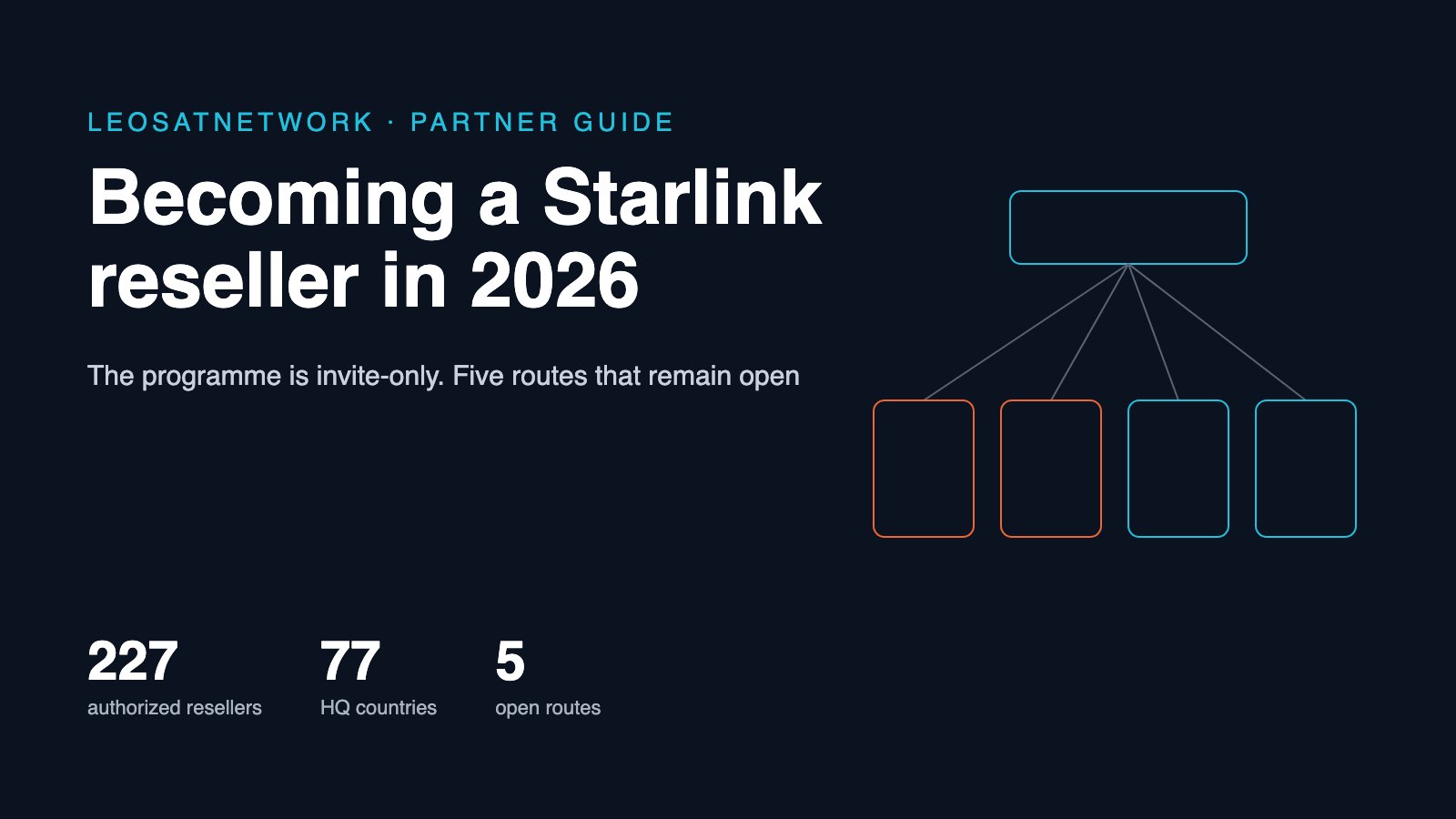
You cannot apply to become a Starlink authorized reseller in 2026. Starlink's Help Center, read on 28 October 2026, says the programme "is currently invite-only": Starlink "is not accepting new reseller applications through our website form" and is "selectively adding resellers in targeted markets and strategic opportunities". The related Indirect Reselling Program, which let smaller companies resell through an authorized reseller, was also restricted in April 2026. Starlink's reseller directory listed 227 authorized resellers on the same day. That does not close the market. A company that wants to sell or install Starlink still has five realistic routes: get invited (with a large, specific business case), work as an indirect reseller under a listed reseller on Global Priority, install for Starlink's residential partners or for resellers, become an aviation dealer if you are a certified repair station, or build a multi-network offer with Amazon Leo, Eutelsat OneWeb or Iridium. This guide sets out each route with the rules as Starlink publishes them.
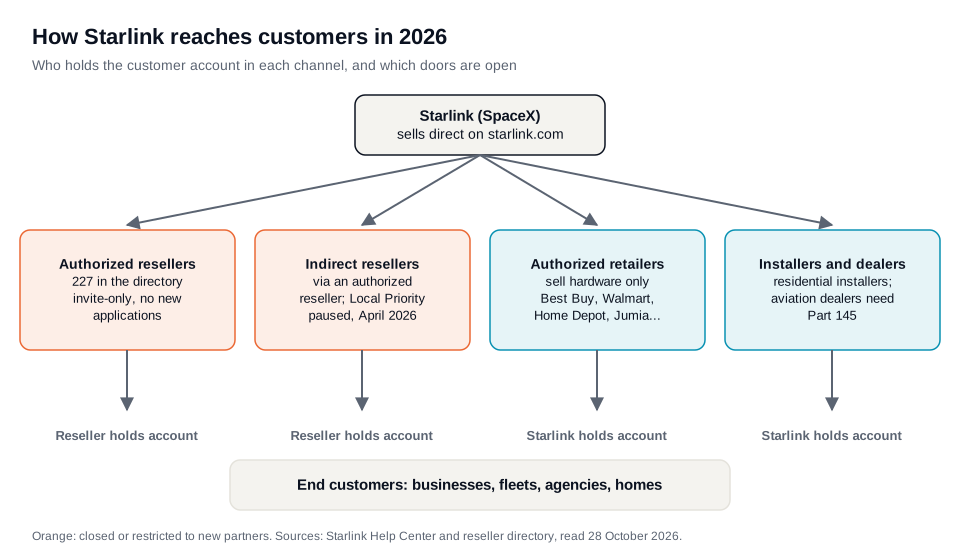
The four ways Starlink sells, and who holds the customer
Starlink distinguishes resellers, indirect resellers, retailers and installers. The question that separates them is who owns the customer account after the sale.
| Channel | What the partner sells | Who holds the account and support | Open to new partners? |
|---|---|---|---|
| Authorized reseller | Hardware and service, bundled with its own services | The reseller, exclusively | No, invite-only |
| Indirect reseller | Service bought through an authorized reseller | The authorized reseller is responsible | Local Priority paused; Global Priority only if registered |
| Authorized retailer | Hardware only, in store or online | Starlink, after activation | Not through a public form |
| Installer or aviation dealer | Installation labour (and, for dealers, aviation kits) | Starlink | Through installer partners; aviation dealers can apply |
Authorized resellers are "independent companies that have been officially approved by Starlink to sell Starlink products and services", only where Starlink is licensed. They can bundle hardware and service with their own value-added services, and the customer manages "account, service, billing, and support exclusively through the reseller". This is the status most companies mean when they ask how to become a Starlink reseller.
Authorized retailers buy hardware from Starlink and sell it to end users in stores or online; Starlink "then manages the service, account, orders and support for the end-user directly". In the United States the list includes Amazon, Best Buy, Home Depot, Walmart, Sam's Club, Tractor Supply and West Marine; in Kenya it runs from Naivas supermarkets to small IT shops. Retail is a volume business for chains, not a route for an IT integrator.
Installers mount kits for Starlink customers. Starlink's own third-party programme covers residential plans only, in 33 countries and territories, through a handful of partners.
Why the authorized reseller programme is closed
PCMag reported on 11 May 2026 that SpaceX had paused reseller applications, citing "overwhelming" demand, after Tim Belfall, a director at the UK installer Westend WiFi, spotted the notice. Belfall wrote that the programme needs "very deep financial pockets". PCMag also reported that applicants had previously needed a business plan reaching at least $5 million a year in recurring Starlink data revenue; we could not find that threshold on a Starlink page, and an African trade publication quoted a different entry figure, so treat it as indicative. Either way, the programme was designed for telecom operators, managed service providers and large integrators, not for a local installer.
The Indirect Reselling Program was restricted first. Starlink's FAQ explains why: "The current approach has created compliance risk and reduced visibility into end customers." The rules as published:
- Local Priority plans: "Paused while under review. New requests are not being accepted."
- Global Priority plans: can continue, but every existing relationship had to be registered by 30 April 2026. Unregistered arrangements "will be considered unauthorized".
- Registration required, for each relationship, the customer names, estimated 12-month revenue, the market and proof of local licensing where required.
- Branding: indirect resellers must identify as "[Your Company] and Starlink Indirect Reseller" and "may not use Starlink logos, call themselves an 'authorized Starlink reseller,' or contact Starlink directly".
- Responsibility: the authorized reseller is "fully responsible for support, onboarding, training, billing, and compliance" of its indirect resellers.
Who the 227 authorized resellers are
Starlink's public directory gives each reseller's headquarters, regions and declared services. On 28 October 2026 it listed 227 companies, every one of them marked as accepting clients. 39 are headquartered in the United States, ten each in the Philippines and the United Kingdom, eight in Indonesia, seven each in Brazil and Mexico, and six each in Canada, France and Japan. In total the headquarters span 77 countries.
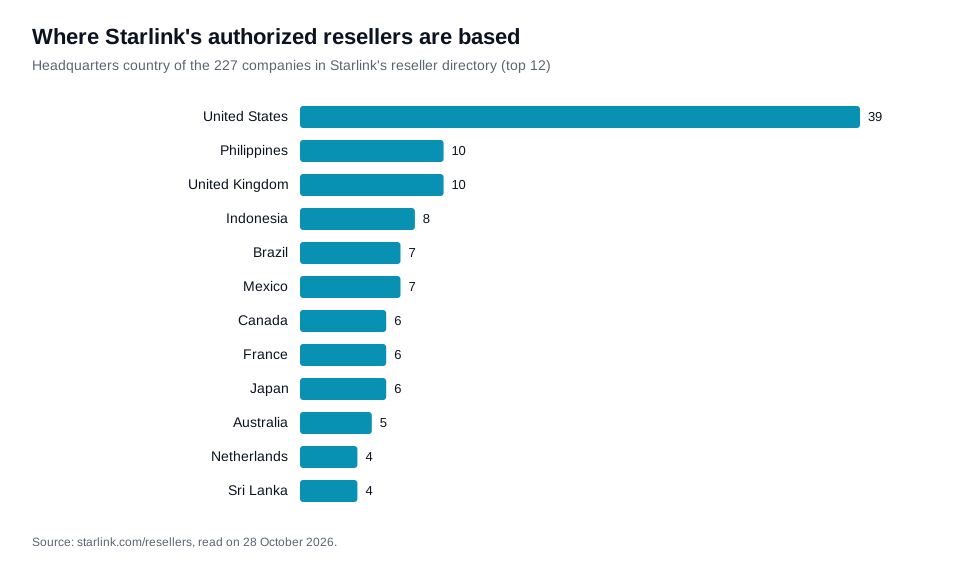
The names show who Starlink chose: national telecom operators (Telefónica Global Solutions, Bouygues Telecom Business, Airtel, One New Zealand, Retelit, Algar), US network and managed service providers (Comcast Business, Granite, MetTel, AireSpring, SageNet), satellite and maritime specialists (Navarino, Elcome, Space Norway, Telespazio), and regional IT and connectivity firms in countries where Starlink needs a local licence holder. By region, 82 list offices in Asia-Pacific, 64 in North America, 61 in Europe, 54 in Latin America, 46 in Africa and 29 in the Middle East (many list several regions).
The services they declare are the bar a new entrant would be measured against: 87% list installation, 86% round-the-clock support, 76% SD-WAN integration, 62% hardware sparing, 55% pooled data plans and 44% a committed information rate SLA. Our satellite installer market report breaks these down further.
The five routes compared
| Route | Who it suits | What you need | Open today? |
|---|---|---|---|
| Authorized reseller | Telecom operators, managed service providers, large integrators | A large, specific business case, licences, 24/7 support, billing systems | By invitation only |
| Indirect reseller | IT and maritime firms with their own customers | An authorized reseller willing to register you; Global Priority use cases | Global Priority only, registered |
| Installer for partners and resellers | Installers, electricians, AV and TV technicians | Insurance, Starlink experience, territory coverage | Yes |
| Aviation dealer | Part 145 repair stations | Certification, in-flight connectivity or SATCOM experience | Yes, by application |
| Multi-network partner | Integrators and maritime specialists | Agreements with Amazon Leo, Eutelsat OneWeb, Iridium or GEO operators | Yes, deal by deal |
What changed in 2026
- February to April 2026: Amazon Leo signs its first resellers (MTN on 10 February, Globalsat on 18 March, Venn Telecom on 13 April), giving integrators a second LEO network to sell.
- April 2026: Starlink restricts the Indirect Reselling Program. New Local Priority arrangements stop; Global Priority ones must be registered by 30 April.
- May 2026: reseller applications are closed; PCMag reports it on 11 May.
- August 2026: the UAE grants Starlink a 10-year licence, after a 2025 consultation on licensing satellite resellers.
- September 2026: AT&T Business adds Amazon Leo to its enterprise portfolio.
- 28 October 2026: Starlink's directory lists 227 authorized resellers, all accepting clients.
Route 1: get invited
Starlink says it adds resellers "in targeted markets and strategic opportunities". In practice that means one of three situations:
- A market where Starlink needs a local partner: a country that licenses Starlink only through a local operator, or where language, payment or import rules make direct sales hard.
- A vertical where you already own the customers: a fleet operator, a public-sector framework, a retail network, a maritime or energy customer base that would bring many terminals at once.
- A service Starlink does not provide: managed SD-WAN, a security wrapper, a multi-orbit network with guaranteed bandwidth, a field service network across a large territory.
There is no public form. Companies that were added in 2025 and 2026 announced it themselves after a commercial negotiation, often through a Starlink enterprise sales contact. Prepare what a channel manager would ask for: the number of terminals over 12 and 36 months, the customer segments, licences held in each country, support organisation and hours, and the value you add on top of the service. Industry analysts have noted that Starlink does not let partners mark up airtime on the connectivity layer; Brent Prokosh of Novaspace said in 2024 that "they allow no markup of airtime or service costs", so the business case has to rest on services, hardware and integration.
Route 2: become an indirect reseller under a listed reseller
If you already sell to customers who need Starlink, an authorized reseller can still supply you on Global Priority plans (maritime and aviation-style mobility), provided the relationship is registered with Starlink. You will invoice your customer under your own brand, describe yourself as "[Your Company] and Starlink Indirect Reseller", and rely on the authorized reseller for the Starlink side. Choose that reseller carefully: it carries the compliance risk, so expect it to ask for your licences, your customer list and your revenue forecast. For fixed sites on Local Priority, new indirect arrangements are not being accepted while the programme is under review.
Route 3: install for Starlink's partners and for resellers
Installation is the most open door. Starlink's residential installation partners recruit subcontracted technicians: SBPM covers a dozen European countries (including France, Germany, Italy, Spain, Poland and the Benelux) plus Canada, Japan and Kenya; SAT-Works covers the United Kingdom, Ireland, Greece, Cyprus, Croatia, the Baltic states and Zimbabwe; OnTech covers the United States and Puerto Rico; CIRCL covers Australia. SpaceX has also advertised for a manager to "build and lead a high-performing network of authorized installers" and develop "training, tools, and certification programs", which suggests a more formal installer programme.
The bigger market for a business installer is the resellers themselves. 87% of the 227 authorized resellers list installation services, but very few have their own technicians in every region they sell to. A managed provider winning a 300-store retail contract needs local installers in every state or county. Get in front of them with proof: insurance for roof work, photos of comparable sites, the kits you have installed (Standard, Mini, Performance), mast and pole work, and the networking you can do on site.
Route 4: aviation dealer
Aviation has its own, open programme. Starlink "follows a strict evaluation process for Part 145 certified MRO stations seeking dealer status" and asks applicants to be "certified as a Part 145 repair station (or equivalent) and in good standing with their local regulator (e.g., FAA, EASA)", with "proven experience installing in-flight connectivity or SATCOM systems". If you are a repair station, this is the one Starlink partner status you can apply for today. Our Starlink aviation directory lists the dealers and installers we track.
Route 5: sell more than one network
A growing share of integrators sell two or three LEO networks, which protects them from depending on one supplier's channel decisions.
- Amazon Leo is recruiting resellers. MTN Satellite Communications announced a maritime reseller agreement on 10 February 2026; Globalsat Group announced an agreement for enterprise customers across the Americas on 18 March 2026; Venn Telecom, based in Brussels, announced it on 13 April 2026 for enterprise customers mainly in Europe; Skyward and PEAKE in the United States also present themselves as Amazon Leo resellers. AT&T Business added Amazon Leo to its enterprise offer in September 2026 (see our Amazon Leo vs Starlink Business article). Initial service focuses on the United States, the United Kingdom, France, Germany and Canada.
- Eutelsat OneWeb sells through distribution partners signed one by one, such as E-Sat for maritime and enterprise customers in Europe (April 2025). See OneWeb providers.
- Iridium works through a partner ecosystem it describes as more than 500 companies (service providers, value-added resellers, manufacturers and developers), for voice, IoT and low-bandwidth data. See Iridium providers.
- GEO and VSAT operators still sell committed bandwidth that LEO networks rarely guarantee. Our satellite options guide compares them.
The full list of Amazon Leo operators and resellers, with dates and regions, is in our Amazon Leo for business guide.
A multi-network offer is also what larger customers increasingly ask for: a primary LEO link with a second network behind it. 58% of Starlink's own authorized resellers list terminal bonding, and many maritime integrators already run Starlink with OneWeb or VSAT.
Licensing: check the country before you sell
Starlink partners may only sell where Starlink holds a licence, and some countries regulate the reseller as well. Three examples show the range:
- Indonesia. Starlink's terms say customers "may not resell access to the service to other people" and that violations may end the service. Bisnis.com reported in May 2024 that this ruled out the informal neighbourhood resale known as RT/RW Net. Resale goes through Starlink's listed partners, eight of which are headquartered in Indonesia.
- United Arab Emirates. The TDRA opened a consultation on 25 July 2025 on a satellite reseller licence ("Category B") that would let businesses sell satellite connectivity devices and services, including LEO services; until then only licensed telecom operators could. Starlink itself received a 10-year general satellite services licence in August 2026, as reported by The National.
- Countries that license Starlink through a local operator. In several markets the local licence holder is the main or only route to customers. National operators such as Airtel, Algar and One New Zealand are among the authorized resellers.
Before investing, ask your regulator three questions: does reselling satellite broadband need a licence, does importing terminals need type approval or a permit, and are there data-localisation or lawful-interception rules for the service.
Where the money is for a Starlink partner
If airtime cannot be marked up, revenue comes from what surrounds it. For the companies in Starlink's directory, the services they list show the model:
- Installation and field work, priced per site, per mast or per vehicle (87% list installation services).
- Managed services: monitoring, SD-WAN, security, support contracts and a monthly per-site fee (86% list round-the-clock support, 73% a service dashboard).
- Billing services: one invoice in local currency, annual or monthly billing, pooled data (84% list monthly billing, 55% pooled data).
- Hardware financing and sparing: leasing kits, keeping spares, swapping failed units (59% list financing or leasing, 62% sparing).
- Integration projects: vehicles, vessels, emergency response kits, Layer 2 networks for enterprises (56%, 52%, 56% and 65% respectively).
The same logic applies to an installer who never becomes a reseller: the margin is in the labour, the network work and the recurring maintenance contract, not in the terminal.
A 90-day plan for an installer who wants Starlink business work
- Weeks 1 to 2. Write down what you have installed (number of Starlink kits, sites, mast and pole work, vehicles, vessels) with photos and permission to cite two customers. Check your insurance covers work at height.
- Weeks 3 to 4. List the authorized resellers in the directory that sell in your country and the managed providers that serve your region. Shortlist those without their own technicians near you.
- Weeks 5 to 8. Contact them with a one-page capability sheet: territory, response time, day rate, kit experience, networking skills, insurance. Offer a first job at cost to be tested.
- Weeks 5 to 8, in parallel. Apply to the residential installation partner for your country if you want volume work between business jobs.
- Weeks 9 to 12. Publish your business work: a page per use case on your site, a complete company profile on directories buyers use, and reviews from business customers.
What it takes to run a Starlink business, whatever your status
- Licences. Starlink partners may only sell where Starlink is licensed. Some countries also license the reseller (a telecom or ISP licence, an import permit for terminals, or a specific category for satellite resale). Check your regulator before you sell.
- A support organisation. If you hold the customer account, you are the first line of support, around the clock for business customers.
- Stock and logistics. Spare kits and a replacement process; 62% of authorized resellers list hardware sparing.
- Network skills. Failover, SD-WAN, firewalls, static IPs and Layer 2. Most of the value a reseller adds sits here, since airtime cannot be marked up.
- Field capacity. Your own technicians or a vetted subcontractor network, insured for roof and mast work.
- Billing. Monthly per-site billing, pooled data across terminals and the systems to reconcile Starlink's invoices with your own.
How to be found by customers
Whatever your status, buyers look for proof. Publish what you install and where, show the networks you are authorized to sell, and keep your company details consistent everywhere. On LeoSatNetwork you can list or claim your company profile for free, receive project requests from businesses in your area, and show our "Listed on LeoSatNetwork" badge on your site. Buyers read our guide on how to choose a business Starlink installer, which tells them to check the official directory and ask for a written scope, so a complete profile with your authorizations and services is what converts.
Browse the companies already active in your market: Starlink resellers, Starlink installers, satellite resellers and enterprise satellite integrators.
Sources
- Who is a Starlink authorized reseller?, Starlink Help Center, read 28 October 2026.
- Indirect Reselling Program, Starlink Help Center, read 28 October 2026.
- Who is a Starlink authorized retailer?, Starlink Help Center, read 28 October 2026.
- Does Starlink provide installers?, Starlink Help Center (third-party installers by country), read 28 October 2026.
- What are the requirements to become a Starlink Authorized Dealer? and How do I apply to become a Starlink Authorized Dealer?, Starlink Help Center (aviation), read 28 October 2026.
- Starlink Authorized Resellers directory, starlink.com, data read on 28 October 2026.
- SpaceX hits the brakes on reseller program, PCMag (Michael Kan), 11 May 2026.
- Fight, run or partner: how regional operators can adapt to Starlink competition, Kratos, 24 May 2024.
- Sr. Manager, Customer Success (Starlink Installer Program), SpaceX job posting.
- MTN finalizes reseller agreement for Amazon Leo maritime deployment, SatNews, 11 February 2026.
- Globalsat Group to resell Amazon Leo services across the Americas, SatNews, 18 March 2026.
- Venn Telecom named an authorized reseller of Amazon Leo, Venn Telecom, 13 April 2026.
- Eutelsat OneWeb and E-Sat sign a distribution partnership agreement, SmallSat News, 22 April 2025.
- The power of our partner network, Iridium, read 28 October 2026.
- SpaceX larang layanan Starlink dijual kembali, Bisnis.com, 27 May 2024.
- Telecom regulator launches consultations on satellite reseller services, Gulf News, 2025.
- UAE grants Starlink 10-year licence, The National, August 2026.