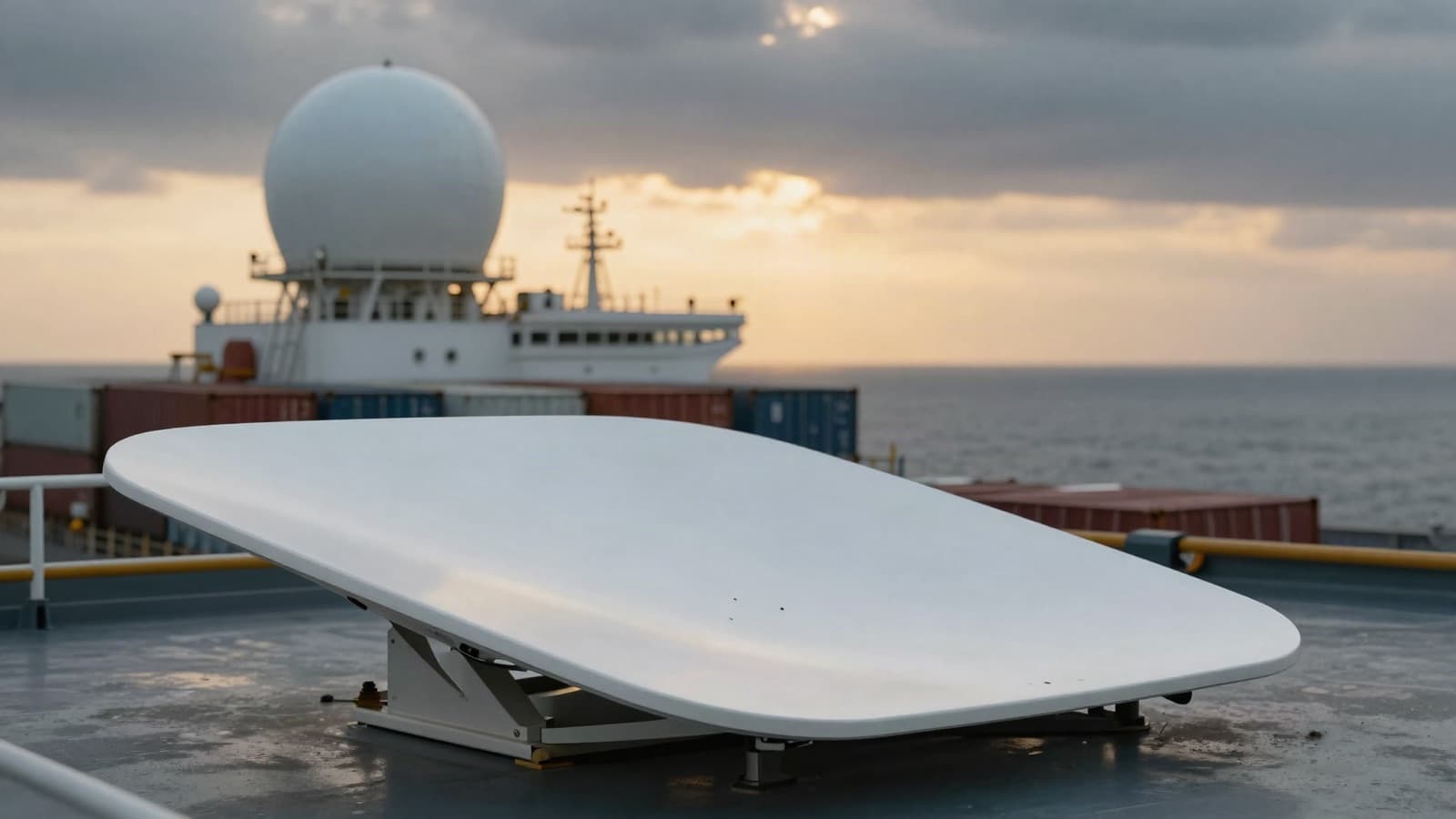
For most commercial vessels in 2026, Starlink is the primary link and VSAT is the fallback. Bought direct, Starlink Global Priority costs $250 a month for 50 GB up to $2,150 for 2 TB per vessel, and authorised distributors sell an unlimited plan to IMO-registered cargo and tanker vessels for $2,495 a month with the terminal included. VSAT airtime is still quoted per vessel, usually on a multi-year term, and keeps its place where you need a committed rate, a high-latitude route or a link that stays up in waters where Starlink is switched off. Every price below was checked on starlink.com and on the distributors' pages on 18 September 2026. The guide ends with the maritime integrators and VSAT providers we list.
What Starlink costs per vessel in 2026
Starlink sells maritime service under one plan family, Global Priority, priced in US dollars worldwide, with a 30-day trial. Roam and Local Priority are not fleet plans: Roam is limited to inland and territorial waters (12 nautical miles from shore) and Local Priority excludes coastal and ocean use altogether.
| Plan | Monthly price (direct) | Who Starlink says it is for |
|---|---|---|
| Global Priority 50 GB | $250 | Backup connectivity |
| Global Priority 500 GB | $650 | 2 to 4 users |
| Global Priority 1 TB | $1,150 | 5 to 10 users |
| Global Priority 2 TB | $2,150 | 10 to 20 users |
| Extra data | +$100 per 50 GB, +$500 per 500 GB | Added from the account in any month |
| Global Priority Unlimited | $2,495 all-inclusive, through distributors | IMO-registered cargo and tanker vessels |
Every Global Priority plan includes network priority, a public IP address, the fleet dashboard, a service level agreement and in-motion use anywhere Starlink is licensed, with up to two terminals on one line for the same vessel. Once the priority allotment is used, the connection keeps running at up to 1 Mbps down and 0.5 Mbps up until the next cycle or a top-up. Speeds are advertised as maximums (the Performance kit is rated at 400+ Mbps) and Starlink's own pages state they are not guaranteed and slow down under congestion.
The unlimited plan deserves its own paragraph. In September 2025 Starlink cut the price of its unlimited maritime package from $25,000 to about $2,500 a month (Splash247, 4 September 2025) and opened it to a shortlist of distributors: Elcome, Marlink, Tototheo, Clarus, Speedcast, KVH, Navarino and Fameline. Elcome's published terms on 18 September 2026: $2,495 a month all-inclusive, a Performance terminal at no cost, a 99.9% uptime SLA, eligibility limited to IMO-registered vessels classed as Cargo or Tanker (supply vessels are excluded, as are fishing and passenger ships), a commitment running to 31 December 2026 with no early termination, and applications closing on 30 November 2026. Valour Consultancy puts the direct price at "just over $2,150" and reseller prices at $2,300 to $2,500.
Hardware: the Performance kit and what it costs
The only Starlink terminal designed for permanent maritime installation is the Performance kit, now in its third generation (the Gen 2 was sold as Flat High Performance). Starlink's specifications: 400+ Mbps download, winds to 270 km/h, operation from -40 °C to 60 °C, IP68 unplugged and IP69K plugged in, a 25 m cable, a rack-mountable Advanced Power Supply that runs on AC or DC with a battery input for uninterrupted operation, a 3-year warranty and a 10-year design life. Starlink says gigabit-class plans will be enabled on the same hardware during 2026 through a service plan upgrade.
Starlink does not print the kit price outside its order flow. On 18 September 2026 US marine resellers listed the Gen 3 kit at $1,999 (tied to an airtime activation) to $2,499, and a maritime bundle with wedge mount and router sat in the same range. The unlimited plan includes the terminal. Actuated kits (Standard Actuated, Performance Gen 1) contain motors and are not approved for in-motion use.
What VSAT costs, and why it is quoted rather than listed
VSAT service over geostationary satellites is sold as a contract: a committed information rate (CIR) and a burst rate, a footprint per beam, a stabilised antenna that is bought or leased, and a term of one to five years. The public figures are therefore averages. Valour Consultancy measured VSAT revenue per merchant vessel at just over $1,300 a month for bulk carriers and $3,000 to $4,000 for LNG tankers with value-added services, with Ku-band around $1,500 and Ka-band around $1,300 (September 2021 figures). Satmarin's indicative 2026 ranges run from a few hundred to several thousand euros a month for GEO VSAT and €100 to €1,000 a month for an L-band backup channel.
That is the comparison to keep in mind: a 1 TB Global Priority plan costs less than the average VSAT airtime of a bulk carrier five years ago, for a much faster, lower-latency link. What the VSAT contract buys that Starlink does not is the guarantee.
Where VSAT still earns its place
- Committed bandwidth. Starlink's SLA does not turn the advertised speeds into a promise. A CIR written into a VSAT contract is the only way to buy a guaranteed rate for chart updates, remote surveys or telemedicine on a schedule
- High latitudes. Coverage thins toward the poles; check the Starlink availability map for Arctic and Antarctic routes before committing a vessel to a plan
- Waters where Starlink is switched off. Starlink geofences the countries where it is not licensed. China requires terminals to be off within 12 nautical miles of its coast, and the Ningbo Maritime Safety Administration issued its first penalty to a foreign vessel on 22 December 2025. A GEO or L-band link keeps the ship connected through those legs
- Safety communications. Starlink is not part of the GMDSS. Inmarsat and Iridium remain the recognised providers, so the SOLAS equipment stays on board whatever you do with broadband
- Segregation. Fleet IT teams keep operational traffic on the contracted link and crew traffic on Starlink, or run both through an SD-WAN router that decides per application
Starlink, GEO VSAT and L-band side by side
| Criterion | Starlink Global Priority | GEO VSAT | L-band (Inmarsat, Iridium) |
|---|---|---|---|
| Monthly cost per vessel | $250 to $2,150 direct; $2,495 unlimited via distributors | Quoted; averages of $1,300 to $4,000 by vessel type (Valour, 2021) | €100 to €1,000 (Satmarin, indicative) |
| Speed | Up to 400+ Mbps, best effort | Committed rate in the contract, burst above it | Below 1 Mbps |
| Latency | Tens of milliseconds | Around 600 ms round trip | High |
| Guarantee | Availability SLA, no throughput commitment | CIR | Availability |
| Coverage | Oceans and licensed countries; off in geofenced waters | Beam footprints of the contracted satellites | Global, including the poles on Iridium |
| Hardware | Performance kit, about $2,000 to $2,500 or included | Stabilised antenna, usually leased with the contract | Compact terminal |
| Contract | Month to month; unlimited plan committed to 31 December 2026 | One to five years | Typically annual |
| Safety role | None (not GMDSS) | None | GMDSS recognised |
What a hybrid setup looks like in 2026
The common pattern on merchant fleets today: Starlink as the primary link (one or two Performance terminals on one Global Priority line), the existing VSAT or a smaller GEO or L-band service kept as the fallback, and an SD-WAN router in between that steers traffic by application and fails over without crew action. Inmarsat's NexusWave packages the idea as one subscription with GEO Ka-band, LEO and LTE bonded together (Valour counted about 1,000 vessels committed to it by mid-2025), and distributors sell the same multi-orbit design under their own names, some with the router bundled into the unlimited plan.
The economics: keeping a small GEO or L-band plan as backup costs a few hundred a month against a Starlink primary priced at $1,150 to $2,495. Dropping VSAT entirely saves the most but leaves the ship on 1 Mbps once the allotment is gone and offline in geofenced waters, so operators with fixed rotations through Chinese or other unlicensed ports keep the second link.
How many vessels before a fleet account makes sense?
Starlink runs two tiers of account. A standard Business account buys online, one plan per terminal, with the fleet dashboard and the option to defer update reboots. An Enterprise account, which Starlink opens above about $1 million of annual recurring spend, adds bulk terminal purchases, invoicing by wire, data pooling across vessels, Layer 2 and Layer 3 VPN, and an API to activate, transfer and configure terminals from your own tools. At $2,150 to $2,495 a month per vessel that threshold sits around 35 to 40 vessels; below it you buy through an authorised distributor, which is also where the unlimited plan and the bundled routers live.
Which plan for which vessel
- Global Priority 50 GB ($250): a backup line on a vessel that keeps VSAT as primary, or a pilot before a fleet rollout
- 500 GB to 1 TB ($650 to $1,150): the working plan for most merchant vessels; Valour calls 1 TB "the statistical norm" and notes that very few ships consume anything near 5 TB
- 2 TB ($2,150) or unlimited ($2,495): crews above 15 to 20 with video calls and streaming, offshore units, research vessels and any operator who prefers a flat bill
- Two terminals on one line: allowed on Global Priority for the same vessel; distributors use the second Performance kit to clear the mast and funnel shadow and to double capacity without a second plan
Installation: what an integrator does on a commercial vessel
The kit fixes most of the design: a flat terminal on a wedge or pole mount with a clear view of the sky, a 25 m run to the rack-mount power supply, then Ethernet into the ship's network. What an integrator adds is the survey (shadowing from the mast, radar and funnel), a class-compliant cable route and deck penetration, a DC feed with battery backup so the link survives a blackout, the SD-WAN configuration and the crew portal or captive Wi-Fi. Quotes are per vessel after a deck survey; ask for the failover test to be written into the acceptance protocol.
Starlink itself sells no installation. The 53 companies in our Starlink maritime directory are the resellers and integrators who supply, fit and manage the kit; the 53 VSAT providers and the 85 maritime satellite providers we list cover the GEO and L-band side of a hybrid setup, and several appear in all three.
Bottom line
Put Starlink on the vessel first: $1,150 a month buys a 1 TB priority plan that covers what most merchant ships actually use, $2,495 buys unlimited if the ship is an IMO cargo or tanker vessel, and the terminal costs $2,000 to $2,500 or comes included. Keep VSAT, or a smaller GEO or L-band service, where the contract, the route or the port calls demand it. Then pick an integrator who will design the failover rather than bolt the dish on.