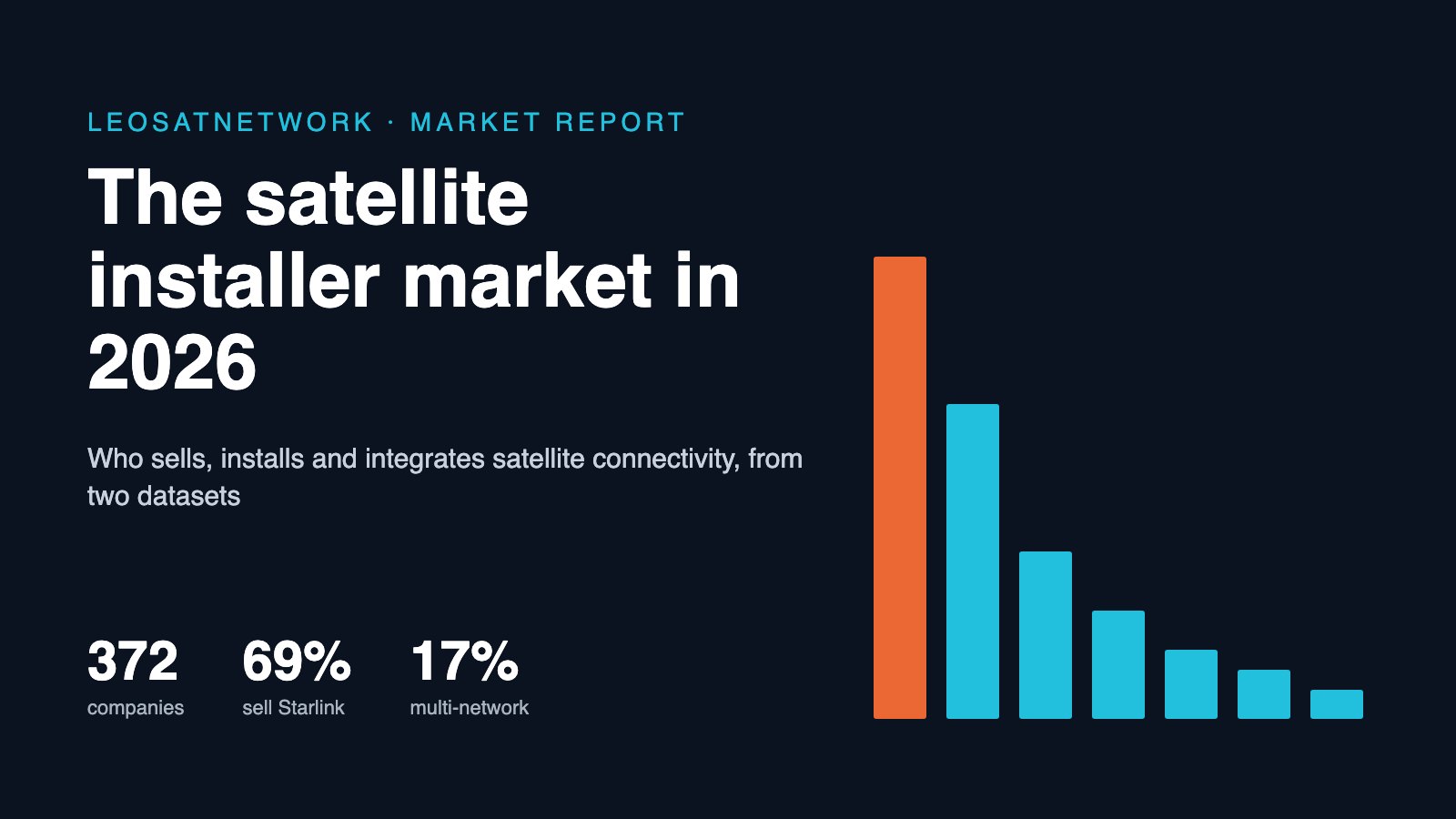
The companies that sell, install and integrate satellite connectivity are now mostly Starlink companies. On 28 October 2026, 255 of the 372 public company profiles in the LeoSatNetwork directory sold or installed Starlink (69%). Only 62 (17%) worked with two or more satellite networks. The market is concentrated: the United States and the United Kingdom account for 110 companies (30%), and only 14 countries have eight or more. Starlink's own directory of authorized resellers listed 227 companies the same day, headquartered in 77 countries. Their declared services show a market that is mature on installation and support (87% and 86%) and thinner on guarantees: only 44% offer a committed information rate SLA. This report sets out the numbers, the method behind them, and what they mean for buyers and for the companies in the market.
Key figures
| Indicator | Value (28 October 2026) | Source |
|---|---|---|
| Public company profiles | 372 in 71 countries | LeoSatNetwork directory |
| Companies selling or installing Starlink | 255 (69%) | LeoSatNetwork directory |
| Companies working with two or more networks | 62 (17%) | LeoSatNetwork directory |
| Starlink authorized resellers | 227, all accepting clients | starlink.com/resellers |
| Countries where those resellers are headquartered | 77 | starlink.com/resellers |
| Resellers offering a committed information rate SLA | 99 (44%) | starlink.com/resellers |
| Countries and territories with a Starlink residential installer partner | 33 | Starlink Help Center |
| Starlink subscribers | 12.0 million at 30 June 2026 | SpaceX filings with the SEC |
Method
Two datasets, read on the same day. The first is the LeoSatNetwork directory: 434 company records, of which 372 are public. Records are built from company websites, and each country page we open is checked company by company; every company is tagged with its roles (installer, reseller, integrator, service provider and so on), the networks it sells, the segments it serves and its services. Most companies hold several roles. The 62 non-public records are companies we removed (closed, off-topic or unverifiable) and are excluded.
The second is Starlink's public directory of authorized resellers at starlink.com/resellers, which lists each reseller's headquarters, regions, languages, industries and "value-added services". We read the complete data behind the page (227 entries). The services are declared by the resellers, not audited by Starlink or by us.
Neither dataset is the whole market. Thousands of small installers work without a website, and many IT firms install Starlink occasionally. The figures describe the companies that present themselves as satellite connectivity specialists, which is the market a business buyer actually searches.
Where the companies are
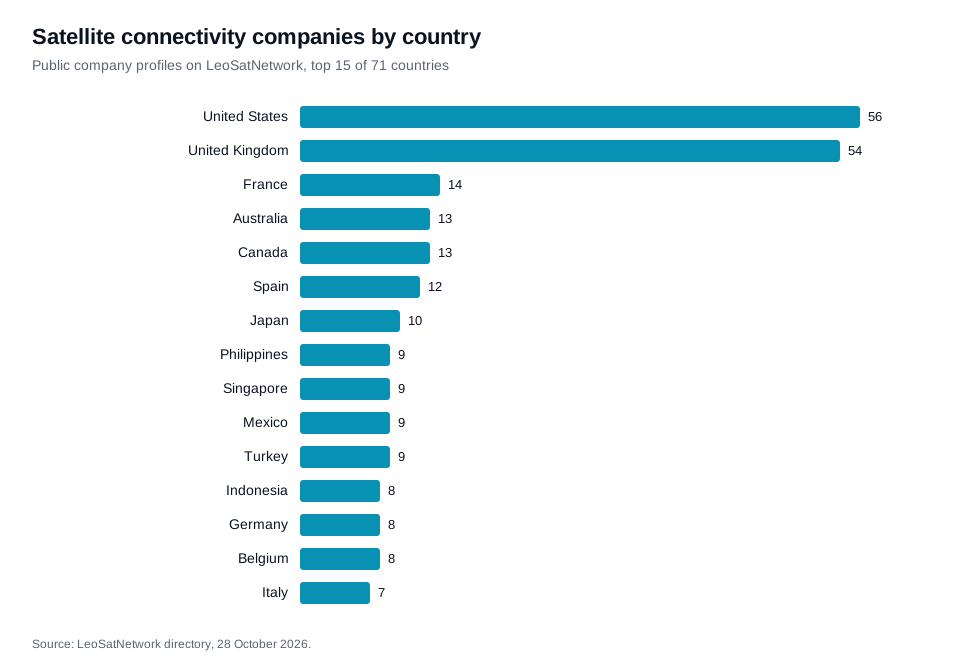
The United States (56) and the United Kingdom (54) dominate. The UK figure is high for the size of the country: it combines many independent installers with a cluster of maritime and enterprise integrators. Then comes a group of a dozen countries with eight to fourteen companies each: France, Australia, Canada, Spain, Japan, the Philippines, Singapore, Mexico, Turkey, Indonesia, Germany and Belgium. Beyond them the market is thin: 25 countries have a single company with a public profile.
Starlink's reseller headquarters follow a different map. The United States leads with 39, then the Philippines and the United Kingdom with 10 each, Indonesia with 8, and Brazil and Mexico with 7. Island and archipelago countries are over-represented (the Philippines, Indonesia, Papua New Guinea with 3, Fiji with 2, Vanuatu, the Solomon Islands, the Cook Islands, the Maldives), which is where terrestrial networks are hardest to build and where Starlink needs local partners. Africa counts resellers headquartered in 18 countries, from Zimbabwe and South Sudan (3 each) to Burundi and Lesotho.
What these companies do
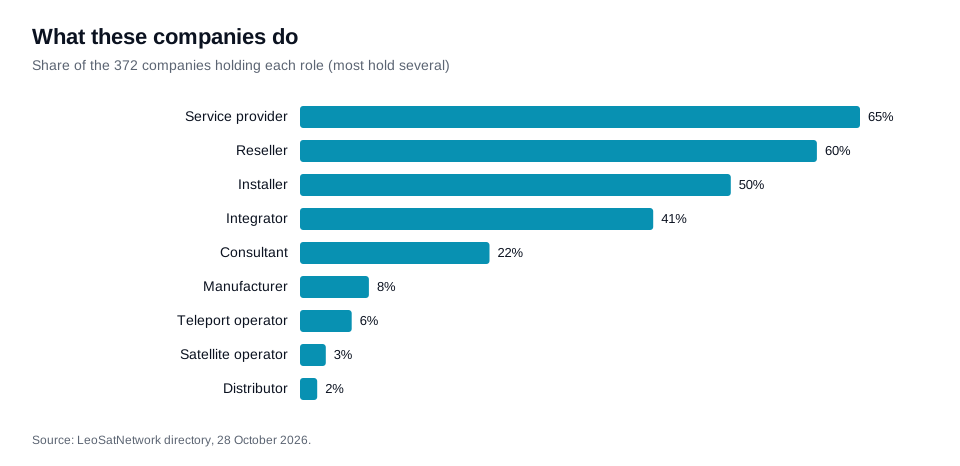
Most companies combine roles. 65% present themselves as service providers (they sell connectivity), 60% as resellers (they sell hardware or airtime from a network), 50% as installers and 41% as integrators. The pure installer, who only mounts equipment, is a minority in the directory; most installers also resell a network or manage the service afterwards. Upstream companies are few: 28 manufacturers, 24 teleport operators and 12 satellite operators.
The services they list confirm the shift from hardware to service. Support (54%) and installation (53%) lead, followed by equipment resale (43%), managed satellite connectivity (41%), integration and network design (39% each) and managed services (38%). The services a multi-site business needs are less common: round-the-clock support (26%), network operations centre monitoring (26%), backup connectivity (19%), redundancy and failover set-up (18%), site surveys (16%) and multi-site deployment (13%).
Which networks they sell
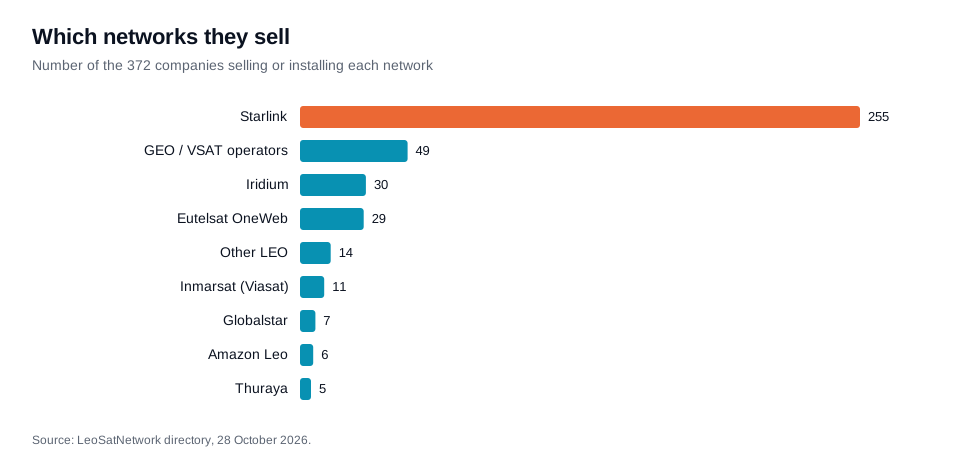
Starlink is in 255 company profiles. The next networks are far behind: GEO and VSAT operators (49), Iridium (30) and Eutelsat OneWeb (29). Amazon Leo already appears in six profiles, a year before its broad commercial service, which matches the reseller agreements announced since February 2026 (MTN, Globalsat, Venn Telecom, Skyward, PEAKE). 72 companies list no specific network, typically integrators and consultants who work with whatever the customer buys.
Since this report, we have checked every Amazon Leo announcement and updated those profiles; the list is in our Amazon Leo for business guide and the Amazon Leo providers directory.
The striking number is how few companies sell more than one network: 62 of 372 (17%). Most of them are maritime and enterprise integrators who run Starlink as the primary link with OneWeb, VSAT or L-band behind it. For a business that needs a second network for resilience, that is a short list.
By technology, 284 companies work with LEO, 69 with GEO, 64 with VSAT and 41 with satellite IoT. By segment, 68% serve fixed (terrestrial) sites, 37% land mobility, 29% maritime and 8% aviation.
Starlink's authorized resellers: who they serve
Starlink's directory tells us what its 227 resellers say about themselves. Every one was marked as accepting clients on 28 October 2026. 211 work in English, 64 in Spanish, 54 in French, 36 in Portuguese, 31 in German and 30 in Arabic.
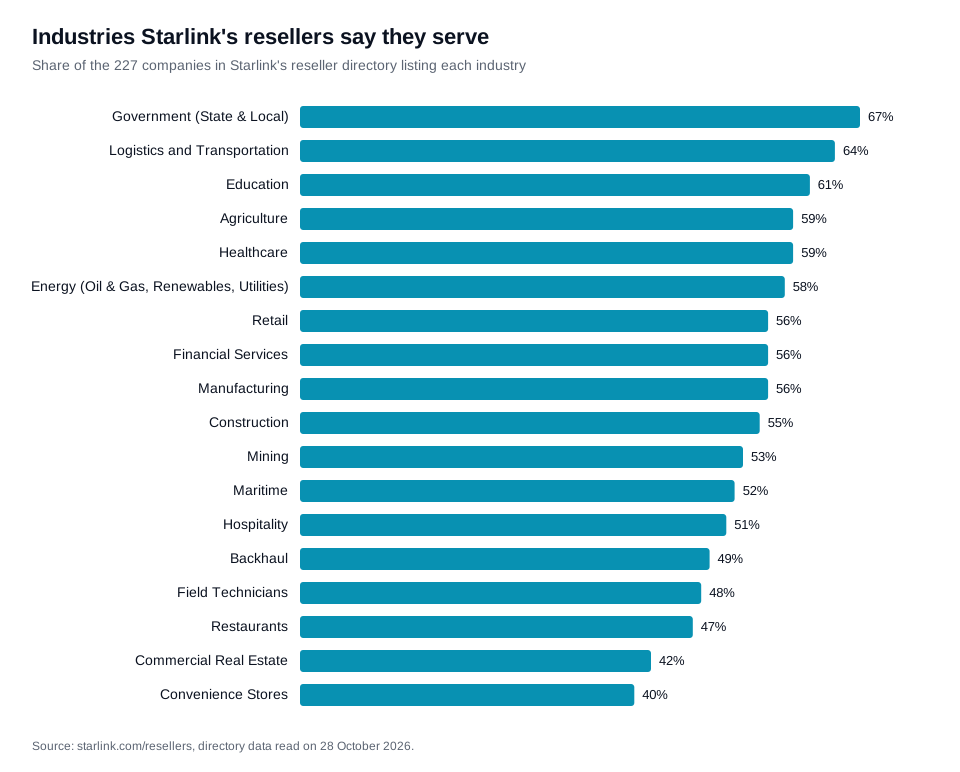
State and local government is the most cited industry (67%), followed by logistics and transportation (64%), education (61%), agriculture and healthcare (59% each) and energy (58%). Retail (56%), restaurants (47%) and convenience stores (40%) show how far Starlink has moved into multi-site commerce, where it usually serves as a backup line.
On services, 87% list installation, 86% 24/7 technical support, 84% monthly billing and 76% SD-WAN integration. The guarantees are rarer: 62% keep spare hardware, 55% offer pooled data plans and 44% a committed information rate SLA. Our guide on choosing a business Starlink installer shows the full list and the questions to ask.
How the two datasets overlap
About 130 of Starlink's 227 authorized resellers (close to six in ten) already have a profile on LeoSatNetwork, matched by company name. The rest are mostly national operators and regional firms in countries where we have not yet opened a country page, particularly in Africa, the Pacific and Central Asia. Conversely, most Starlink companies in our directory are not authorized resellers: they are installers working for customers who bought direct, IT firms and integrators who buy through a reseller, or companies that sell Starlink hardware alongside their own services.
Authorized resellers vs the wider market: the service gap
Starlink's authorized resellers declare far more services than the average company in the market. The comparison is not exact (the two lists use different service names, and resellers tick boxes in a form while our tags come from company websites), but the gap is large enough to matter.
| Service | Starlink authorized resellers (227) | All companies on LeoSatNetwork (372) |
|---|---|---|
| Installation | 87% | 53% |
| 24/7 support | 86% | 26% |
| Monitoring dashboard or NOC | 73% (service dashboard) | 26% (NOC monitoring) |
| Failover, bonding or backup | 58% (terminal bonding) | 19% (backup connectivity), 18% (failover set-up) |
| Multi-site or pooled offers | 55% (pooled data plans) | 13% (multi-site deployment) |
The reason is structural. Authorized resellers are mostly telecom operators, managed service providers and large integrators; Starlink's programme was built for companies that can carry enterprise accounts. The wider market is made of smaller installers and IT firms. For a buyer with one site, a local installer is often the better fit. For a buyer with fifty, the reseller list is where the services are.
Regions and languages
Starlink's resellers declare the regions where they have offices. 82 list Asia-Pacific, 64 North America, 61 Europe, 54 Latin America, 46 Africa and 29 the Middle East; many list several. Asia-Pacific leads because the region combines archipelagos, large rural areas and countries where a local partner is required. English is offered by 211 resellers, Spanish by 64, French by 54, Portuguese by 36, German by 31 and Arabic by 30; 23 offer Chinese, 19 Indonesian and 16 each Dutch, Italian, Russian and Japanese. For a buyer outside the main languages, the language filter in Starlink's directory narrows the list quickly.
Country by country: our listings vs Starlink's reseller network
Comparing the two datasets country by country shows where buyers have choice and where the visible market is thin. The last column counts the authorized resellers that Starlink's directory shows as serving the country, wherever they are based.
| Country | Companies on LeoSatNetwork | of which Starlink | Authorized resellers based there | Authorized resellers serving it |
|---|---|---|---|---|
| United States | 56 | 34 | 39 | 63 |
| United Kingdom | 54 | 30 | 10 | 43 |
| France | 14 | 9 | 6 | 35 |
| Australia | 13 | 7 | 5 | 23 |
| Canada | 13 | 5 | 6 | 45 |
| Spain | 12 | 10 | 3 | 33 |
| Japan | 10 | 5 | 6 | 22 |
| Philippines | 9 | 9 | 10 | 24 |
| Mexico | 9 | 7 | 7 | 37 |
| Indonesia | 8 | 8 | 8 | 24 |
| Germany | 8 | 7 | 3 | 35 |
| Belgium | 8 | 8 | 1 | 30 |
| Brazil | 7 | 7 | 7 | 36 |
| Colombia | 0 | 0 | 2 | 26 |
| Peru | 0 | 0 | 0 | 24 |
Three patterns stand out. First, in the largest European markets most authorized resellers serving the country are based elsewhere: Germany has 3 resellers headquartered there but 35 serving it, Belgium 1 and 30, Spain 3 and 33. Pan-European integrators, maritime specialists and telecom groups sell across borders, so a German or Belgian buyer can choose from far more companies than the local market suggests. Second, Canada is served by 45 authorized resellers, most of them based in the United States, while the Canadian companies with a public Starlink offer are few (5 in our directory). Third, Latin America outside Mexico and Brazil is under-represented in our own listings: Colombia and Peru are served by more than 20 authorized resellers each, but we do not yet list a company based there. That is a gap we are working on.
A caution on the last column: it is the coverage each reseller declares in Starlink's directory. A reseller "serving" a country may only sell there for maritime or enterprise accounts, or through a local partner.
Who sells more than one network
Of the 62 companies in our directory that list two or more satellite networks, 27 list three or more. They fall into three groups:
- Maritime and remote-operations integrators that combine Starlink, Eutelsat OneWeb, Iridium and Inmarsat or VSAT: Speedcast, IEC Telecom, GlobalTT-IPSEOS, Station Satcom, Verasat Global, Satcenter and GRC, for example.
- Specialists in L-band and handheld services that sell Iridium, Inmarsat, Thuraya and Globalstar for voice, tracking and IoT, often in Turkey, the United Kingdom and the United States (SATCOM Türkiye, OSAT, NextPlat, Globalsat Group).
- Early Amazon Leo partners that already add it to their Starlink or OneWeb offer, such as ProSat Networks, Skysol Solutions and Speedcast in our listings.
For buyers that want two independent paths, these are the companies to start with. For the rest of the market, adding a second network is the clearest way to stand out in a list where seven in ten companies sell the same one.
Maritime, mobility and aviation
108 companies in our directory (29%) serve maritime customers and 136 (37%) land mobility, often the same companies. Among Starlink's authorized resellers, 52% list maritime integration, 56% vehicle integration and 52% the maritime industry. Maritime remains the segment where multi-network offers are the norm, because ships cross waters where one network is unavailable or switched off; our Starlink Maritime vs VSAT guide covers the economics. Aviation is the smallest segment (31 companies, 8%), and the only one where Starlink still accepts partner applications, from Part 145 certified repair stations.
Starlink's installer network is residential
Starlink's own installation programme covers residential plans only. On 28 October 2026 its Help Center listed partners in 33 countries and territories: OnTech in the United States and Puerto Rico, SAT-Works in the United Kingdom, Ireland and seven other countries, SBPM across a dozen European countries plus Canada, Japan and Kenya, and local partners in Australia, New Zealand, Indonesia, Brazil, Peru, Portugal and Albania. A standard installation "typically takes around 90 minutes"; pole mounts are excluded. Business sites therefore depend on independent installers and on resellers, which is the market this report describes.
A channel that is closing
Starlink's channel policy tightened in 2026. In April it paused new indirect reselling arrangements on Local Priority plans and required existing Global Priority ones to be registered by 30 April. In May it stopped taking reseller applications; its Help Center now describes the programme as "invite-only". The 227 resellers in the directory are therefore close to a fixed list for now, and new entrants come in through installation, indirect arrangements on Global Priority or other networks. Our guide on becoming a Starlink authorized reseller sets out those routes.
At the same time competitors are building channels. Amazon Leo has signed resellers since February 2026 and AT&T Business added it to its enterprise portfolio in September 2026. Eutelsat OneWeb sells through distribution partners signed one by one, and Iridium works with an ecosystem it puts at more than 500 partner companies.
The market around it
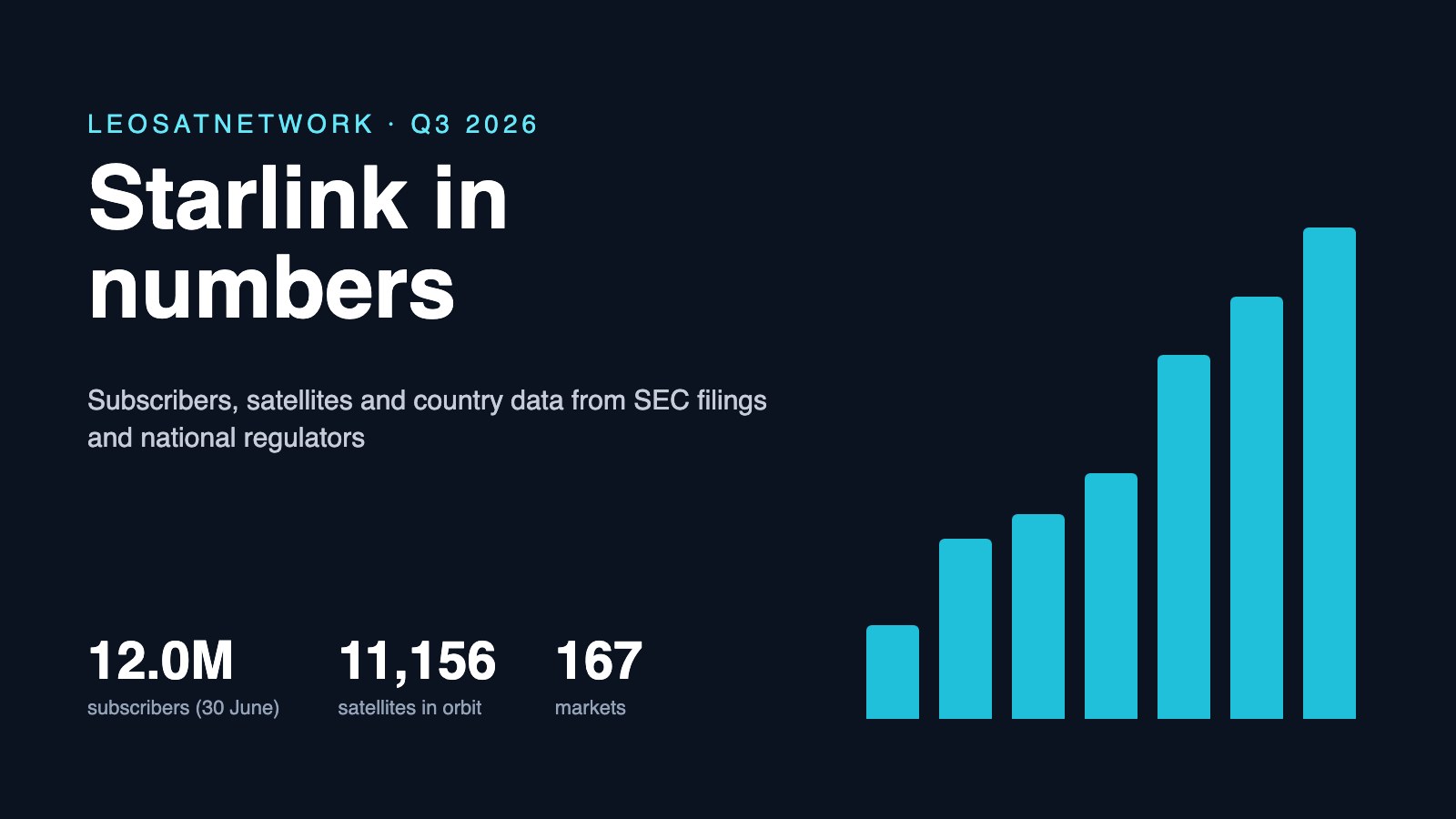
The installer and reseller market sits on a fast-growing base. SpaceX reported 12.0 million Starlink subscribers at 30 June 2026, up from 4.4 million at the end of 2024, in 167 markets, with average revenue per user of $66 a month in the second quarter of 2026 (see Starlink in numbers). Jonathan McDowell's catalogue counted 11,156 Starlink satellites in orbit on 13 October 2026. As the subscriber base grows and the price per user falls, the business value moves from selling kits to installing, integrating and running them, which is what most companies in this report already do.
What it means for buyers
- Outside the top 15 countries, choice is limited. Check the companies that cover your region rather than your city; many integrators work across borders.
- Do not assume a guarantee. Fewer than half of authorized resellers offer a committed information rate. Ask for it in writing if your use depends on it.
- For resilience, look for multi-network companies. Only 17% of the companies we list work with two or more networks.
- Check the status. A company that sells you Starlink service should be in Starlink's directory or able to name the authorized reseller it works through.
You can describe your project once and receive quotes from up to five companies that serve your area, or browse Starlink installers, Starlink resellers and enterprise satellite integrators.
What it means for installers and resellers
- Differentiate on what is rare. Site surveys, failover set-up, multi-site deployment, monitoring and committed bandwidth are listed by a minority of companies; these are what multi-site buyers ask for.
- Add a second network. With Amazon Leo resellers signing and Starlink's reseller list closed, a multi-network offer is the most open growth route.
- Work for the resellers. 87% of authorized resellers sell installation, but few have technicians everywhere they sell.
- Be findable. Buyers compare companies on their websites and in directories. List or claim your company on LeoSatNetwork to receive project requests in your area.
What we will track next
We will update this report each quarter with the same method: the number of authorized resellers and whether Starlink reopens applications, the spread of Amazon Leo and Eutelsat OneWeb across company profiles, the share of multi-network companies, and the countries we open next (Latin America first). Companies that want to appear in the next edition can list their profile before the end of the quarter.
The methodology for our listings is described on our methodology page.
Sources
- LeoSatNetwork directory, 372 public company profiles, extracted on 28 October 2026 (see our methodology).
- Starlink Authorized Resellers directory, starlink.com, data read on 28 October 2026.
- Does Starlink provide installers?, Starlink Help Center (third-party installers by country), read 28 October 2026.
- Indirect Reselling Program, Starlink Help Center, read 28 October 2026.
- Who is a Starlink authorized reseller?, Starlink Help Center, read 28 October 2026.
- Starlink in numbers, Q3 2026, LeoSatNetwork (SpaceX SEC filings and Jonathan McDowell's catalogue).
- MTN finalizes reseller agreement for Amazon Leo maritime deployment, SatNews, 11 February 2026.
- Globalsat Group to resell Amazon Leo services across the Americas, SatNews, 18 March 2026.
- Venn Telecom named an authorized reseller of Amazon Leo, Venn Telecom, 13 April 2026.
- Eutelsat OneWeb and E-Sat sign a distribution partnership agreement, SmallSat News, 22 April 2025.
- The power of our partner network, Iridium, read 28 October 2026.