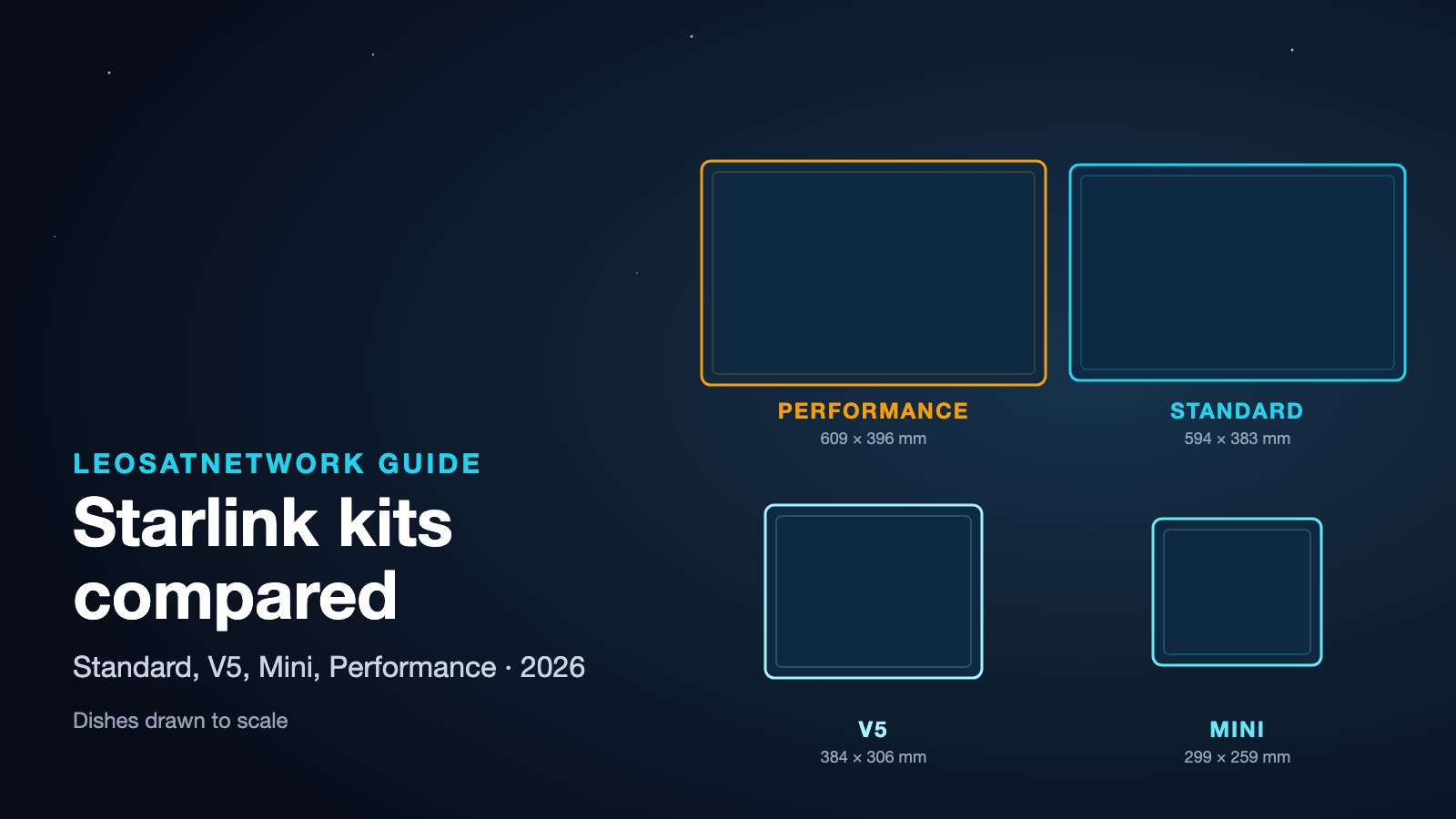
Starlink sells six kits in 2026: the Standard in two versions (Standard 4 with the Router Mini, Standard 4 X with Router 3), the new lightweight Starlink V5, the Mini and Mini X, the Performance (Gen 3) and the Enterprise. For a house, the Standard is the default and costs €349 in most of Europe, $349 in the US and £299 in the UK, or nothing upfront where Starlink rents it. The Mini (€199 in France and Germany) is for vans, boats and backup on battery power. The Performance kit (€2,160 in France) is for snow, wind, vehicles in motion and business sites. The specifications below come from Starlink's own sheets, and the prices from starlink.com's offer data on 24 October and 2 November 2026.
The 2026 line-up at a glance
| Kit | Dish size and weight | Power draw | Weather rating | Router | Best for |
|---|---|---|---|---|---|
| Standard 4 / Standard 4 X | 594 × 383 mm, 2.9 kg | 75–100 W | IP67, 96 km/h operational wind, 40 mm/h snow melt | Router Mini (204 m²) or Router 3 (297 m²) | Homes, small offices, Roam |
| Starlink V5 | 384 × 306 mm, 1.1 kg | 35–50 W | IP67, 265 km/h mounted wind, 40 mm/h snow melt | Router Mini | Homes where a small, light dish is easier to place |
| Mini / Mini X | 299 × 259 mm, 1.1 kg | 25–40 W, 12–48 V DC | IP67, 96 km/h, 25 mm/h snow melt | Built-in Wi-Fi 5 (112 m²); Mini X adds a Router Mini | Vans, boats, hiking, backup |
| Performance (Gen 3) | 609 × 396 mm, 5.2 kg | 75–100 W, AC or 12–56 V DC | IP68/IP69K, 280 km/h survivable wind, 85 mm/h snow melt, −40 to 60 °C | Third-party routers, Router 3 or Router Mini | Business sites, mountains, vehicles in motion, workboats |
| Enterprise | 594 × 383 mm | 75–100 W | IP67, 96 km/h, 40 mm/h | None included: plugs into your own router | Fixed business sites with existing network gear |
All of them use the same constellation and an electronically steered antenna with a 110° field of view (140° on the Performance), and all reach the same satellites. The difference is how much capacity, weather and installation flexibility you are paying for, not whether you get coverage.
Standard: the default for a home
The Standard dish is what Starlink ships to most households. It comes with a kickstand for the garden, a 15 m cable and a power supply, and it melts up to 40 mm of snow an hour. The two versions differ only by router: the Standard 4 comes with the small Router Mini, rated for about 204 m², and the Standard 4 X with Router 3, rated for about 297 m², with latching Ethernet ports and up to three Starlink mesh nodes. In a large house or a stone farmhouse with thick walls, the 4 X or a mesh node saves a trip back.
The Standard draws 75–100 W on average, so it is not designed for a solar or battery setup. It is approved for in-motion use on a Roam Unlimited plan with a Starlink-approved mount, but the Mini or the Performance are better suited to a vehicle.
Starlink V5: smaller and lighter
The V5 is Starlink's newest residential dish: about half the Standard's area, 1.1 kg, and 35–50 W average power, yet rated for 265 km/h winds once mounted and the same 40 mm/h of snow melt. It ships with the Router Mini and a pipe adapter. On 2 November 2026 it was sold in the United States at $349, the same price as the Standard, and also listed as a rental; we did not find it in the European offers. It does not yet appear on Starlink's list of kits approved for in-motion use.
Mini and Mini X: travel, boats and backup
The Mini has the router built into the dish and runs on 12–48 V DC, or from a 100 W USB-C power bank with Starlink's adapter cable. At 25–40 W it can stay on all day from a leisure battery, which is why it dominates in camper vans, sailing boats and field work. Its built-in Wi-Fi 5 covers about 112 m²; the Mini X adds a separate Router Mini for a cabin or a small house.
The trade-offs are capacity and weather. The Mini melts only 25 mm of snow an hour and is less suited to a permanent home in a snowy region. It costs €199 in France and Germany, £179 in the UK and about €199 at the median across the 116 countries where Starlink sells it, from under €90 in parts of Latin America to more than €300 in a few island states. Starlink has also sold the Mini bundled with a 12-month commitment in some countries, such as Brazil.
Performance (Gen 3): weather, motion and business
The Performance (Gen 3) succeeds the High Performance and Flat High Performance kits, now listed as Performance Gen 1 and Gen 2. It is heavier (5.2 kg) and pricier, but it survives 280 km/h winds, melts 85 mm of snow an hour, works from −40 °C to 60 °C, has a wider 140° field of view, and is sealed to IP68 and IP69K. Its Advanced Power Supply accepts AC or 12–56 V DC with a backup battery, is rack-mountable and has a PoE port for third-party routers. It costs €2,160 including VAT in France, or €1,800 excluding VAT on a business account.
Choose it for a mountain chalet or farm under heavy snow, a remote business site that cannot go down, a bus, truck, ambulance or workboat in motion, or any site where the router must be your own. It is the usual choice for commercial vessels and vehicle fleets.
Enterprise: for your own network
The Enterprise kit is a Standard-size dish sold for business use with a longer cable, a mount in the box and no Starlink router: the power supply feeds Ethernet straight into the company's firewall or SD-WAN appliance. It suits integrators who already manage the site network. If you want a Starlink router, it is sold separately.
What it costs around the world
Across the 150 countries where starlink.com lists a Standard kit price, the median on 24 October 2026 was €349. It ranged from about €93 in Australia (A$149, a promotion) to €466 in Paraguay. In 45 of 154 countries Starlink also rents the kit with nothing to pay upfront, including the US, the UK, France, Germany, Belgium, Canada and Australia. Where it does, rental is the safer choice if fibre may arrive within a year or two; buying makes sense if you will keep Starlink, since you can then resell the kit. Kit prices for every country are in our Starlink prices by country table.
Which kit should you choose?
| Use | Kit | Plan |
|---|---|---|
| Main home, no snow problem | Standard 4 (Standard 4 X for a large house), or V5 where sold | Residential |
| Home in a snowy or windy region | Standard; Performance for exposed or high-altitude sites | Residential |
| Second home | Standard | Residential with Standby mode between stays |
| Camper van or caravan | Mini | Roam (Unlimited for use while driving) |
| Sailing or motor yacht | Mini for coastal use; Performance offshore | Roam, or Global Priority at sea |
| Business site | Performance, or Enterprise with your own router | Local Priority |
| Vehicles in motion, fleets | Performance on an approved mount | Roam Unlimited or Priority plans |
In-motion use: what is allowed
Starlink's support pages list the Performance (Gen 3 and Gen 2), Standard 4, Standard 4 X and Mini as supported for in-motion use, with Roam Unlimited or a Priority plan. The cheaper Mini Roam plan is not allowed in motion or at sea. The dish must be on a mount Starlink designates for the purpose; using another mount or an actuated dish voids the warranty. Some countries ban in-motion use on land, including Indonesia, Malaysia, Japan, Jordan and Mexico.
What installers add
A professional installer matters more for the Standard and Performance than for the Mini: the dish has to clear trees and roofs to the north, the cable has to enter the building cleanly, and on a vehicle or boat the mount has to survive vibration and salt. The Starlink installers we list quote the hardware and installation together, and many are also authorised resellers who can supply the Performance or Enterprise kits with a business plan.
Bottom line
Buy the Standard for a house, the Mini for anything that moves on battery power, and the Performance where weather, motion or business uptime justify about six times the price. If Starlink rents the kit in your country and you are not sure you will keep it, rent.