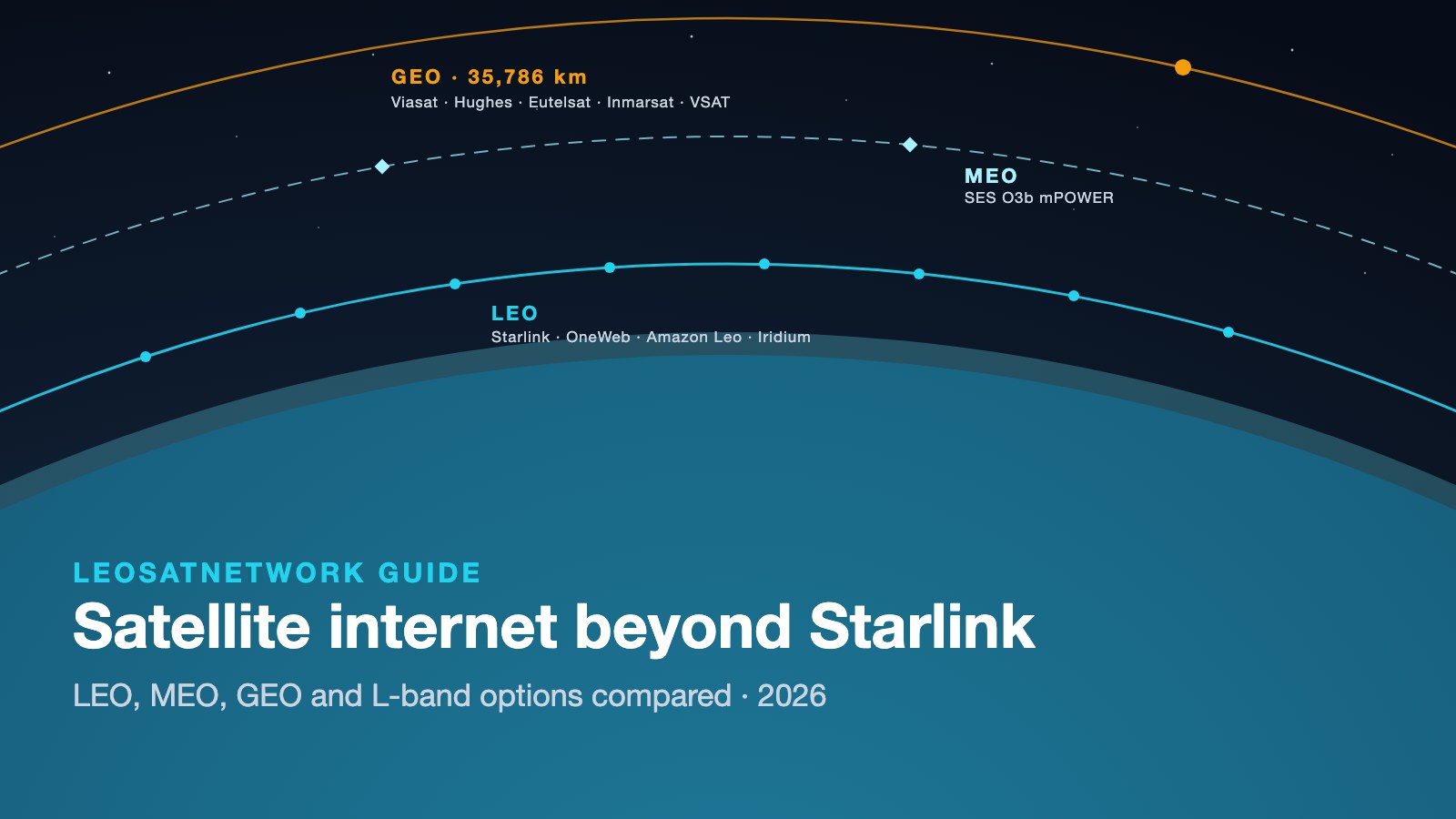
Starlink is the default answer to "satellite internet" in 2026, but it is not the only network in the sky, and for some buyers it is not the right one. This guide maps every option a home, a company or a fleet can actually buy today, by orbit: low Earth orbit (Starlink, Eutelsat OneWeb, Amazon Leo and the networks still being launched), medium Earth orbit (SES O3b mPOWER), geostationary broadband (Viasat, Hughes, Eutelsat, VSAT), L-band mobile networks (Iridium, Inmarsat, Thuraya, Globalstar) and the new direct-to-device services that reach an ordinary phone. Facts are dated; status was checked on 24 and 25 October 2026. The guide ends with a decision table and the providers we list for each network.
The short answer
- A home or a small business: Starlink is the only satellite network that sells consumer broadband in most countries at fibre-like latency. Geostationary plans (Viasat, Hughes, Eutelsat konnect) remain where Starlink is not sold or as a cheaper, slower option
- A company that needs a contract, a second network or sovereignty: Eutelsat OneWeb today, Amazon Leo from its launch, SES O3b mPOWER for high, committed throughput, all sold through partners rather than online
- Ships, aircraft, field teams: a LEO primary link plus a GEO or L-band backup; Iridium is the only network that covers the poles and the only one besides Inmarsat recognised for maritime safety
- A phone with no signal: direct-to-device services (T-Mobile's T-Satellite on Starlink, AST SpaceMobile with mobile operators) add texting and some apps, not broadband
Why the orbit matters
The height of a satellite sets three things a buyer feels: latency, coverage per satellite and the terminal you need.
| Orbit | Altitude | Round-trip latency | Satellites needed | Typical terminal |
|---|---|---|---|---|
| LEO | About 300 to 1,200 km | Tens of milliseconds (20 to 60 ms quoted for Starlink business service) | Hundreds to thousands, moving across the sky | Flat electronically steered antenna |
| MEO | About 8,000 km (O3b mPOWER) | Around 125 to 150 ms | A dozen or more | Tracking antennas, usually two |
| GEO | 35,786 km | Around 600 ms | Three cover most of the inhabited world | Fixed dish pointed once; stabilised on ships |
Low orbit wins on latency, which is what video calls, gaming and interactive business applications notice. Geostationary satellites stay over one spot, so a single satellite covers a continent and the dish never moves, which is why they still carry TV, VSAT networks and much of maritime and aviation traffic. Medium orbit sits between the two and is built for very high, managed throughput to a few sites rather than for millions of homes. More and more contracts mix them: see multi-orbit networking.
Low Earth orbit
Starlink (SpaceX)
The reference point. SpaceX reported 12.0 million Starlink subscribers on 30 June 2026, and Jonathan McDowell counted 11,156 Starlink satellites in orbit on 13 October 2026. On 24 October 2026 Starlink's own site offered residential service in 154 of the 224 countries and territories we checked, with a median entry plan of about $40 a month; country by country prices are on our Starlink by country page. It sells online to consumers and businesses, through authorized resellers for companies and governments, and for ships and aircraft. The main limits are regulatory (not licensed in countries such as South Africa, India or Turkey, switched off in their waters) and contractual: throughput is best effort, without a committed rate.
Eutelsat OneWeb
The other LEO network in full commercial service, and the European alternative governments turn to. It is sold only to businesses, governments, maritime and aviation customers, through distribution partners such as telecom operators and satellite integrators, never directly to households. About 650 first-generation satellites are in orbit (an independent count gave 636 operational on 10 September 2026) and none has been launched since October 2024. Eutelsat has ordered replacement satellites from Airbus, which delivered the first 32 in October 2026; launches are planned for 2027 and 2028, and the next-generation fleet is meant to work with IRIS², the EU constellation due around 2030. For a buyer this means a mature, contract-based service with fewer satellites, and therefore less capacity per area, than Starlink. We list 29 OneWeb providers; see also OneWeb (Eutelsat).
Amazon Leo (formerly Project Kuiper)
Amazon had launched nearly 400 satellites by July 2026 and said it had enough in orbit to start initial service before the end of the year, beginning at high latitudes and spreading toward the equator as launches continue (the next Ariane 6 flight, with 36 satellites, is set for 23 November 2026 at the earliest). Selected businesses have tested it in an enterprise preview since November 2025; AT&T announced in September 2026 that it will sell Amazon Leo to business customers with its fibre and 5G, without a start date; JetBlue plans to connect flights in 2027. Consumer service is planned first in the United States, Canada, the UK, France and Germany, with a waitlist open, but no retail price had been published by late October 2026. Read our analysis of the AT&T deal and the Amazon Kuiper entry.
Networks still being launched
- Telesat Lightspeed (Canada): 156 satellites for enterprise, government, maritime and aviation customers only. First launches are planned from late 2026, and Telesat starts global service once 96 satellites have been in orbit for a few months, which it places around 2027
- Qianfan / SpaceSail (China): about 250 satellites in orbit by September 2026, some of them failed. Brazil's Anatel authorised up to 324 satellites in 2026 and the operator reported trials in Malaysia, Mongolia and Kazakhstan, but no commercial service had been confirmed
- IRIS² (European Union): a sovereign multi-orbit system for governments, expected around 2030
Medium Earth orbit: SES O3b mPOWER
SES, which completed its acquisition of Intelsat on 17 July 2025, runs the only commercial MEO broadband network. Ten O3b mPOWER satellites were in service by March 2026, and the last three launched in September 2026, bringing the fleet to 13 once commissioned around mid-2027. It sells managed, high-throughput links with service levels to telecom operators (mobile backhaul, island connectivity), cruise lines, energy companies and governments, typically through SES or its partners, with latency around 125 to 150 ms. It is not a consumer product; it is what you buy when a site needs hundreds of megabits to gigabits with a guarantee.
Geostationary broadband and VSAT
GEO is the oldest satellite broadband and is still on sale almost everywhere, because one satellite covers a continent and a licence is often already in place.
- Viasat (US consumer plans, and Inmarsat since 2023): In October 2026 a US price comparison listed its residential plans from about $40 a month for the first year, then $70 to $180 depending on the plan, plus a $15 monthly equipment lease; check the promotion in force at your address. The ViaSat-3 satellites meant to add capacity over the Americas and Asia-Pacific were due to enter service during 2026
- HughesNet (EchoStar, Americas): still sold on the Jupiter satellites with speeds up to 100 Mbps, but EchoStar has refocused Hughes on enterprise customers and, after selling spectrum to SpaceX in 2025, refers consumer customers to Starlink under a fee-based programme disclosed in its filings
- Eutelsat konnect (Europe and Africa): a high-throughput GEO service sold through local distributors and internet providers rather than by Eutelsat itself; prices depend on the country
- VSAT: the business version of GEO, sold as a contract with a committed information rate, a beam footprint and an antenna, from one to five years. It remains the way to buy guaranteed bandwidth over a high-throughput satellite in Ku or Ka band
The trade-off is the same everywhere: about 600 ms of latency, data caps or traffic management on consumer plans, and a fixed dish, against wide availability and, for VSAT, a guarantee. We list 69 GEO providers and 63 VSAT providers.
L-band mobile satellite networks
L-band networks carry little data but work with small terminals, through rain and on the move, which is why they handle satellite phones, trackers, aircraft cockpits and maritime safety.
- Iridium: 66 cross-linked LEO satellites, the only network that covers the whole planet including both poles. Its Certus broadband reaches up to 704 kbps, alongside voice, push-to-talk, IoT and a positioning service. We list 30 Iridium providers
- Inmarsat (Viasat): GEO L-band and Ka-band (Global Xpress) services for ships and aircraft; its NexusWave package bonds GEO, LEO and LTE into one managed maritime service
- Thuraya (Space42, United Arab Emirates): satellite phones and terminals over Europe, Africa, the Middle East and Asia
- Globalstar: phones, trackers and the emergency messaging built into recent iPhones
Iridium and Inmarsat are the providers recognised for the GMDSS maritime distress system, so their equipment stays on board whatever broadband a ship uses. The trade-offs are explained in our Starlink Maritime vs VSAT guide.
Direct to device: satellite on an ordinary phone
The newest category connects unmodified smartphones to satellites acting as cell towers in space (non-terrestrial networks). T-Mobile launched T-Satellite on Starlink's direct-to-cell satellites in the United States on 23 July 2025: texting, location sharing and a growing list of data apps such as WhatsApp and Google Maps, for $10 a month or included in its top plans. AST SpaceMobile received FCC authorisation for commercial service in May 2026, had 13 BlueBird satellites in orbit by August and works with operators including AT&T, Verizon, Vodafone, Bell and Telus. In Europe, Deutsche Telekom announced Starlink direct-to-cell for ten countries from 2028 and Fastweb + Vodafone trialled it in Italy in July 2026. These services fill the gaps in mobile coverage; they do not replace a broadband dish.
Side by side
| Network | Orbit | Status (Oct. 2026) | Who can buy | Best for |
|---|---|---|---|---|
| Starlink | LEO | Commercial, residential in 154 countries | Everyone, online or via resellers | Homes, businesses, mobility, maritime, aviation |
| Eutelsat OneWeb | LEO | Commercial, ~650 satellites, renewal ordered | Businesses and governments via partners | Enterprise backup, sovereignty, maritime, aviation |
| Amazon Leo | LEO | Enterprise preview, launch planned by end of 2026 | Enterprise first (AT&T), consumers later | A second LEO network for companies |
| Telesat Lightspeed | LEO | Launches from late 2026 | Enterprise and government | Carrier-grade enterprise links |
| SES O3b mPOWER | MEO | Commercial, 13 satellites | Operators, enterprises, governments | High committed throughput per site |
| Viasat, HughesNet, konnect | GEO | Commercial | Consumers and businesses (regional) | Where LEO is not sold, budget plans |
| VSAT (various operators) | GEO | Commercial | Businesses on contract | Guaranteed bandwidth, wide beams |
| Iridium | LEO (L-band) | Commercial, 66 satellites | Via service providers | Global and polar voice, data, IoT, safety |
| Inmarsat, Thuraya, Globalstar | GEO / LEO (L-band) | Commercial | Via service providers | Phones, trackers, maritime and aviation safety |
| T-Satellite, AST SpaceMobile | LEO (direct to device) | US commercial; operator betas elsewhere | Mobile subscribers | Texts and light data where there is no cell signal |
How to choose
- Check what is licensed where you are. A network you cannot legally activate is not an option; our country table shows where Starlink sells, and the GEO and L-band operators publish their coverage maps
- Decide whether you need a guarantee. Best effort is fine for a home; a payment terminal, a SCADA link or a vessel's operations may need a committed rate (VSAT, MEO) or at least a second network
- Count the latency you can live with. Video calls and remote desktops want LEO; email, telemetry and backups tolerate GEO
- Plan the backup on a different orbit or network. Two dishes on the same network fail together; LEO plus GEO, or LEO plus L-band, does not
- Buy through someone who can integrate it. Above a few sites, an integrator or managed provider designs the failover, the router and the service levels
Every company in our directory is tagged with the networks it sells: start from the LEO providers, the GEO providers, the OneWeb or Iridium specialists, or the enterprise satellite integrators who combine several.