Resources
Tools, sites and references for satellite connectivity
A curated collection of tools, websites, reports and videos to help you navigate the LEO satellite ecosystem.
Type
Tags
14 resources found

Eutelsat's OneWeb LEO constellation, explained by Eutelsat (video)
Eutelsat's own 2.5-minute explainer (July 2026) of the OneWeb constellation: 600+ satellites in 12 polar planes at 1,200 km, Ka-band gateways and Ku-band user links, sold to enterprises, governments, ships and aircraft through distributors rather than direct. Context: the September 2026 order of 229 more satellites and the IRIS² transition.
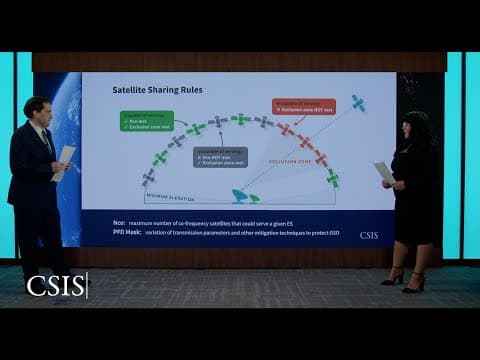
Outdated rules, new space race: modernising LEO spectrum policy (CSIS)
An 11-minute CSIS video (August 2025) in which Matt Pearl (CSIS) and Karina Perez (CCIA) argue that decades-old spectrum rules, notably the power limits shared between LEO and GEO systems, slow US LEO innovation, and explain what modernising them would mean for capacity and competition.

Europe steps up satellite capabilities amid doubts over Starlink (Bloomberg)
Bloomberg's 6-minute report (March 2025, 428,000 views) on Europe looking at Eutelsat OneWeb as a sovereign alternative to Starlink after the US paused support to Ukraine. We add what Europe actually did next: the IRIS² contracts and the 229-satellite OneWeb order of September 2026.
Starlink for Business: how to pick the right plan and dish (Nextiva)
A four-minute explainer from Nextiva (March 2025) on what a business buyer must know before ordering Starlink: how the service plans differ, which hardware fits which site, and when Starlink is the right fit for a company that fibre and cable do not reach. We add the 2026 prices and the questions the video does not ask.

T-Mobile Starlink direct-to-cell tested in the Rocky Mountains (DISHYtech)
An 11-minute independent field test (February 2025, 131,000 views) of T-Mobile's Starlink direct-to-cell service in the Colorado Rockies, filmed during the beta: what a standard phone could and could not do with satellite texting. We add what changed by September 2026 and what it means for enterprise mobility.
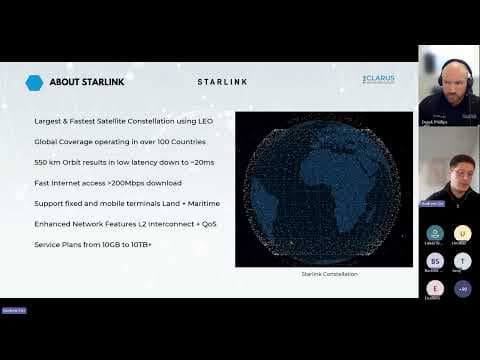
Starlink Mini for remote business operations: Clarus Networks webinar
A 48-minute webinar (February 2025) by Clarus Networks, a UK Starlink authorised reseller, on using the Starlink Mini instead of 4G/5G for remote operations in energy, emergency services, mining and construction: 25 W power draw, around 200 Mbps download, and fleet management through the reseller's portal.

Ground stations explained: how satellite data reaches Earth (Geoawesome)
A 2.5-minute explainer (September 2024) from Geoawesome, the geospatial industry site, on what ground stations do, where they are placed and where ground-station-as-a-service is heading. Written for Earth observation, but the same ground segment is what gives a Starlink or OneWeb link its latency and its resilience.

FCC Space Bureau briefing: how satellite spectrum coordination works
A 50-minute recording of the FCC Space Bureau's 18 April 2024 transparency session on satellite spectrum coordination and Commission procedures, held one year after the Bureau's creation. The authoritative walkthrough of how operators coordinate frequencies and what the FCC expects in a filing.

How Iridium and Globalstar changed the world: the first constellations (Scott Manley)
Scott Manley's 18-minute history (December 2023, 165,000 views) of the first LEO constellations: how Iridium and Globalstar were designed and launched in the 1990s, why both went bankrupt, and how they survived to serve today's maritime, aviation and IoT markets. The best single background piece on why constellations are hard.

Mega-constellations in three minutes: O3b mPOWER, OneWeb and Starlink
A concise academic explainer (November 2023) of non-geostationary constellations, comparing SES's O3b mPOWER in medium Earth orbit with OneWeb and Starlink in low Earth orbit, made alongside a Frontiers paper on connecting space missions through NGSO constellations. Good for the orbit and orbital-plane basics.

Project Kuiper (now Amazon Leo): Amazon's 2021 case for satellite broadband
Amazon's own 8-minute film (December 2021, 171,000 views) on why it is building a LEO constellation: residents and small businesses in Cle Elum, Washington, describe life without broadband, and the Project Kuiper team explains the plan. Five years on, Kuiper is Amazon Leo, with 398 satellites launched and an enterprise beta.

Starlink vs Amazon Kuiper vs OneWeb: the 2020 comparison (Found And Explained)
An 8-minute 2020 explainer comparing the three LEO broadband projects as they were planned: Starlink, Amazon's Kuiper and OneWeb, then in bankruptcy. Useful as a time capsule; we score the predictions against the 2026 reality: 11,000+ Starlink satellites working, 398 Amazon Leo launched, OneWeb at 600+ under Eutelsat.

Iridium Certus: L-band broadband for maritime, aviation and IoT (video)
A 2.5-minute product video (November 2019) from reseller Apollo Satellite presenting Iridium Certus, the multi-service L-band platform on the upgraded Iridium constellation for maritime, IoT, aviation, land mobile and government users. We explain what Certus is for in a Starlink world: the truly global, weather-proof, safety-grade fallback.

The FCC Spectrum Dashboard: who holds which frequencies (FCC video)
The FCC's own 2-minute introduction (2010, public domain) to its Spectrum Dashboard, the public tool that shows how bands between 225 MHz and 3.7 GHz are allocated, what they are used for and who holds licences where. Old, but the tool and the questions it answers are still current for anyone tracking direct-to-cell and mid-band spectrum.