Starlink for Business: how to pick the right plan and dish (Nextiva)
A four-minute explainer from Nextiva (March 2025) on what a business buyer must know before ordering Starlink: how the service plans differ, which hardware fits which site, and when Starlink is the right fit for a company that fibre and cable do not reach. We add the 2026 prices and the questions the video does not ask.
In this video
Published on 4 March 2025 by Nextiva, a US business communications provider, this 3 minute 58 second video is aimed at a business owner rather than an engineer. According to its description it breaks down "what a business buyer needs to know before signing up: how Starlink's service plans differ, which hardware" suits which deployment, and when Starlink is the right answer for a company operating "somewhere fiber and cable will not reach". It had about 20,000 views when we checked. Nextiva sells cloud phone systems, so watch for the framing: the video's interest is in Starlink as the underlay for VoIP and video calls, which is a fair test of any link.
Why it matters for a business buyer
The plan structure the video explains has stayed the same into 2026, but the prices have moved, so here are the figures we read on starlink.com on 21 September 2026 (US):
- Local Priority (fixed site) from $55 a month for 50 GB of priority data, with 500 GB, 1 TB and 2 TB tiers at $155, $280 and $530 (Business.org, June 2026), and add-on blocks of 50 GB or 500 GB. Priority data gets network precedence, a public IPv4 address, an SLA and 24/7 prioritised support.
- Global Priority (mobile, maritime, multi-country) $250 to $2,150 a month per terminal for 50 GB to 2 TB, checked 18 September 2026.
- Hardware: Standard kit $349; the Starlink Performance kit, built for harsh sites and in-motion use with a 3-year warranty, $1,999, currently 400+ Mbps and positioned for gigabit service through a plan upgrade announced for 2026.
- Terms: monthly, 30-day refund, no early-termination fee.
What the video does not cover, and a buyer should ask: whether the site is in a sold-out cell (see the availability map), who installs and mounts the dish (a local installer versus the customer), how the link is monitored (the gRPC tools for one site, the DataMiner connector for a fleet), and whether a managed provider such as CommandLink should own the whole thing.
Watch this if
You are explaining Starlink Business to a non-technical decision maker, or you sell it and want a short, vendor-neutral clip to send before a quote. It will not help with maritime or aviation (see our maritime comparison) or with multi-orbit designs.
Go further
Guide: Starlink in the United States: prices, installation cost and installers. Analysis: Amazon Leo vs Starlink Business, September 2026. Definitions: satellite broadband, throughput, Starlink. Directories: Starlink resellers in the US, enterprise satellite solutions.
Find a provider
The listings this resource is relevant to — every company is profiled with services, coverage and contact details.
Keep reading
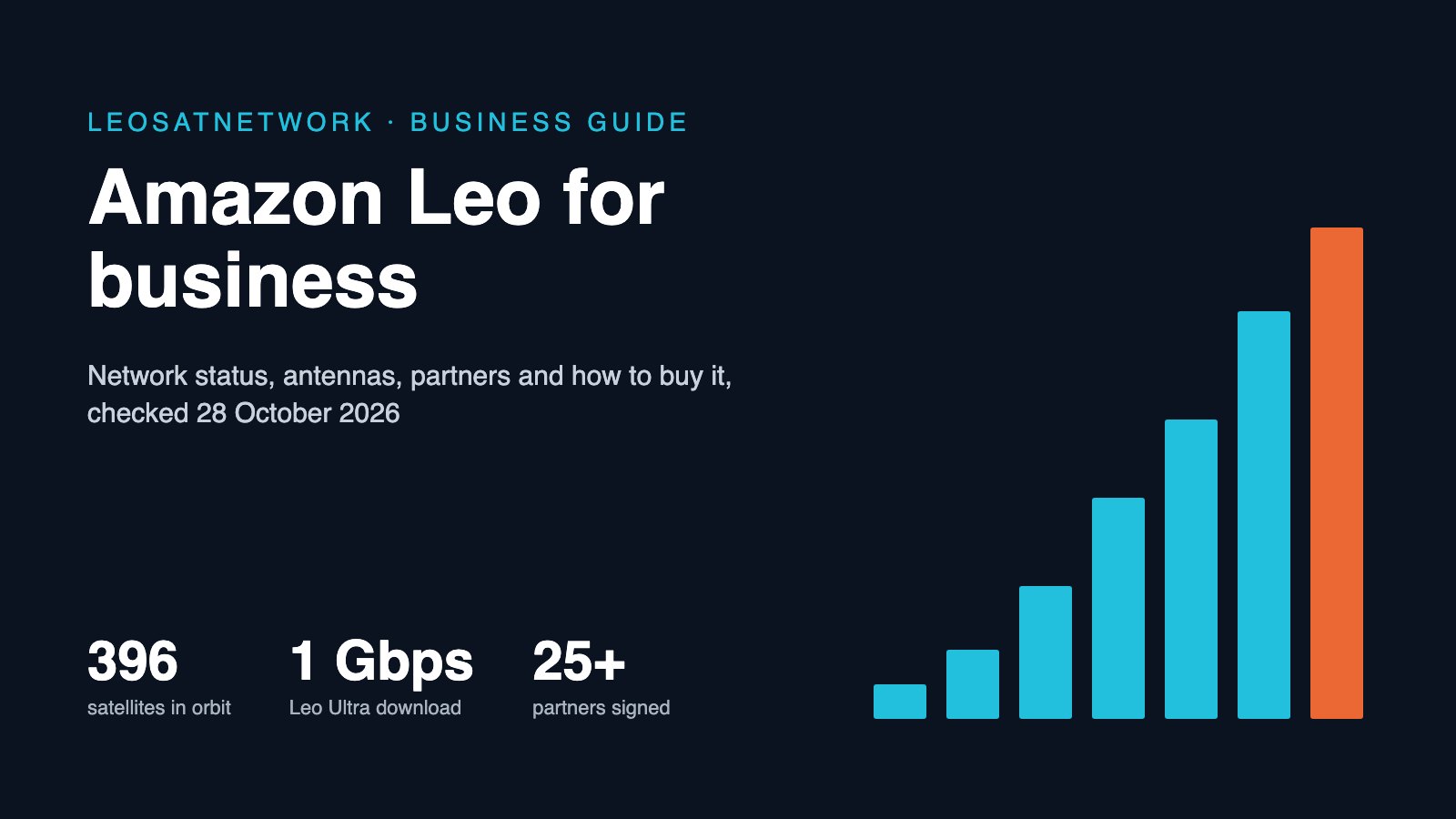
Amazon Leo for business (2026): network status, antennas, partners and how to buy it
Amazon Leo, formerly Project Kuiper, had 396 satellites in orbit on 28 October 2026 and plans initial service in certain latitudes before the end of…
How to become a Starlink authorized reseller in 2026 (and the routes that remain open)
Starlink no longer accepts reseller applications: the programme is invite-only and indirect reselling on Local Priority plans was paused in April…
How to choose a Starlink installer for your business (2026): reseller, installer or managed provider
Starlink's own installers cover residential plans only, so a business site goes through an independent installer or an authorized reseller. This…
Related resources

T-Mobile Starlink direct-to-cell tested in the Rocky Mountains (DISHYtech)
An 11-minute independent field test (February 2025, 131,000 views) of T-Mobile's Starlink direct-to-cell service in the Colorado Rockies, filmed during the beta: what a standard phone could and could not do with satellite texting. We add what changed by September 2026 and what it means for enterprise mobility.
Starlink Network Update: SpaceX's official performance figures
SpaceX's own network report: ~200 Mbps median peak-hour download and 25.7 ms median latency in the US (mid-2025), 450 Tbps of cumulative capacity, 6 million+ customers, 7,800+ satellites, 100+ US gateway sites, and the third-generation satellite targets. The numbers to quote, and how to read them.
Starlink Mini for remote business operations: Clarus Networks webinar
A 48-minute webinar (February 2025) by Clarus Networks, a UK Starlink authorised reseller, on using the Starlink Mini instead of 4G/5G for remote operations in energy, emergency services, mining and construction: 25 W power draw, around 200 Mbps download, and fleet management through the reseller's portal.