Mega-constellations in three minutes: O3b mPOWER, OneWeb and Starlink
A concise academic explainer (November 2023) of non-geostationary constellations, comparing SES's O3b mPOWER in medium Earth orbit with OneWeb and Starlink in low Earth orbit, made alongside a Frontiers paper on connecting space missions through NGSO constellations. Good for the orbit and orbital-plane basics.
In this video
Ali Georganaki published this 2 minute 50 second explainer on 30 November 2023 as a companion to the paper "Connecting Space Missions Through NGSO Constellations" (Frontiers in Communications and Networks, 2024). The description lists its scope: satellite communication, LEO, MEO, mega-constellations, non-terrestrial networks, O3b mPOWER, OneWeb, Starlink, orbital planes, and the use of these networks by other space missions. It is short, sober and free of marketing; the view count is small (a few hundred), which says nothing about its accuracy.
Why it matters for a business buyer
The three systems in the title are the three commercial answers to "non-geostationary" and they sit at different altitudes, which drives everything a buyer feels:
- Starlink, LEO at about 550 km: thousands of satellites, 25 to 60 ms latency on land, consumer-scale pricing, terminals that need no pointing.
- OneWeb, LEO at 1,200 km in 12 polar planes: 600+ satellites, roughly 70 ms, sold as managed capacity through distributors.
- O3b mPOWER (SES), MEO at about 8,000 km: a handful of high-throughput satellites with steerable beams, around 150 ms, committed gigabit-class links for cruise ships, mines, governments and mobile backhaul, tracked by larger antennas.
The video's orbital-plane view explains why coverage at high latitudes differs between systems and why a Walker geometry needs a given number of planes for continuous service. For a fleet or a remote-site operator the practical translation is in our maritime comparison: LEO for cost and latency, MEO or GEO where committed bandwidth and contractual availability matter more.
Watch this if
You need the orbit vocabulary before a supplier meeting, or a neutral three-minute clip to show a customer who has only heard of Starlink. For the deep version, Hypatia lets you simulate exactly these geometries.
Go further
Definitions: SES O3b mPOWER, mega-constellation, non-terrestrial network, orbital inclination. Directories: LEO providers, GEO providers, OneWeb providers.
Find a provider
The listings this resource is relevant to — every company is profiled with services, coverage and contact details.
Keep reading
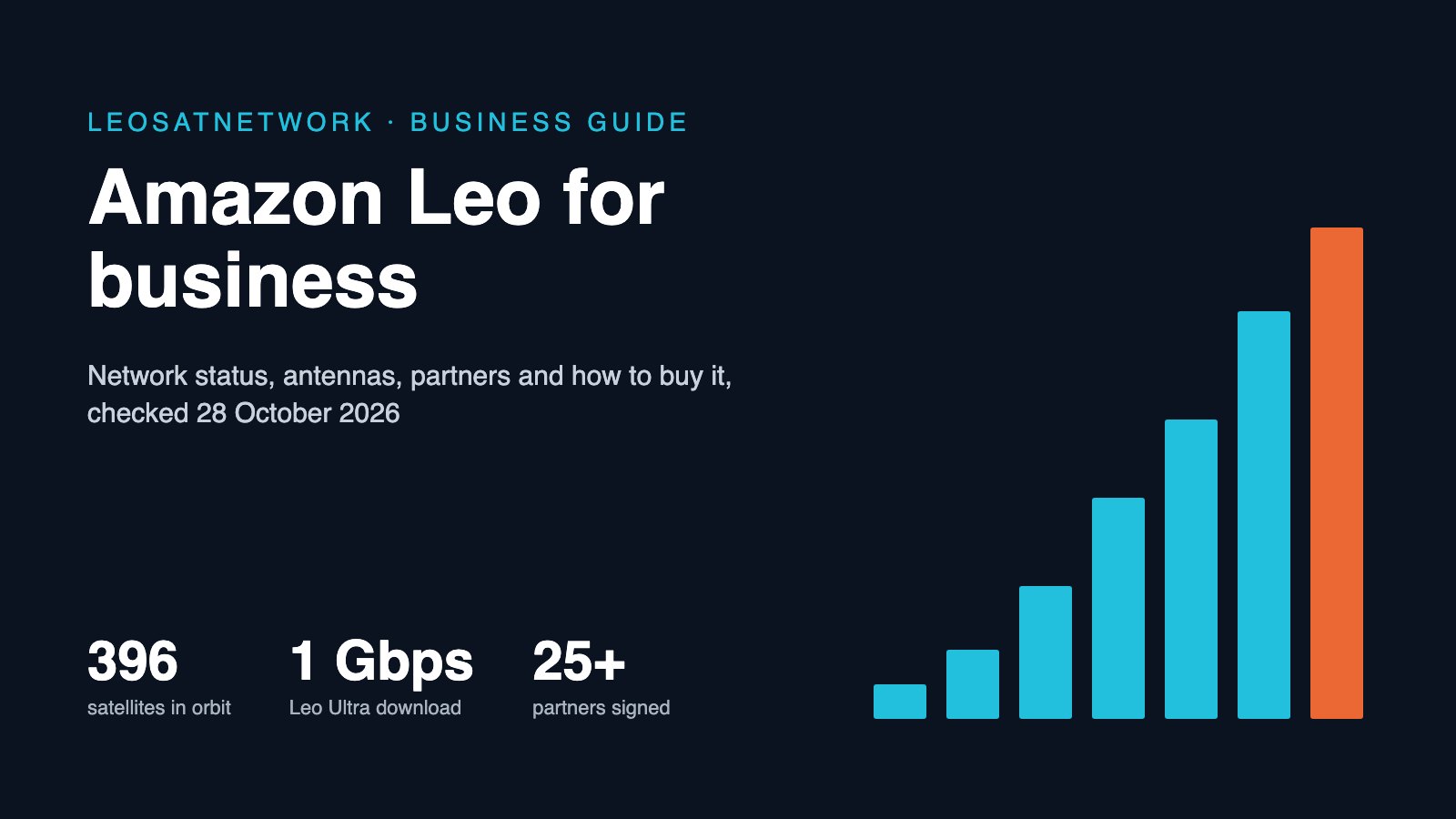
Amazon Leo for business (2026): network status, antennas, partners and how to buy it
Amazon Leo, formerly Project Kuiper, had 396 satellites in orbit on 28 October 2026 and plans initial service in certain latitudes before the end of…
How to become a Starlink authorized reseller in 2026 (and the routes that remain open)
Starlink no longer accepts reseller applications: the programme is invite-only and indirect reselling on Local Priority plans was paused in April…
How to choose a Starlink installer for your business (2026): reseller, installer or managed provider
Starlink's own installers cover residential plans only, so a business site goes through an independent installer or an authorized reseller. This…
Related resources

Starlink vs Amazon Kuiper vs OneWeb: the 2020 comparison (Found And Explained)
An 8-minute 2020 explainer comparing the three LEO broadband projects as they were planned: Starlink, Amazon's Kuiper and OneWeb, then in bankruptcy. Useful as a time capsule; we score the predictions against the 2026 reality: 11,000+ Starlink satellites working, 398 Amazon Leo launched, OneWeb at 600+ under Eutelsat.
LeoLabs Space Platform: live LEO visualization and conjunction search
LeoLabs' browser visualization of low Earth orbit, built on its own radar network: search the catalogue by satellite or constellation, watch today's conjunctions and follow launches. Free to open, commercial data behind it.
Hypatia: LEO satellite network simulation framework (ETH Zurich)
Hypatia is the reference open-source framework for simulating LEO networks: it generates a constellation and its routing over time (satgenpy), runs packet-level ns-3 simulations (ns3-sat-sim) and renders Cesium visualisations. From the IMC 2020 paper; 518 GitHub stars, last update May 2024.