The FCC Spectrum Dashboard: who holds which frequencies (FCC video)
The FCC's own 2-minute introduction (2010, public domain) to its Spectrum Dashboard, the public tool that shows how bands between 225 MHz and 3.7 GHz are allocated, what they are used for and who holds licences where. Old, but the tool and the questions it answers are still current for anyone tracking direct-to-cell and mid-band spectrum.
In this video
The Federal Communications Commission published this 2 minute 24 second walkthrough on 14 March 2010, in the public domain. Per its description, the Spectrum Dashboard "lets you review how spectrum bands are allocated, what they are used for and who holds licenses in what areas", with plain-language information on frequencies from 225 MHz to 3.7 GHz. The interface shown is dated, and the video predates every LEO broadband constellation, but the dashboard itself is still online and the questions it answers have become more relevant, not less.
Why it matters for a business buyer
The satellite bands themselves (Ku and Ka, at 12 to 40 GHz) sit above the dashboard's range. What sits inside it is the mobile spectrum that satellite operators are now buying or borrowing to reach ordinary phones:
- T-Mobile's direct-to-cell service with Starlink uses T-Mobile's PCS band around 1.9 GHz, licensed on the dashboard's map.
- SpaceX's purchase of EchoStar's AWS-4 and H-block holdings (65 MHz in the 2 GHz range, announced in 2025, closing around late 2027) is the basis of the "Starlink Mobile" plan disclosed in August 2026; the dashboard is where those licences and their coverage areas are recorded.
- AST SpaceMobile's agreements with AT&T and Verizon rely on those carriers' low-band licences.
Knowing who holds what, and where, is how an analyst judges whether a direct-to-device promise is backed by spectrum or by press releases. For a business that plans to rely on satellite texting for lone workers, it is the difference between a service and a beta.
How to use the dashboard today
- Open the FCC Spectrum Dashboard from fcc.gov and browse by frequency band to see the allocation and the service rules.
- Switch to the licence view and search by licensee (a carrier, EchoStar, SpaceX) to see holdings by market area.
- For satellite filings above 3.7 GHz use the FCC's IBFS system and the Space Bureau pages instead; the Space Bureau's coordination briefing explains those procedures.
Watch this if
You are new to US spectrum data and want a two-minute orientation before opening the tool; then move on to the TeleGeography interview for the policy layer.
Go further
Definitions: FCC, direct-to-device, S-band, frequency coordination. Directory: satellite providers in the United States.
Find a provider
The listings this resource is relevant to — every company is profiled with services, coverage and contact details.
Keep reading
Starlink in the United States: prices, installation cost and installers (2026)
Starlink covers every US state. Residential costs $55, $85 or $130 a month by speed tier, there is no upfront hardware cost in select areas ($349…
Managed Starlink providers in the US: enterprise resellers compared (2026)
Managed Starlink providers resell Starlink Business and run it for you: one bill, pooled data, failover with your network, installers and 24/7…
Amazon Leo goes B2B first: what AT&T's bundle means for enterprise buyers still choosing Starlink (September 2026)
AT&T Business started selling Amazon Leo on 8 September 2026 as a third network layer next to fibre and 5G, with the 1 Gbps Leo Ultra terminal and no…
Related resources
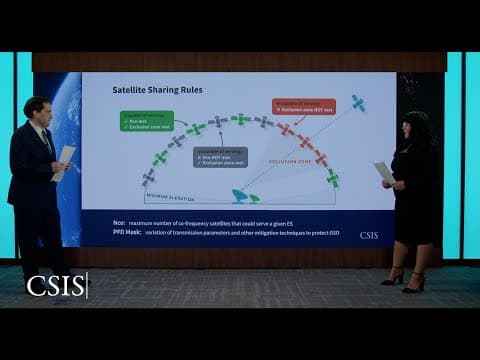
Outdated rules, new space race: modernising LEO spectrum policy (CSIS)
An 11-minute CSIS video (August 2025) in which Matt Pearl (CSIS) and Karina Perez (CCIA) argue that decades-old spectrum rules, notably the power limits shared between LEO and GEO systems, slow US LEO innovation, and explain what modernising them would mean for capacity and competition.

FCC Space Bureau briefing: how satellite spectrum coordination works
A 50-minute recording of the FCC Space Bureau's 18 April 2024 transparency session on satellite spectrum coordination and Commission procedures, held one year after the Bureau's creation. The authoritative walkthrough of how operators coordinate frequencies and what the FCC expects in a filing.

An FCC commissioner on spectrum allocation and broadband (TeleGeography podcast)
Episode 614 of TeleGeography's podcast (68 minutes, June 2025): host Greg Bryan interviews FCC Commissioner Nathan Simington on spectrum allocation and broadband expansion, recorded the week he left the Commission. The clearest hour on how US spectrum decisions get made, which is where every satellite operator's capacity starts.