FCC Space Bureau briefing: how satellite spectrum coordination works
A 50-minute recording of the FCC Space Bureau's 18 April 2024 transparency session on satellite spectrum coordination and Commission procedures, held one year after the Bureau's creation. The authoritative walkthrough of how operators coordinate frequencies and what the FCC expects in a filing.
In this video
The FCC published this 49 minute 50 second recording on 18 April 2024. Per its description, the Space Bureau's Transparency Initiative "aims to provide resources to support industry engagement with the Commission"; this session gave an overview of satellite spectrum coordination and FCC procedures and closed by marking one year since the Space Bureau was created (April 2023, when the former International Bureau was split into a Space Bureau and an Office of International Affairs). It is a government briefing with slides: dense, precise, and the primary source on how the process actually runs.
Why it matters for a business buyer
Every satellite service sold in the United States rests on a licence or a market-access grant from this Bureau, and on coordination between operators that share bands. The briefing explains:
- How frequency coordination among non-geostationary systems works under the FCC's processing-round rules, including the default spectrum-splitting when operators cannot agree, which is why Starlink, Amazon Leo, OneWeb and Telesat negotiate with each other.
- What the Bureau expects in a filing (technical showings, orbital debris mitigation plans, milestones) and how the public can follow applications in the IBFS database.
- How US procedures connect to ITU filings, which set priority dates internationally.
Concrete 2026 cases that these procedures governed: the June 2026 waiver of Amazon Leo's half-constellation milestone, the approvals for Starlink's third-generation satellites, and the coordination conditions attached to direct-to-cell operations. For an integrator, understanding the process is what lets you read a provider's licence conditions (coverage, power, deployment deadlines) rather than its brochure; the LEO and GEO operators in our directory all live under these rules.
Watch this if
You work on the regulatory side of a satellite deployment, you prepare filings or comments, or you want the official version after the policy arguments in the CSIS video. The Spectrum Dashboard covers the terrestrial bands the Bureau does not.
Go further
Definitions: FCC, spectrum coordination, orbital slot, debris mitigation. Directories: satellite providers in the United States, LEO providers.
Find a provider
The listings this resource is relevant to — every company is profiled with services, coverage and contact details.
Keep reading
Starlink in the United States: prices, installation cost and installers (2026)
Starlink covers every US state. Residential costs $55, $85 or $130 a month by speed tier, there is no upfront hardware cost in select areas ($349…
Managed Starlink providers in the US: enterprise resellers compared (2026)
Managed Starlink providers resell Starlink Business and run it for you: one bill, pooled data, failover with your network, installers and 24/7…
Amazon Leo goes B2B first: what AT&T's bundle means for enterprise buyers still choosing Starlink (September 2026)
AT&T Business started selling Amazon Leo on 8 September 2026 as a third network layer next to fibre and 5G, with the 1 Gbps Leo Ultra terminal and no…
Related resources
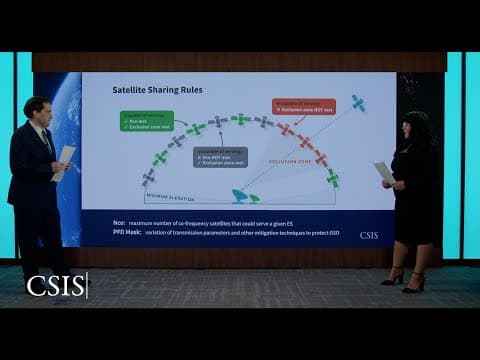
Outdated rules, new space race: modernising LEO spectrum policy (CSIS)
An 11-minute CSIS video (August 2025) in which Matt Pearl (CSIS) and Karina Perez (CCIA) argue that decades-old spectrum rules, notably the power limits shared between LEO and GEO systems, slow US LEO innovation, and explain what modernising them would mean for capacity and competition.
The FCC Spectrum Dashboard: who holds which frequencies (FCC video)
The FCC's own 2-minute introduction (2010, public domain) to its Spectrum Dashboard, the public tool that shows how bands between 225 MHz and 3.7 GHz are allocated, what they are used for and who holds licences where. Old, but the tool and the questions it answers are still current for anyone tracking direct-to-cell and mid-band spectrum.

An FCC commissioner on spectrum allocation and broadband (TeleGeography podcast)
Episode 614 of TeleGeography's podcast (68 minutes, June 2025): host Greg Bryan interviews FCC Commissioner Nathan Simington on spectrum allocation and broadband expansion, recorded the week he left the Commission. The clearest hour on how US spectrum decisions get made, which is where every satellite operator's capacity starts.