Resources
Tools, sites and references for satellite connectivity
A curated collection of tools, websites, reports and videos to help you navigate the LEO satellite ecosystem.
Type
Tags
17 resources found
CelesTrak: orbital element sets for Starlink, OneWeb, Kuiper and every constellation
CelesTrak, run by Dr. T.S. Kelso, publishes the general perturbation element sets (TLE, OMM, JSON, CSV) for every tracked satellite, grouped by constellation: Starlink, OneWeb, Kuiper, Iridium NEXT, Globalstar and more, plus operator-supplied supplemental data. Free, updated continuously.
DataMiner Starlink Enterprise connector: NOC monitoring of Starlink fleets
Skyline's DataMiner connector polls Starlink's Enterprise Telemetry API every 60 seconds and the Management API for usage and activation, giving a NOC per-terminal signal quality, throughput, alerts, service lines and 12 months of data usage. Versions 1.1.0.x support API v2.
Jonathan McDowell's Starlink statistics: launched, in orbit, working, reentered
The independent ledger of the Starlink constellation, updated several times a day by astronomer Jonathan McDowell: 12,962 satellites launched, 11,154 in orbit, 11,139 working and 1,808 reentered or failed as of 21 September 2026, broken down by generation and by launch. The citation-grade source for constellation size.
satellitemap.space: real-time map of Starlink, OneWeb and 30,000 satellites
satellitemap.space, online since 2019, plots more than 30,000 satellites live on a WebGL globe with dedicated views for Starlink and other internet constellations: growth and launch charts, decays, orbits, ground stations, a re-entry monitor, close-approach detector and a LEO box score comparing constellations.
CommandLink Managed Starlink: Starlink inside a managed SD-WAN service
CommandLink sells Starlink as one circuit inside its managed network platform: professional installation, monitoring and alerting through its ITSM tooling, billing administration and 24/7 tier-3 support, next to SD-WAN, SASE and 5,000+ ISPs.
Starlink availability map: check coverage and waitlists by address
Starlink's official map shows, per country and per address, whether Residential, Roam and Business service can be ordered today, is waitlisted, or is sold out. It is the first check before quoting a site, and the source for the "150+ countries, territories and markets" figure.
LeoLabs Space Platform: live LEO visualization and conjunction search
LeoLabs' browser visualization of low Earth orbit, built on its own radar network: search the catalogue by satellite or constellation, watch today's conjunctions and follow launches. Free to open, commercial data behind it.
Starlink Network Update: SpaceX's official performance figures
SpaceX's own network report: ~200 Mbps median peak-hour download and 25.7 ms median latency in the US (mid-2025), 450 Tbps of cumulative capacity, 6 million+ customers, 7,800+ satellites, 100+ US gateway sites, and the third-generation satellite targets. The numbers to quote, and how to read them.

Starlink for Business: how to pick the right plan and dish (Nextiva)
A four-minute explainer from Nextiva (March 2025) on what a business buyer must know before ordering Starlink: how the service plans differ, which hardware fits which site, and when Starlink is the right fit for a company that fibre and cable do not reach. We add the 2026 prices and the questions the video does not ask.

T-Mobile Starlink direct-to-cell tested in the Rocky Mountains (DISHYtech)
An 11-minute independent field test (February 2025, 131,000 views) of T-Mobile's Starlink direct-to-cell service in the Colorado Rockies, filmed during the beta: what a standard phone could and could not do with satellite texting. We add what changed by September 2026 and what it means for enterprise mobility.
starlink-client: Python library for the Starlink dish and account API
starlink-client (MIT, version 0.1.13, February 2025) wraps the Starlink terminal's local gRPC service and the account API in Python: account data, device location or H3 cell, network statistics, telemetry, and a remote reboot. Requires Python 3.9+.
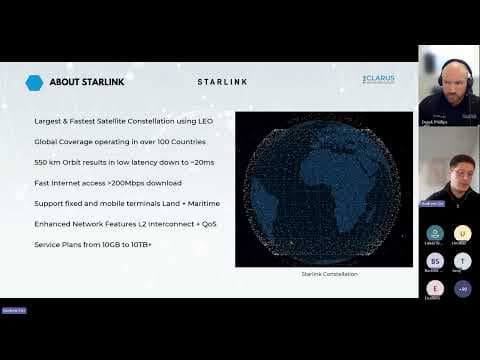
Starlink Mini for remote business operations: Clarus Networks webinar
A 48-minute webinar (February 2025) by Clarus Networks, a UK Starlink authorised reseller, on using the Starlink Mini instead of 4G/5G for remote operations in energy, emergency services, mining and construction: 25 W power draw, around 200 Mbps download, and fleet management through the reseller's portal.

Mega-constellations in three minutes: O3b mPOWER, OneWeb and Starlink
A concise academic explainer (November 2023) of non-geostationary constellations, comparing SES's O3b mPOWER in medium Earth orbit with OneWeb and Starlink in low Earth orbit, made alongside a Frontiers paper on connecting space missions through NGSO constellations. Good for the orbit and orbital-plane basics.
Star Debug: open-source Starlink terminal manager for Android and iOS
Star Debug is a free, open-source Flutter app (Android and iOS) that reads the Starlink app's DebugData, shows terminal telemetry and alerts, and sends reboot, stow and GPS commands to the dish. 80 stars, last pushed August 2026, born from the Ukrainian volunteer initiative Narodnyi Starlink.
starlink-grpc-tools: the reference scripts for the Starlink dish's gRPC interface
The most used open-source toolkit for reading a Starlink terminal: Python scripts and a Docker image that pull status, obstruction, alert and history data from the dish's gRPC service and write it to text, InfluxDB, SQLite, MQTT or a Prometheus endpoint. Public domain, 706 stars, updated September 2026.

Starlink vs Amazon Kuiper vs OneWeb: the 2020 comparison (Found And Explained)
An 8-minute 2020 explainer comparing the three LEO broadband projects as they were planned: Starlink, Amazon's Kuiper and OneWeb, then in bankruptcy. Useful as a time capsule; we score the predictions against the 2026 reality: 11,000+ Starlink satellites working, 398 Amazon Leo launched, OneWeb at 600+ under Eutelsat.
Hypatia: LEO satellite network simulation framework (ETH Zurich)
Hypatia is the reference open-source framework for simulating LEO networks: it generates a constellation and its routing over time (satgenpy), runs packet-level ns-3 simulations (ns3-sat-sim) and renders Cesium visualisations. From the IMC 2020 paper; 518 GitHub stars, last update May 2024.