Resources
Tools, sites and references for satellite connectivity
A curated collection of tools, websites, reports and videos to help you navigate the LEO satellite ecosystem.
Type
Tags
9 resources found
LeoLabs Space Platform: live LEO visualization and conjunction search
LeoLabs' browser visualization of low Earth orbit, built on its own radar network: search the catalogue by satellite or constellation, watch today's conjunctions and follow launches. Free to open, commercial data behind it.

Eutelsat's OneWeb LEO constellation, explained by Eutelsat (video)
Eutelsat's own 2.5-minute explainer (July 2026) of the OneWeb constellation: 600+ satellites in 12 polar planes at 1,200 km, Ka-band gateways and Ku-band user links, sold to enterprises, governments, ships and aircraft through distributors rather than direct. Context: the September 2026 order of 229 more satellites and the IRIS² transition.
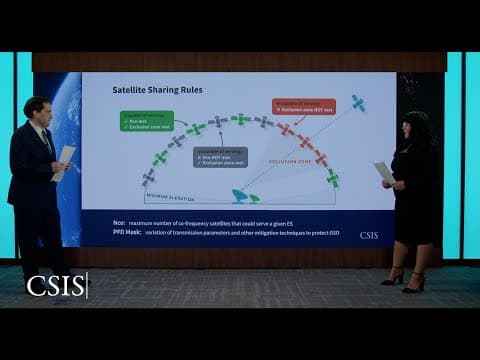
Outdated rules, new space race: modernising LEO spectrum policy (CSIS)
An 11-minute CSIS video (August 2025) in which Matt Pearl (CSIS) and Karina Perez (CCIA) argue that decades-old spectrum rules, notably the power limits shared between LEO and GEO systems, slow US LEO innovation, and explain what modernising them would mean for capacity and competition.
OpenSN: open-source emulator for large LEO satellite networks
OpenSN, from Beihang University, emulates LEO satellite networks with one container per node so that real routing software runs on every satellite and gateway. It scales across machines and builds mega-constellations 5 to 10 times faster than StarryNet. Published in IEEE TPDS, August 2025.

How Iridium and Globalstar changed the world: the first constellations (Scott Manley)
Scott Manley's 18-minute history (December 2023, 165,000 views) of the first LEO constellations: how Iridium and Globalstar were designed and launched in the 1990s, why both went bankrupt, and how they survived to serve today's maritime, aviation and IoT markets. The best single background piece on why constellations are hard.

Mega-constellations in three minutes: O3b mPOWER, OneWeb and Starlink
A concise academic explainer (November 2023) of non-geostationary constellations, comparing SES's O3b mPOWER in medium Earth orbit with OneWeb and Starlink in low Earth orbit, made alongside a Frontiers paper on connecting space missions through NGSO constellations. Good for the orbit and orbital-plane basics.

Project Kuiper (now Amazon Leo): Amazon's 2021 case for satellite broadband
Amazon's own 8-minute film (December 2021, 171,000 views) on why it is building a LEO constellation: residents and small businesses in Cle Elum, Washington, describe life without broadband, and the Project Kuiper team explains the plan. Five years on, Kuiper is Amazon Leo, with 398 satellites launched and an enterprise beta.

Starlink vs Amazon Kuiper vs OneWeb: the 2020 comparison (Found And Explained)
An 8-minute 2020 explainer comparing the three LEO broadband projects as they were planned: Starlink, Amazon's Kuiper and OneWeb, then in bankruptcy. Useful as a time capsule; we score the predictions against the 2026 reality: 11,000+ Starlink satellites working, 398 Amazon Leo launched, OneWeb at 600+ under Eutelsat.
Hypatia: LEO satellite network simulation framework (ETH Zurich)
Hypatia is the reference open-source framework for simulating LEO networks: it generates a constellation and its routing over time (satgenpy), runs packet-level ns-3 simulations (ns3-sat-sim) and renders Cesium visualisations. From the IMC 2020 paper; 518 GitHub stars, last update May 2024.