A managed Starlink provider buys Starlink Business service and hardware as an authorized reseller, then installs, monitors and bills it for you, usually alongside your other lines. In the United States the companies that do this at scale are network carriers and managed service providers (MetTel, Granite, Comcast Business, AireSpring, SageNet), specialists for distributed sites such as 2pifi, and field-operations firms for jobsites and public safety (Stallion, ConstructEdge, IP Access International, PEAKE). This guide compares what each one adds over buying Starlink directly, from what they publish on their own sites (checked October 21, 2026) and from Starlink's own reseller directory (read October 28, 2026). The table is alphabetical, not a ranking.
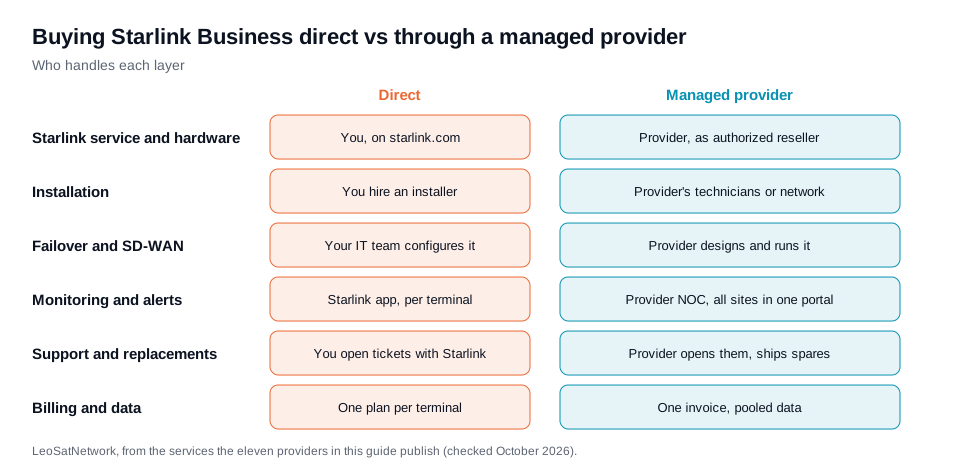
Buying Starlink Business directly vs through a managed provider
You can order Starlink Business yourself on starlink.com. In October 2026 the US Business page advertises service from $55 a month; Local Priority plans come in data blocks ($55 for 50 GB, $155 for 500 GB, $280 for 1 TB, as listed in our US price guide), with priority data, a public IPv4 address, 24/7 prioritized support and a service level agreement. That works well for one office, a farm or a handful of sites.
The model breaks down when one person ends up managing dozens of terminals, card payments and support tickets. Managed providers fix four things:
- One bill and one contract for every terminal, often with the hardware financed or included in the monthly fee.
- Pooled data: one data allowance shared across many terminals, instead of sizing a plan for each site.
- Failover and integration: Starlink as a second path behind fiber or cable, steered by an SD-WAN or a dedicated router, so a store or branch keeps taking payments when the primary line fails.
- Field work at scale: site surveys, certified installers, spare kits and someone who opens the ticket with Starlink for you.
None of the providers below publish a price for the managed layer; expect a per-site monthly fee quoted after a survey of your locations.
Managed Starlink providers in the US compared
| Provider | Best fit | What it adds to Starlink |
|---|---|---|
| 2pifi (Cedar Rapids, IA) | Multi-site fixed locations: retail, convenience stores, restaurants, healthcare | Turnkey survey, install, test and turn-up; 24/7 US support; consolidated billing; public static IPs; transfer of an existing Starlink service |
| AireSpring (Clearwater, FL) | Multi-location enterprises already on SD-WAN or SASE | Starlink nodes in its AIreCONTROL portal via the Starlink API; 24/7 NOC with alerts within 10 minutes; equipment in stock, next-day replacements; installation dispatch at extra cost |
| Armada | Remote industrial sites that also need edge compute | Atlas dashboard for all terminals; pooled data; custom SLAs; purchase through a Microsoft Azure consumption commitment |
| Comcast Business (Philadelphia, PA) | Enterprises buying a managed network from one carrier | Starlink inside its Managed Connectivity portfolio as an extra path for sites that wired networks miss |
| ConstructEdge (Cedar Rapids, IA) | Construction sites and site trailers | Starlink with Peplink routers for cellular failover and bonding; several antennas run as one managed network; equipment tracked and reused between projects |
| Granite (Quincy, MA) | Multi-location businesses and government agencies (US and Canada) | Each kit paired with its edgebootPro power unit for monitoring, diagnostics and automated failover |
| IP Access International (San Juan Capistrano, CA) | Public safety and government fleets | Vehicle, facility and portable installs; pooled data across qualifying terminals; fleet-wide management; 24/7 US-based NOC |
| MetTel (New York, NY) | Enterprise and government networks | Authorized reseller for Enterprise and Government; managed SD-WAN; multi-tenant dashboard for bulk terminals; one bill with financing; Emergency Starlink Kit |
| PEAKE (Glen Burnie, MD) | Public safety, government and defense | CONNECT kits with Starlink in a case, BLEND kits combining satellite, cellular and broadband; also resells OneWeb and Amazon Leo |
| SageNet (Tulsa, OK) | Distributed retail, convenience stores and restaurants | Enterprise Starlink next to VSAT and hybrid networks; SD-WAN integration; 24/7 monitoring in SageVision; rollouts from one site to thousands on one invoice |
| Stallion Infrastructure Services (Houston, TX) | Temporary jobsites, field fleets and branch failover | Mini, Standard and Performance kits in stock; pooled priority data; OSHA-compliant installers; 25+ locations |
Nine of the eleven appear in Starlink's authorized reseller directory (starlink.com/resellers, read October 28, 2026): 2pifi, AireSpring, Armada, Comcast Business, Granite, IP Access International, MetTel, SageNet and Stallion. ConstructEdge, a CCR Technologies business, and PEAKE describe themselves as authorized Starlink resellers on their own sites but were not listed in the directory that day; ask them which authorized reseller or agreement they work under. Each name links to its profile on LeoSatNetwork, with the services, coverage and contact details we hold.
What each provider declares to Starlink
Starlink's reseller directory asks each authorized reseller to tick the value-added services it offers. For the nine US providers above that are listed, the answers differ on the four services that matter most to multi-site buyers. These are declarations, not audited capabilities, but they are a good first filter.
| Provider | SD-WAN integration | Pooled data plans | Hardware sparing | Committed information rate SLA |
|---|---|---|---|---|
| 2pifi | Yes | Yes | Yes | Yes |
| AireSpring | Yes | Not declared | Yes | Yes |
| Armada | Yes | Yes | Not declared | Not declared |
| Comcast Business | Yes | Not declared | Yes | Yes |
| Granite | Yes | Not declared | Yes | Not declared |
| IP Access International | Yes | Yes | Yes | Yes |
| MetTel | Yes | Yes | Yes | Not declared |
| SageNet | Yes | Yes | Yes | Not declared |
| Stallion Infrastructure Services | Yes | Yes | Yes | Not declared |
All nine declare installation services, 24/7 technical support and SD-WAN integration. A committed information rate (a guaranteed minimum bandwidth on top of Starlink's own service level agreement) is the rarest: four of the nine declare it, in line with the market, where 44% of Starlink's 227 authorized resellers do. If your stores or sites need a guaranteed rate, start with those four and ask how the commitment is measured and what the remedy is.
The directory also lists the industries each reseller serves. MetTel lists 18, Granite and Comcast Business 16 each, SageNet and AireSpring 14 each. 2pifi lists only two industries but the widest set of services among the nine after IP Access International (18 services).
What a managed rollout costs: a worked example
Managed providers do not publish per-site fees, so the useful comparison is against doing it yourself. Take a 50-store retail chain that wants Starlink as a backup behind its main circuit, at October 2026 US list prices.
- Hardware: per kit on Starlink's Business page, so ,450 for 50 stores (more if exposed sites need the Performance kit).
- Service: Local Priority at a month for 50 GB per store, ,750 a month or ,000 a year. With pooled data, a chain can usually size the shared pool well below 50 times the busiest store.
- Installation: business installs published by US installers start at about per site, so roughly ,000 for 50 stores before travel, masts or trenching.
- Integration and running: configuring failover on each store's router or SD-WAN, testing it, monitoring 50 terminals, replacing failed kits and handling tickets. Done in-house, this is staff time; done by a managed provider, it is the monthly fee.
On that basis a do-it-yourself rollout costs about ,000 in the first year before staff time, and ,000 a year after. A managed provider's quote will typically spread hardware and installation over a 36-month term and add a per-store management fee. Compare the two on the three-year total and on what the managed fee includes: failover tests, response times, spare kits and who holds the Starlink accounts at the end of the term. Our guide on how to choose a business Starlink installer lists the questions that make quotes comparable.
Contract points to check
- Account ownership. When you buy through an authorized reseller, Starlink says the account, billing and support are handled "exclusively through the reseller". Ask whether the service lines and terminals can be transferred to you or to another provider at the end of the contract.
- Term and exit. Starlink sells Business service month to month; a managed contract usually has a minimum term. Check the early-termination terms for sites that close.
- Service levels. Separate Starlink's own SLA on Priority plans from what the provider commits to: time to answer, time to replace a kit, and any committed rate.
- Data overage. What happens when a site or the pool exceeds its priority data: throttling, automatic top-up blocks, or an alert first.
- Change of network. Several of these providers also sell other networks (PEAKE resells Amazon Leo; IP Access International lists OneWeb). If you may add a second LEO network later, ask whether it fits the same contract and portal.
Sizing data for a backup line
A backup line only carries traffic during outages, so the data plan can be small, but it should be sized on purpose. A simple rule: multiply the average traffic of a site during business hours by the longest outage you plan for. A store averaging 5 Mbps of traffic uses about 2.25 GB an hour, so a 4-hour outage consumes about 9 GB; the 50 GB Local Priority block covers several outages a month. A branch office with video calls at 20 Mbps uses about 9 GB an hour and needs a larger block or pooled data. Two traps: software updates and cloud backups that start as soon as the link is up (exclude them from the backup path in your SD-WAN or router policy), and guest Wi-Fi that should not fail over at all.
How a chain rollout usually runs
- Pilot (3 to 5 sites, 4 to 6 weeks). Pick sites that represent the estate: a flat-roof store, a site in a dense urban area with tall neighbours, a rural site. Test failover, measure real data use and check how alerts reach your team.
- Standard design. Freeze the kit, the mount types, the router configuration and the failover policy, so every installer does the same job.
- Waves. Roll out by region in waves of 20 to 50 sites, with a remote survey for each site before the truck rolls and an on-site survey only where the remote check fails.
- Acceptance. For each site, a failover test with the main line disconnected, photos of the mount and cable entry, and the terminal registered in the monitoring portal.
- Run. Monthly reporting on failover events, data use against the pool and replaced kits.
Managed providers that have done chain rollouts will propose a version of this plan; ask to see the acceptance checklist they use.
Retail chains, convenience stores and restaurants
For a chain the question is uptime: point-of-sale, payment, loyalty apps, digital menu boards and, on a forecourt, the pumps all stop when the line does. Starlink is used in three ways. As backup behind the main circuit, steered by SD-WAN so payments switch over automatically. As a bridge to open a new store on time when the carrier circuit is late, which SageNet describes in its guide to Starlink for c-stores. And as the primary line where no wired option is worth paying for.
SageNet and 2pifi both list convenience stores, restaurants and retail among the industries they serve with Starlink. AireSpring, MetTel and Granite fit chains that want the satellite path managed by the same provider as the rest of their network. Ask each one how failover is tested, who owns the router at the store, and whether data is pooled across locations.
Federal, state and local government, public safety
Agencies use Starlink in patrol cars and fire apparatus, mobile command posts, emergency operations centers and remote facilities, and as continuity of operations when terrestrial networks are damaged. MetTel is an authorized Starlink reseller for both Enterprise and Government and holds task orders on the GSA EIS telecom contract. IP Access International focuses on public safety and government fleets, with vehicle installations, pooled data across qualifying terminals and a US-based NOC. PEAKE builds rapidly deployable CONNECT kits and resells OneWeb and Amazon Leo as well as Starlink, which matters if an agency wants a second LEO network. Granite lists government agencies among its multi-location customers.
For secure environments, ask how traffic leaves the Starlink network (public internet, VPN or private network), who holds the terminal accounts, and how the provider handles hardware replacement in the field.
Construction sites, temporary and remote locations
Jobsites need connectivity from day one, long before a fiber trench, and only for the length of the project. Stallion Infrastructure Services stocks Mini, Standard and Performance kits, pools priority data across a fleet of sites and installs with OSHA-compliant technicians. ConstructEdge installs Starlink with Peplink routers that fail over to cellular, bonds the connections, runs several antennas as one network and tracks the equipment between projects. Armada adds a management platform and edge computing for remote industrial operations. For buildings and trailers that are not a construction site, see our list of Starlink installers in the United States.
SD-WAN and existing networks
If you already run SD-WAN or SASE, the simplest route is usually your current provider. MetTel combines Starlink with its managed SD-WAN, SageNet integrates it into its SD-WAN and monitoring, AireSpring brings Starlink nodes into the same portal as its SD-WAN, SD-Branch and SASE services, and Comcast Business sells it inside its Managed Connectivity portfolio. Check that the provider monitors the Starlink link itself, not just the router, and that alerts reach your team.
How to choose a managed Starlink provider
- Count your sites and how often they change. Fixed branches favor a network provider; temporary jobsites favor a field-operations firm with stock and installers.
- Decide primary or backup. Backup needs failover testing and an SD-WAN or router policy; primary needs the right data plan and an obstruction survey at each site.
- Ask about pooled data and what happens when a site exceeds its share.
- Ask who installs: in-house technicians, a subcontracted network, or Starlink's own installer, and whether roof work is insured.
- Get the support path in writing: hours, where the NOC is, who opens tickets with Starlink, and how fast a failed kit is replaced.
- Compare the total per site: Starlink service, hardware (bought, financed or included), installation and the managed fee.
- Check the directory. A provider that sells you Starlink service should appear on starlink.com/resellers, or name the authorized reseller it works through.
Find more providers
We list Starlink resellers in the United States, the wider list of Starlink installers and providers in the US and every satellite connectivity provider in the US, including VSAT and other LEO networks. Amazon Leo is entering the same market through AT&T; our article on Amazon Leo with AT&T vs Starlink Business explains what that means for enterprise buyers.
Sources
- Starlink Authorized Resellers directory, starlink.com, data read on 28 October 2026.
- Who is a Starlink authorized reseller?, Starlink Help Center, read 28 October 2026.
- Starlink for Business, starlink.com (US), read 28 October 2026.
- Starlink for jobsites, ConstructEdge, read 28 October 2026.
- Enterprise LEO satellite internet, PEAKE, read 28 October 2026.
- Commercial Starlink installation, Dish Ninjas, read 28 October 2026.
- Pricing, Starlink Local Installers, read 28 October 2026.
- Provider pages linked from each company profile, checked 21 October 2026.